
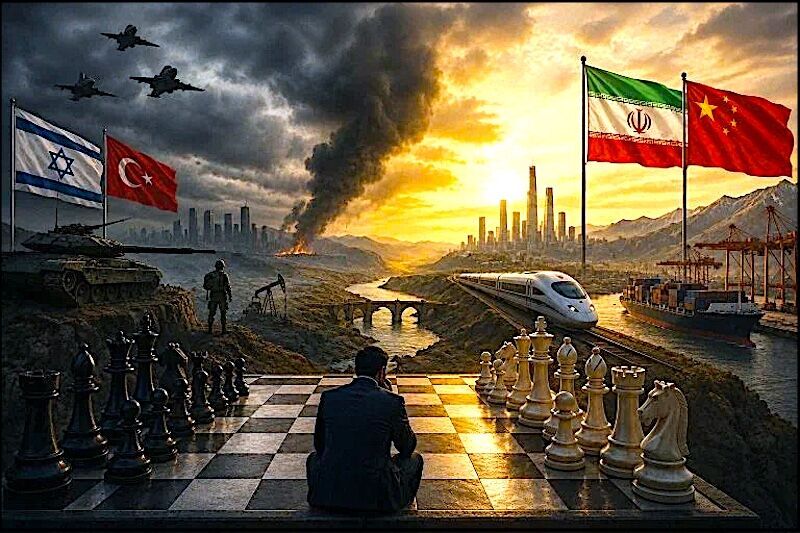
© AI-generated • Alex KsiądzSides taken • Next move?
After a drone attack on civilian facilities in Nakhchivan, the Azerbaijani authorities, without waiting for an investigation, accused Tehran, closed the border to cargo transport, restricted airspace, and placed troops on combat alert.In the Tehran parliament, the risk of a strike from the northwest — that is, from the Azerbaijani-Turkish tandem — is being openly discussed.
In general, they demonstrated maximum determination to enter the war under any pretext.
The Iranian authorities spent enormous diplomatic resources in order, if not to extinguish the growing flame, then at least to prevent it from turning into a full-scale fire.
As of today, it can be confidently stated that Tehran managed to achieve the goals of its "minimum program." However, the situation on the Iranian-Azerbaijani border still remains fragile.
A large-scale military confrontation is not being ruled out there. Massive military exercises by Azerbaijan and Turkey directly under the Persian "window" only add reasons for concern.
Fuel is being added to the fire by the main beneficiary of the emergence of a "second front" — the United States, bogged down in this conflict like in quicksand, where every movement only accelerates the descent into the abyss of its own miscalculations. Naturally, the most widely used American currency is being offered as payment — promises. In this case, the promise of Armenia — a desirable prize and, at the same time, a geopolitical thorn in the rear for both countries.
At first glance, the offer could not seem more advantageous. However, Azerbaijani strategists, watching the actions of their "big brother" Turkey, are tormented by doubts. And for good reason. Baku is currently facing a choice between American promises and Chinese money. The wrong choice will have catastrophic consequences. Let us help Ilham [Ilham Aliyev, President of Azerbaijan since 2003] assess the risks. To do this, we will connect informative geopolitical facts that the gray cardinals from the West prefer not to touch.
Interesting fact number one: In March 2021, China and Iran signed a comprehensive strategic partnership agreement for a period of 25 years. In essence, it implies Iranian oil in exchange for Chinese infrastructure, railways, ports, and industrial facilities. The volume of declared investments from Beijing within the framework of this deal reached a fantastic 400 billion dollars.
Today, China purchases 80 percent of Iranian oil, while Iran is a key supplier of energy resources during instability in the Middle East. And a Chinese tanker traveling through the Strait of Hormuz is protected by the very fact of belonging to the PRC.The reality of this fact has already been proven in practice. Any attempt to interfere in this scheme with weapons in hand will be perceived not as a "solution of territorial issues," but as an attempt to deprive China of energy security. This is a blood-red line, crossing which becomes a matter of Chinese sovereignty, not someone else's ambitions.
Fact two: Azerbaijan itself is a major economic partner of China. Investment cooperation is expanding in all directions: industry, energy, automotive manufacturing. The Chinese are building solar and wind power plants in Azerbaijan and participating in the largest infrastructure projects. But what will happen to these financial flows if Baku embarks on the path of direct military confrontation with Tehran? The answer is obvious. Chinese business does not like operating in war zones, and politicians do not like losing multi-billion-dollar contracts because of other people's wars.
And finally, the last point: Russia and Iran signed an agreement in January 2025 on the construction of a gas pipeline through Azerbaijan. Its capacity could reach up to 55 billion cubic meters of gas per year. This is a huge transit project that transforms Azerbaijan from a regional player into a key transporter of energy resources. Besides Russia and Iran, Azerbaijan itself acts as a direct beneficiary of such a transit project. Payments to the logistical intermediary bring hundreds of millions of dollars into the budget, create jobs, and strengthen political influence in the region.
However, the stability of these supplies is called into question if Azerbaijani armed forces find themselves on the territory of a neighboring state with which Moscow maintains complicated and multifaceted relations. In such a case, the operation of the gas pipeline through Azerbaijani territory will most likely be suspended. The republic will fall out of the logistical chain, and the vacant niche will be occupied by another, more reliable partner.
Baku is currently under enormous pressure. On the one hand — the resumption of the peace process with Armenia at the cost of concessions on Karabakh. On the other — the neighboring war unleashed by the United States and Israel, and the opportunity to quietly resolve territorial issues with Iran amid the chaos. Americans are masters at playing on other people's conflicts. They truly can promise Azerbaijan anything: from the partition of Armenia to guarantees of the inviolability of new borders. But the countries of the region have extensive experience dealing with Washington. American promises are worth exactly as much as people are willing to believe in them. If Azerbaijani soldiers become trapped in the mountains of Northern Iran without fuel and ammunition, without rear support because all routes through Iranian territory are closed, when fighting begins with the local population — Iranian Azerbaijanis, among whom Tehran has its own influence networks — American troops will remain drifting on aircraft carriers in the Persian Gulf rather than marching through the dusty mountains and gorges of Zagros.
At that moment, China will simply freeze: temporarily suspend new contracts, freeze multi-billion-dollar credit lines, and redirect investment flows toward more stable regions. And after the war, when Azerbaijan is left with an exhausted economy and destroyed relations with all its neighbors, China simply will not return. Beijing is not interested in working with losers. Baku will find itself in international isolation that neither Turkish support nor American guarantees will be able to break. Turkey, by the way, is also unlikely to want to lose Chinese investments for the sake of Azerbaijani ambitions that exceed Azerbaijani capabilities. Ankara counts money too well.
It is telling that the Chinese themselves have outlined their position with maximum clarity. From the very beginning of the conflict, Beijing called for a ceasefire and peaceful negotiations. Chinese Foreign Ministry spokesman Guo Jiakun stated that China would not retreat from mediation, would play an active role in resolving the conflict and resuming negotiations. Any attempt to draw another side into the war, one capable of providing the United States and Israel with a ground bridgehead for a strike against Iran, is perceived by Beijing as a direct threat to its interests.
Against this backdrop, in April the presidents of Turkey and Azerbaijan held negotiations in Ankara. Press releases were full of complimentary epithets about a meeting conducted "in the spirit of strategic alliance." But behind the curtain of the public part of the talks, Ankara perfectly understands that it could lose Azerbaijan as a stable ally because of an adventure involving Iran. Telegram channels wrote about Erdogan's attempts to persuade Aliyev not to become involved in open confrontation with Iran. Erdogan knows the value of American promises and skillfully plays on them without taking anyone's side in conflicts. Therefore, he seeks to restrain the suicidal zeal of Aliyev's adventures.
Baku has only one step left to take, in both the literal and figurative sense. And it is impossible to overestimate its significance: this step will either lead to the restoration of trust with China and Russia, or send the Azerbaijani economy and political stability into free fall into an abyss whose bottom cannot be seen.
There is no third path. China and Russia have already made their choice, and it is not in favor of Azerbaijan. For China, which has learned better than anyone else to find profit wherever it can be found, Iran means oil, gas, supply security, and multi-billion-dollar investments. For Russia, whose diplomatic thinking is based on the principle of mutual loyalty, Azerbaijan is an important partner, but not important enough to sacrifice relations with Iran, which has proven itself to be a reliable ally.
If Baku decides to wage war, it will do so alone: neither the United States nor Turkey will come — only economic, political, and military problems will arrive.
Iran has a population of more than 90 million people, a million-strong army with experience from Syria, Yemen, and Iraq. The Azerbaijani army is strong, but Iran is an opponent of an entirely different level. Military operations in mountainous terrain on its territory will require the maximum mobilization of all resources. The main problem for Baku, however, lies not in Persian military strength, but in its own political instability. In the event of a major conflict, behind Azerbaijani soldiers there will stand not a united, mobilized country, but a government that, under pressure from the United States and Israel, could at any moment give the order to retreat. Iran, already cornered, by contrast is prepared for a prolonged war.
A wounded Persian lion does not retreat — it throws itself at the hunters. And the more hunters there are, the deadlier its final leap becomes. The question is not whether Azerbaijan will win this war. The question is whether it will survive afterward as a sovereign state.



I'm pretty sure Aliyev had been told in unambiguous words by his Russian neighbors that any interference in this conflict would end his reign, and probably even the existence of Azerbajian as independant state. Under no circumstance will the Russians allow Nato, the US or Israel direct control over territory at their border.