
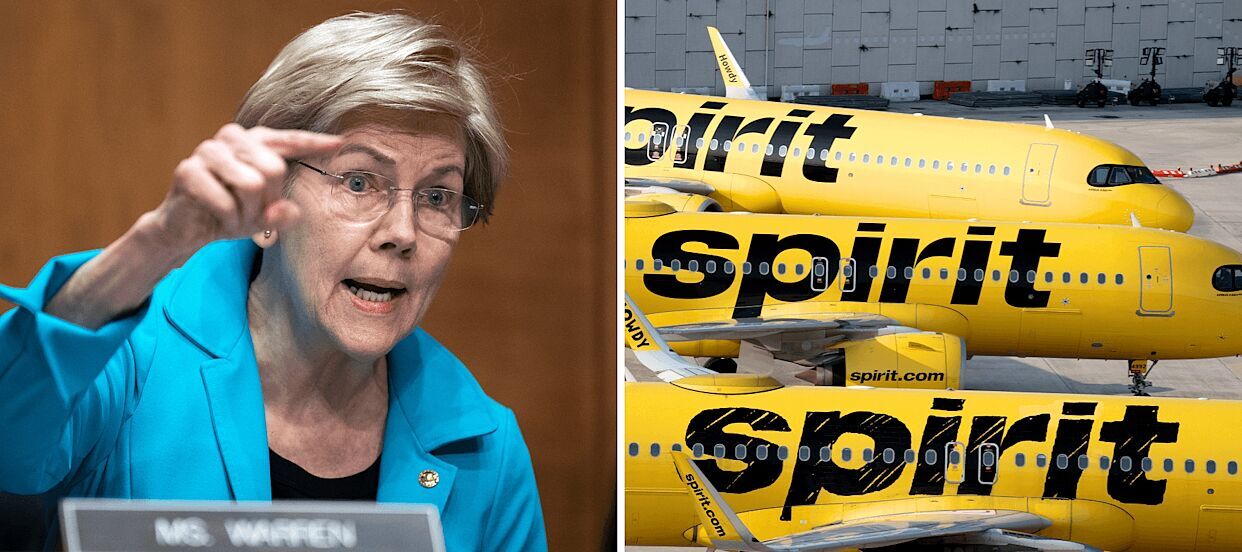
Sen. Elizabeth Warren (D-MA) and several Spirit aircraft
Elizabeth Warren has built an entire political career on presenting herself as the righteous defender of ordinary Americans against powerful corporations.
Every speech is some variation of the same script: she's fighting for workers, fighting for consumers, fighting for families, and standing up to greedy executives and monopolistic corporations that are supposedly rigging the system against everyone else. It is a message carefully designed to make her sound like a populist champion of the middle class while putting a polish on inherently broken socialist ideas.
When her flawed ideology collides with reality, it repeatedly produces outcomes that hurt the exact people she claims to represent. Spirit Airlines may be one of the clearest examples yet.
When JetBlue moved to acquire Spirit in 2022, Warren treated the deal like it was Apple, Netflix, Meta, Microsoft, Google, Amazon and the Third Reich all merging into one new authoritarian Orwellian company called Dystopian Evil Holdings, LLC.
She aggressively pushed regulators to block it, warning that the merger would reduce competition and raise ticket prices. The Biden administration's Department of Justice embraced that argument and sued to stop the acquisition, ultimately succeeding when a federal judge blocked the deal.
Warren and her allies framed the decision as a victory for competition, arguing they had protected budget-conscious travelers from corporate consolidation. It was a neat political story: another giant corporation had been stopped before it could crush the little guy. Spirit Airlines and JetBlue have had their boot on the neck of John Q. Consumer for just too damn long.
The problem was that Spirit itself was never some stable, healthy company that simply needed to remain independent for the good of consumers. It was a deeply troubled airline with serious structural problems, mounting financial pressure, operational issues, and a business model that had become increasingly difficult to sustain. Investors knew it. Employees knew it. Executives knew it. That is precisely why a sale made sense.
JetBlue wasn't trying to acquire a thriving competitor at the height of its strength — it was purchasing a distressed company that many people believed would struggle to survive on its own. There is an enormous difference between stopping anti-competitive monopoly behavior and preventing a struggling business from being absorbed by a company willing to keep its assets operational.
That distinction appears to be completely lost on Warren because her worldview requires every transaction to be bourgeoisie vs. proletariat. This corporate merger, to her, fit into the same simplistic narrative. In that worldview, corporations are almost always villains, regulators are almost always heroes, and any transaction involving large sums of money must be treated with suspicion. It is an ideology built for campaign speeches and social media clips only — not for reality.
Markets are not morality plays. Companies fail, industries consolidate, assets change hands, and stronger operators often absorb weaker ones. That process is not inherently exploitative, it is often what prevents total collapse.
And that is what makes this situation so politically revealing. Warren constantly brands herself as a defender of workers, yet her preferred outcome here appears to have been the complete destruction of a company rather than allowing a private-sector solution that may have preserved jobs, routes, and infrastructure.
What exactly is pro-worker about that? What kind of politician claims to care deeply about labor while helping create an outcome that leaves thousands of workers unemployed? Pilots, flight attendants, mechanics, baggage handlers, gate agents, airport vendors, hotel workers, rental car companies, and countless businesses connected to Spirit's network all now face the consequences of a collapse that regulators helped accelerate. These are not abstract numbers on an antitrust white paper. These are actual people whose livelihoods depend on functioning businesses.
Or, as Warren put it: "This is a Biden win for flyers!"
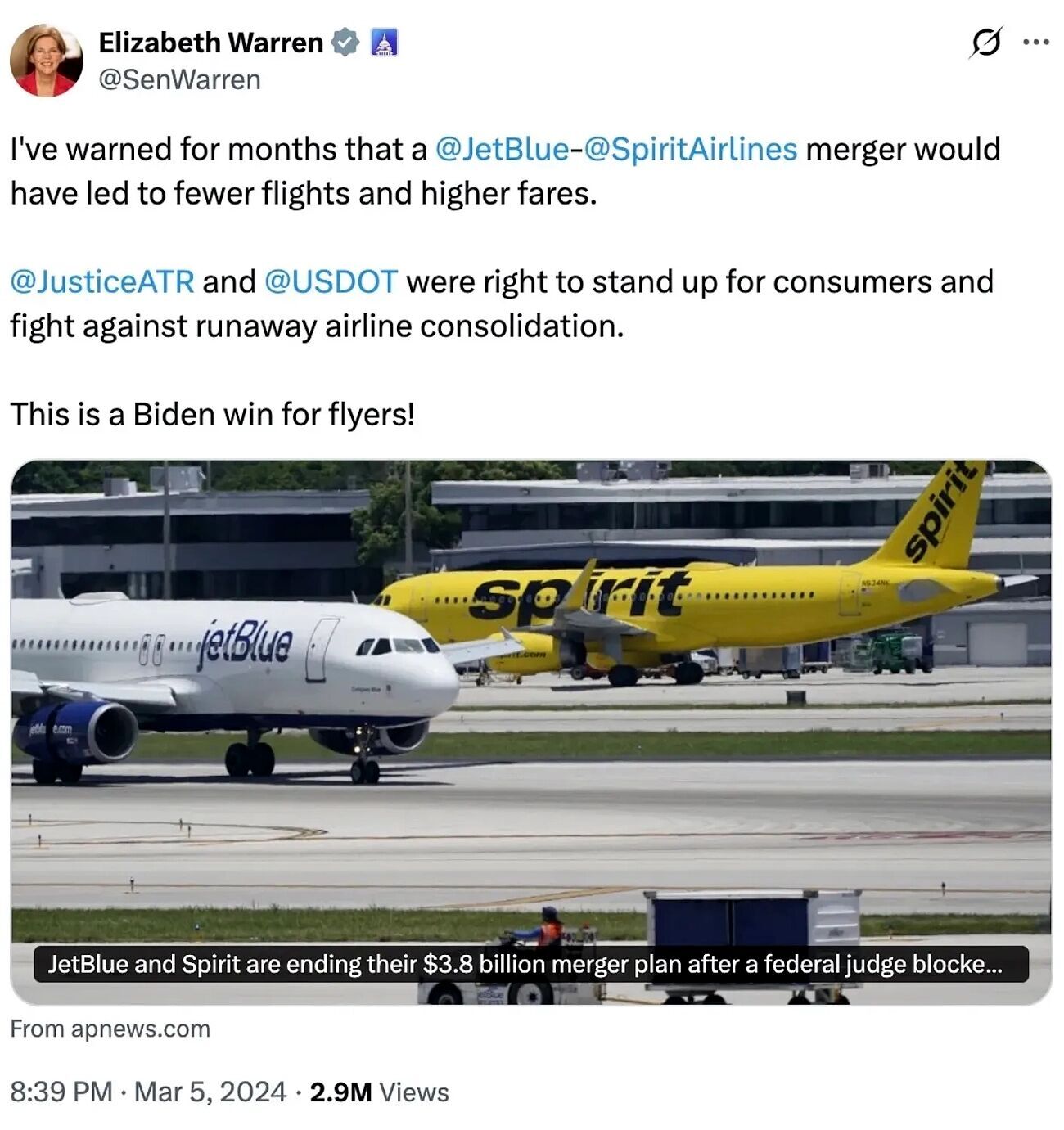
© Elizabeth Warren/X
This reflects a broader flaw in modern progressive economic thinking: an almost religious belief that government officials are uniquely qualified to outsmart markets.
The assumption is always that regulators can better allocate resources, predict outcomes, and manage industries than investors, executives, workers, and consumers operating within those markets. That belief has repeatedly failed in practice because markets are dynamic and often messy. Politicians frequently intervene with enormous confidence and then act surprised when unintended consequences emerge. The people making those decisions rarely bear the cost of being wrong.
That may be the most frustrating part of this story. Elizabeth Warren will not suffer from Spirit's collapse. She will not lose a paycheck. She will not be explaining layoffs to families. She will not be dealing with reduced travel options in underserved markets. She will not face higher airfare costs. She will continue appearing on television and telling voters she fought greed and protected consumers. The workers and travelers dealing with the consequences of her policies are the ones who will absorb the damage.
To be clear, Spirit was not a perfect company. It had major flaws and serious operational challenges. Bad business models fail all the time, and capitalism requires that poorly run companies face consequences. But capitalism also includes mergers, acquisitions, restructurings, and private-sector rescue attempts. If another company sees value in preserving assets and maintaining operations, that is part of how markets correct themselves. Preventing that process simply because it conflicts with an ideological hostility toward corporate transactions is not economic justice. It is performative politics masquerading as consumer advocacy.
Elizabeth Warren wanted to stop a merger because it allowed her to posture as a warrior against corporate power. She got her headline. She got her applause from anti-corporate activists. She got to claim another victory over big business. What she did not get was a better outcome for workers or consumers. Instead, she helped create a scenario where an already struggling airline disappeared entirely, leaving employees without jobs and consumers with fewer affordable options.
For someone who constantly claims to fight for working Americans, that is a remarkable record of harming them in the name of helping them.








Real estate: A three-story Victorian home in Cambridge, MA, purchased in 1995 for $447,000 and valued at $4.7 million in 2026 (Zillow); a Washington, DC condo worth approximately $800,000.
Investments: Dominated by TIAA-CREF mutual funds, including the TIAA-CREF Equity Index and Real Estate funds. Her largest holding, the TIAA-CREF Traditional fund, is valued between $1 million and $5 million.
Book income: Warren earned a $525,000 advance for A Fighting Chance and over $3 million in total book royalties and advances since 2013, with peak income of $1.5 million in 2014.
Senate salary: $174,000 annually (increased to $194,000 by 2025), contributing about 20% of her household income.
Despite her progressive platform advocating for wealth taxation, Warren’s financial status has consistently placed her among the wealthier members of Congress, though not among its very richest."
She "cares" about the working man BS.