
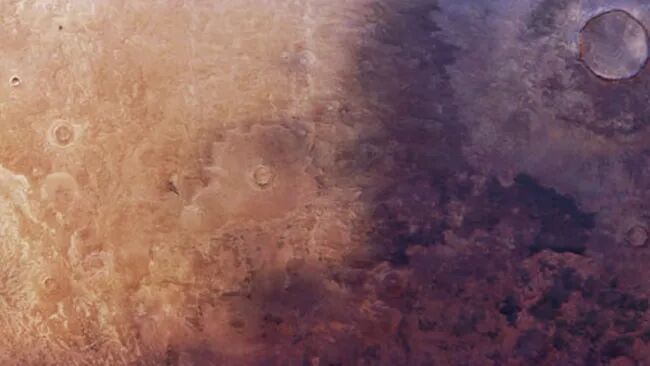
© ESA/DLR/FU BerlinA section of Mars' Utopia Planitia covered with dark volcanic materials is slowly expanding across the Red Planet's surface. And experts are not sure why.
The shadowy structure is a patch of ground covered with ash and volcanic rocks, such as olivine and pyroxene, from ancient eruptions that occurred millions of years ago, before Mars was considered geologically dead. It is located in Utopia Planitia, a roughly 2,000-mile-wide (3,300 kilometers) plain in Mars' northern hemisphere.
NASA's Viking probes first photographed the blackened ground in 1976, shortly after arriving at the Red Planet. Since then, several photos have shown that this feature is expanding across the surrounding landscape; these include new images from the European Space Agency's (ESA) Mars Express orbiter, which were captured in 2024 and released April 15.
It is unclear how large the shadowy feature is. However, sections of the patch's southern boundary have moved farther south by at least 200 miles (320 km), based on the latest photos from ESA. This suggests the dark terrain has been expanding by around 4 miles (6.5 km) per year.
Scientists are confident that the movement of the dark patch has something to do with Martian winds, which are known to scour the surface and kick up ash and dust.
"The spread of the ash over the last 50 years has two possible explanations: either it has been picked up and moved about by Martian winds, or the ochre dust that previously covered the dark ash has been blown away," ESA representatives wrote in a statement.
However, there is currently no clue as to which hypothesis is correct, they added.
Utopia Planitia
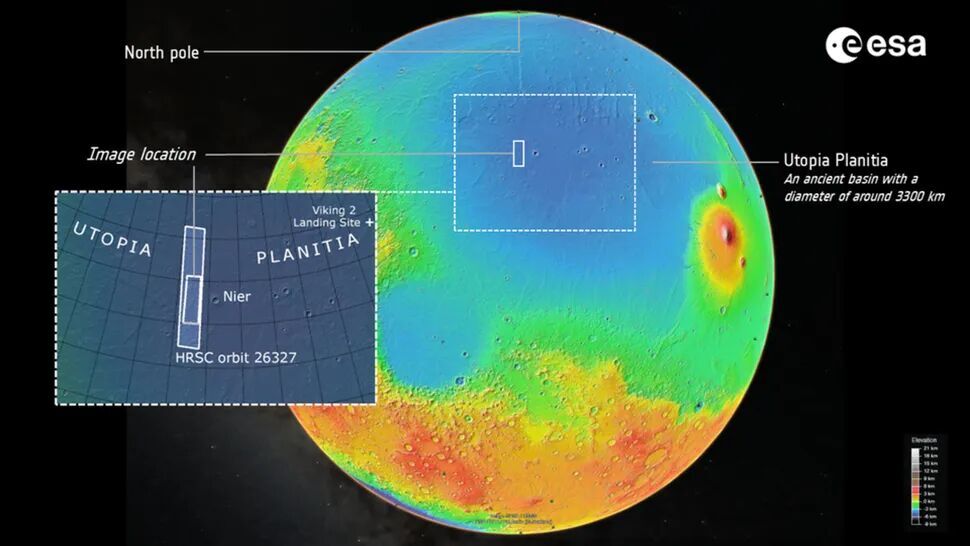
© NASA/USGS; ESA/DLR/FU BerlinUtopia Planitia is one of the largest and flattest plains on Mars. The smallest white box shows roughly where its dark "shadow" is located.
More recently, China's Zhurong rover also touched down there in 2021 and explored the giant plain before going dark in 2023. Chinese scientists have since used the Zhurong data to show that Utopia Planitia was most likely once covered with one of Mars' largest oceans, and they have even mapped out what they think was once a shoreline. The rover also may have detected clues of a surprising "climatic shift" in the region around 400,000 years ago.
Utopia Planitia is home to several large cracks in the ground, known as grabens, which are one of Mars' most unusual features and could also help provide clues to any tectonic activity that once rocked the Red Planet, according to ESA.
In addition, researchers think there is a significant amount of buried ice beneath the region, which could have big implications for the hunt for extraterrestrial life.




Reader Comments
I'm going to include an excerpt from a book given to humanity in 1990 by a 'benevolent' race on the history of Earth, and it included a short piece about Mars:
(according to “Thiaoouba Prophecy”, Chapter 3.)
(Thao, the author's mentor during his abduction, discussing explaining the arrival of the first humans – the black and asian races, from a planet in the constellation Centaur – 1.35 million years ago, when they settled in the area of Australia and Burma)
“As I said earlier, the people [blacks & Asians] knew that their planet was going to become uninhabitable within 500 years. Knowing there were other planets, inhabited and inhabitable, in the galaxy, they mounted one of the most serious exploratory expeditions.
Eventually, they penetrated your solar system, first visiting Mars which was known to be inhabitable and which, at that time in fact was inhabited.
The human beings on Mars had no technology but, by contrast, they were spiritually highly evolved. They were very small people measuring in height between 120cm to 150cm, and of Mongoloid [Asian] type. They lived in tribes in huts of stone.
The fauna of Mars was scarce. There was a kind of dwarf goat, some very large hare-like creatures, several species of rat and the largest animal resembled a buffalo but had the head like a tapir. There were also some birds and three species of snakes, one of which was quite venomous. The flora was also poor, trees attaining no more than four meters in height. They had too, an edible grass that you might compare with buckwheat.
The [explorers] conducted their research, realizing soon that Mars was also cooling down at a rate which indicated that it would no longer be inhabitable in four to five thousand years. In terms of it's flora and fauna, it was barely rich enough to sustain those already living there, let alone cope with an emigrant mass from [another world]. Besides, the planet did not appeal to them.
[These explorers did land on Earth and eventually 3.6 million of each race emigrated to Earth.]
Their original home planet eventually cooled down as predicted, and became a desert, much like Mars.
(look for the free pdf)