
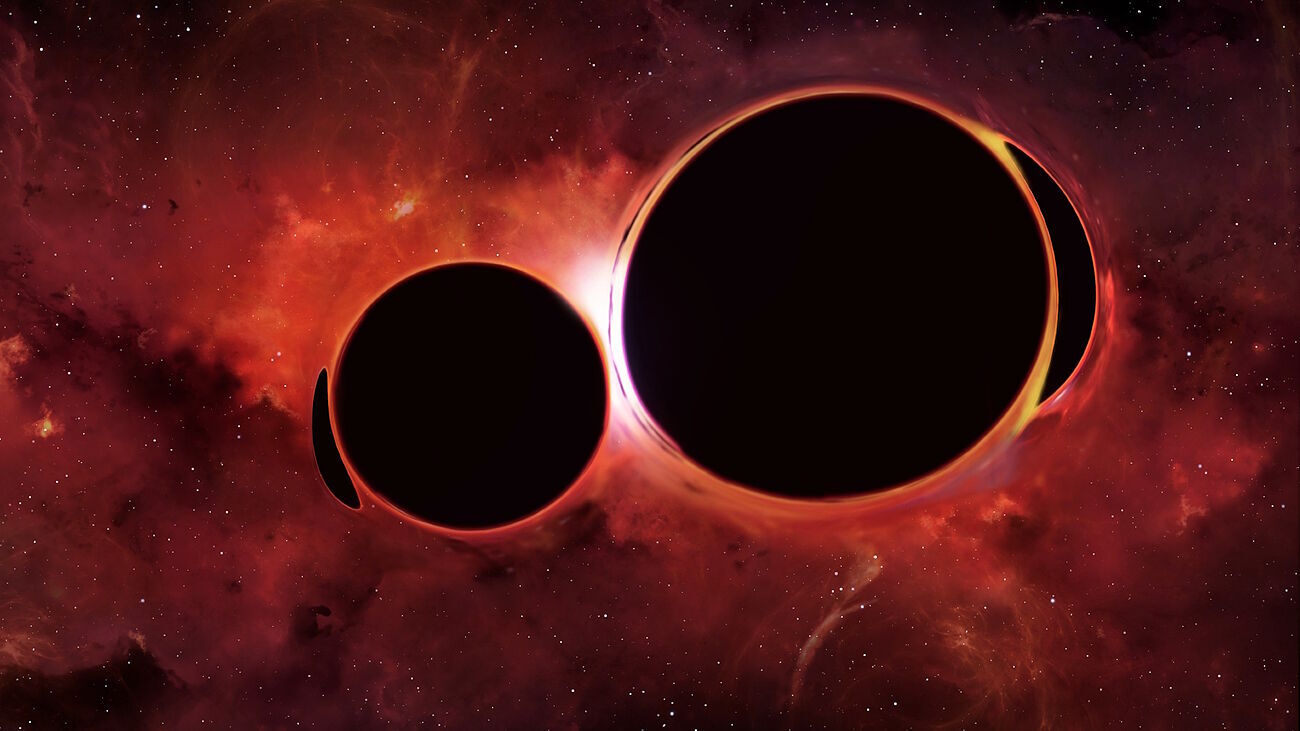
© Mark Garlick/Science Photo Library via Getty ImagesAn illustration showing two black holes beginning to collide.
Astronomers may have discovered an extreme pair of light-spewing black holes that are spiraling toward an enormous collision — the effects of which could be felt in the next century.
Using decades of radio telescope observations, the astronomers studied an ultrabright object that was previously thought to be a blazar — a glowing core of a galaxy usually powered by a black hole — some 500 million light-years from our solar system. The observations revealed a hidden jet of energy that suggests the intensely bright object is actually two black holes on the verge of colliding, perhaps less than 100 years from now.
"We expect one (merged) black hole to remain," study co-author Silke Britzen, an astronomer at the Max-Planck Institute for Radio Astronomy, told BBC Science Focus. "I am really curious to observe how this 'dance' will continue."
The findings were published March 27 in the journal Monthly Notices of the Royal Astronomical Society.
Finding two black holes
Blazars are some of the most luminous objects in the universe. They're classified as active galactic nuclei — actively feeding objects at the centers of galaxies, usually powered by supermassive black holes — and typically shoot jets of high-energy radiation toward Earth. Usually, a central black hole is the source for this jet, but in the case of the blazar in the galaxy Markarian 501, something didn't quite add up.
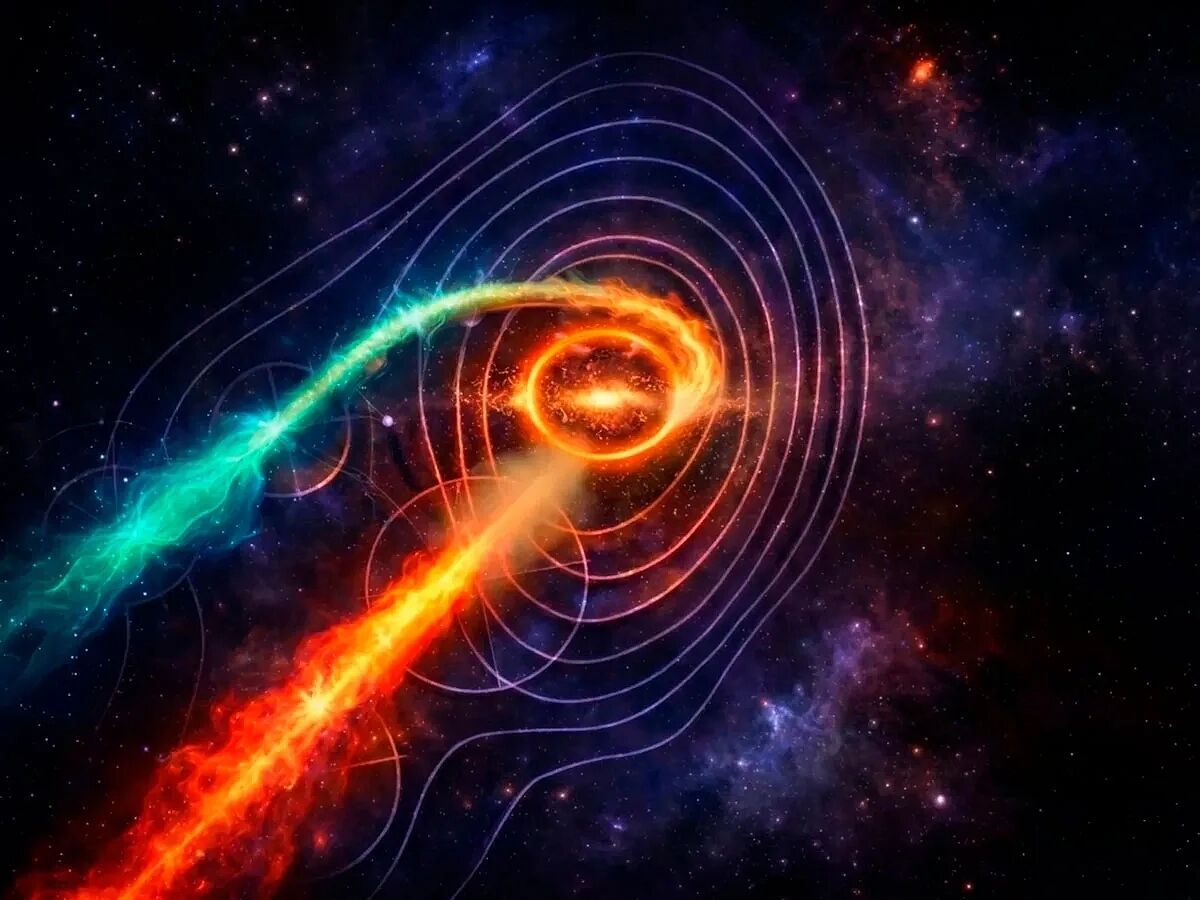
© Emma Kun / HUN-REN Konkoly ObservatoryThe supermassive black hole at the centre of Markarian 501, whose existence was already known, partially bends the light from the jet behind it into a so-called Einstein ring - Photo credit:
The results revealed that, instead of one large jet, there was also a second jet looping counterclockwise around the blazar's center. The team believes each of these jets is powered by a supermassive black hole, each weighing between 100 million and a billion times the sun's mass.









Comment: From Science Focus: