
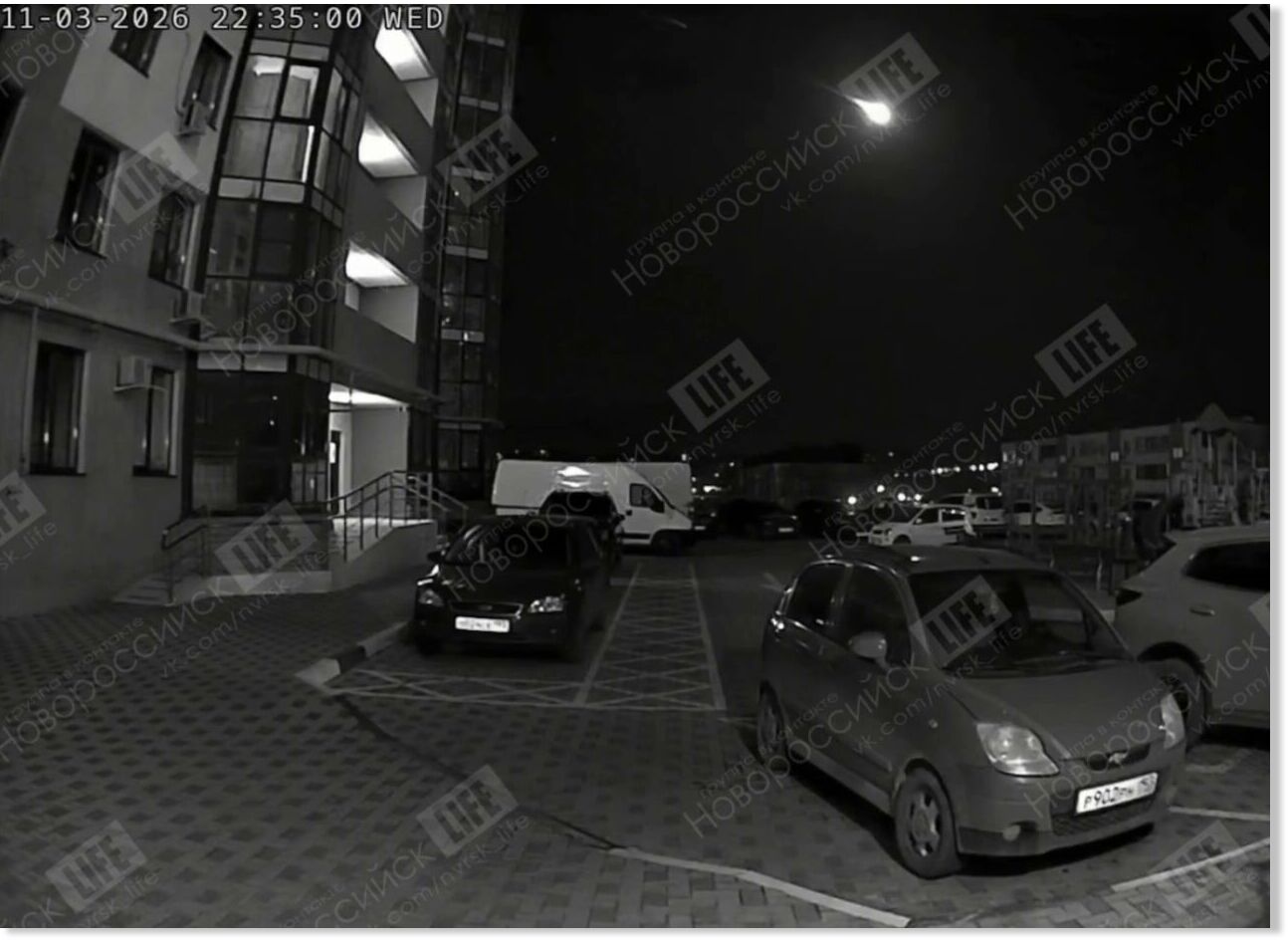
Preliminary calculated information has been released on the trajectory and nature of the bright bolide observed last night near the Black Sea coast. Based on the current data, the object's movement was completely above water. The object (meteorite) entered the Earth's atmosphere at approximately 22:35 Moscow time (to be further clarified) in the area of the central water area of the Black Sea, approximately 100-150 km south of the Crimean Bridge. The cameras located on the transport hub, if they have the appropriate spatial orientation, should have recorded the moment of the body's appearance and the entire trajectory of its flight.
The bolide was moving in a northwesterly direction towards the Crimean Peninsula and was observed for about 4 seconds. During this time, the body traveled a distance of 100 to 200 km, which completely excludes its man-made origin. The corresponding speeds in the range from 25 to 50 km/s are available only to objects of cosmic nature. In the 1st and 2nd seconds of movement, two episodes of the body breaking into fragments were observed. Presumably, for about 2-3 seconds after the cessation of the bright glow, small fragments could move by inertia, having covered an additional distance from 50 to 100 km, after which they fell out in the Black Sea.
The meteorite is not previously associated with any known large meteor shower and is a small stone that accidentally encountered the Earth — one of those that massively fill the Solar system. On a global scale, as already reported, the frequency of such events ranges from 1 to several episodes per day.
Reports of meteorite sightings from fairly remote locations, in particular in Rostov-on-Don, located almost 500 km from the event site, are associated with the high altitude at which high—speed fireballs glow - from 70 to 100 km. This, combined with the high brightness of the glow and the dark background of the night sky, makes it possible to observe such bodies from very long distances, which sometimes creates the illusion of a body flying in close proximity to the observer.



Reader Comments
to our Newsletter