

I'm pretty sure I've mentioned once or twice in my recent posts that I've been planning to write about epistemology. It sure has been on my mind a lot for the past few weeks and the more I look into it and think about it, the more complicated it seems.
We recently had guests - a young couple - and, over supper, I was asked what I was working on. I said that I was thinking about - not actually working on - epistemology. The husband and wife looked at each other and exchanged some sort of silent communication which she then explained. Apparently, her father, a professor at a university, has been writing a book about epistemology for the past 40 years. I thought, 'holy frijoles!' I worked on the research for my book on early Christianity - off and on - from about 1982 until it was finally completed in 2020. That's only 38 years and I'm satisfied with the work I did on that. But this poor guy -the father of our guest- has been working on epistemology longer than that and is still laboring with, apparently, no end in sight.
So, I did a lot more thinking and poking into the matter. Naturally Grok got a real workout with me sending it out to fetch data to help me think even harder. I am no longer surprised that someone can work on this topic for 40 years with no end in sight.
What is Epistemology and What Does it Do?
The word epistemology comes from the Greek words epistēmē (ἐπιστήμη), meaning "knowledge" or "understanding," and logos (λόγος), meaning "study" or "discourse." So, epistemology literally means the study of knowledge. (It's not related to the word 'epistle'; they only share a prefix: epi.)
Epistemologists are philosophers who specialize in epistemology, the branch of philosophy that examines the nature, origins, scope, and limits of knowledge. Their work primarily involves analyzing fundamental questions such as: What constitutes knowledge? How do we distinguish between justified beliefs and mere opinions? What are the sources of knowledge (e.g., perception, reason, memory, or testimony)? And how can we respond to skepticism about whether we can truly know anything at all?
In practice, epistemologists engage in a range of activities:
- They develop theories and arguments about concepts like belief, truth, justification, and evidence. For instance, they might debate whether knowledge requires certainty or if it's possible to have knowledge without absolute proof, often using thought experiments.
- Many epistemologists are academics who lecture at universities, design courses on philosophy of knowledge, and mentor students in critical thinking and logical reasoning.
- They collaborate with fields like cognitive science, artificial intelligence, law, or education to apply epistemological insights, such as evaluating the reliability of eyewitness testimony or the ethics of belief in misinformation eras.
- Overall, their role is more theoretical than practical; they aim to clarify how humans achieve cognitive success (accurate understanding) and avoid failure (false beliefs or ignorance), rather than conducting empirical experiments like scientists.
The Failure of Epistemology
It seems pretty obvious to me that somehow, epistemology has lost its way in the West, at least. There is substantial discussion in recent analyses about a perceived downturn in educational outcomes and knowledge retention in Western countries. For instance, standardized test scores in reading, math, and science have stagnated or fallen in many nations, including the U.S., where national assessments show declines since the 1990s, exacerbated post-COVID. Critics argue this reflects systemic failures: outdated curricula that prioritize standardized testing over critical thinking, inadequate teacher training, and a shift away from core subjects like history and civics. In Europe, similar issues emerge, with reports highlighting school failure linked to socioeconomic disparities and rigid structures that don't adapt to modern needs. Some attribute this to a broader "dumbing down," where rote memorization replaces deep understanding, leading to lower civic knowledge among youth.

© Bettmann ArchiveAn anti-Vietnam war rally, 1968.
It appears that we are experiencing an 'epistemic rebellion' where facts fracture along partisan lines, eroding shared reality. Can we trace this back to epistemology? Since the 1980s, influences like postmodernism, relativism, and critical theory have gained prominence, challenging traditional notions of objective truth. Postmodernism, popularized by thinkers like Foucault and Derrida, emphasizes that knowledge is socially constructed, power-laden, and relative — rejecting universal truths in favor of multiple perspectives. Critical theory extends this to critique structures of oppression, influencing academia and activism. All of these influences appear to have fostered relativism, where facts become subjective, enabling misinformation and identity-based "gnosis" over evidence. If knowledge is seen as fluid, education might prioritize "lived experience" over facts, and politics devolves into echo chambers. This has led to what we see as postmodern shifts eroding objective morality and truth in universities since the 1940s-1960s, leading to societal nihilism. The social sciences have become "threats to free society" via dogmatic critical theory. Critics of this narrative defend these shifts as progressive, enabling marginalized voices and critiquing flawed "objective" systems (e.g., biased science). Alternatives like critical realism propose balancing relativism with empirical rigor. If epistemology plays a role, it might be in how we've prioritized subjective narratives over rigorous evidence.
Of course, the old epistemology had issues which made it susceptible to being overtaken and dismantled by the so-called progressives. A long time ago, it was thought that the Sun circled around the Earth (and the Earth was flat). We now know that isn't true. But, at the time, it was considered to be secure knowledge; it was thought to be true, it was based on observations as far as they could go.
Traditional epistemology, rooted in Western philosophy (e.g., Descartes, Kant), for a long time, was shaped by male scholars in male-dominated institutions. This led to an emphasis on reason, reliance on standardized observation, and prioritizing detachment and objectivity. I'm not going all feminist here, but it is true that, for a very long time, knowledge produced by male-dominated institutions such as the academic world and science, seriously marginalized women - half of the human population on Earth. One example of this is the fact that medical research historically focused on male physiology to the detriment of women and children.
This male domination of what counts as knowledge, i.e. true, has been with us for a very long time. Aristotle, in his History of Animals (Book II, Part 3), states, "Males have more teeth than females in the case of men, sheep, goats, and swine." This is not a direct assertion about human teeth counts but a generalization based on apparently no observation, and stating baldly that men and women differ in a particular way without evidence of actually counting teeth. Aristotle's unverified claim exemplifies how male-dominated epistemology ignored women's realities for a good portion of human history.
Another bit of so-called 'knowledge' that sends my blood pressure through the roof was the casual assumption of the medical profession that infants did not feel pain. They routinely performed surgery, including open-heart surgery, on infants utilizing only paralytics and NO pain relief, up until the 1990s, at least. Let me tell you, I was in the doctor's office when a baby boy was circumcised and the screams and sobs of that infant will haunt me all my life. Yet the doctor stood there pronouncing sagely that infants really don't feel pain like adults do. I didn't believe it and I did NOT allow them to circumcise my son.
Why did they believe this insane bit of nonsense? Medical professionals truly believed that infants' nervous systems were insufficiently developed to process pain, based on outdated neuroscientific models. Early 20th-century studies (e.g., 1940s research on neonatal reflexes) suggested infants lacked cortical pain perception, ignoring behavioral evidence like screaming and crying.
What the heck? Can you believe that?
The assumption that babies don't feel pain was justified by studies that outright ignored the behavioral and physiological cues and adhered strongly to the abstract, male-centric scientific models over experiential evidence. The male dominated hierarchy gave value to what they called 'objective data' and dismissed lived experience or information given to them by caregivers who were usually women. This assumption was, in fact, NOT TRUE.
Another real howler: Woman with all kinds of symptoms such as anxiety, fatigue, neurological issues, depression, shortness of breath, fainting, sexual misconduct, and much more, were routinely diagnosed with 'hysteria' due to a 'wandering womb'. Treatments included being put in insane asylums where all kinds of creative horrors were inflicted on them, or being handed over to doctors who specialized in delivering orgasms called 'hysterical paroxysms'.
Consider also Thalidomide, which was safety tested only on men, but was then prescribed to pregnant women for morning sickness. More than 10K children were born with severe birth defects as a result.
Next, lobotomies were performed on over 40K people in just the US to cure such things as depression and schizophrenia. The assumption was that brain surgery could cure behavior with no consideration whatsoever for possible long-term effects.
That's just a few severe, even catastrophic failures of knowledge when knowledge acquisition adhered to a certain set of epistemological standards and norms. These oversights reflect systemic failures in epistemology. The problem was that male dominated institutions excluded or marginalized women's perspectives and contribution to the sum of information. These biases needed to be addressed and I am glad they were, but once 'feminist epistemology' got its foot in the door, it was like letting the camel's nose into the tent.
What we see is that limiting its scope led to failures of normative epistemology; it was a limitation in epistemological approach and application. The same applies to gender based power structures that determine what counts as knowledge, justification and truth. Analyzing systemic biases should be a function within the field itself. Epistemology, per se, in and of itself, should acknowledge, humanity as a whole, including that half which is female just as it should acknowledge racial differences in relation to health, intelligence, and so forth.
I also think that 'gender theory' is shaping up to be another catastrophic failure of epistemology, this time dominated by feminism.
A Brief History of Epistemology
As already noted, Epistemologists are philosophers who specialize in epistemology. The ancient Greeks, supposedly, were the first to engage in epistemology though they didn't call it that at the time, and the debates have been hot and heavy ever since.
Early philosophers like Heraclitus and Parmenides debated the reliability of sensory perception versus rational thought. Heraclitus argued that everything is in flux, challenging stable knowledge, while Parmenides emphasized reason over senses, claiming reality is unchanging.
Through his method of questioning, Socrates explored knowledge as justified belief, emphasizing self-examination and the limits of human understanding, as seen in his famous claim, "I know that I know nothing."
Plato formalized epistemology in works like Theaetetus, where he defined knowledge as "justified true belief" (a definition still debated today). In his Allegory of the Cave (Republic), he distinguished between sensory appearances and true knowledge of eternal Forms, accessible through reason.
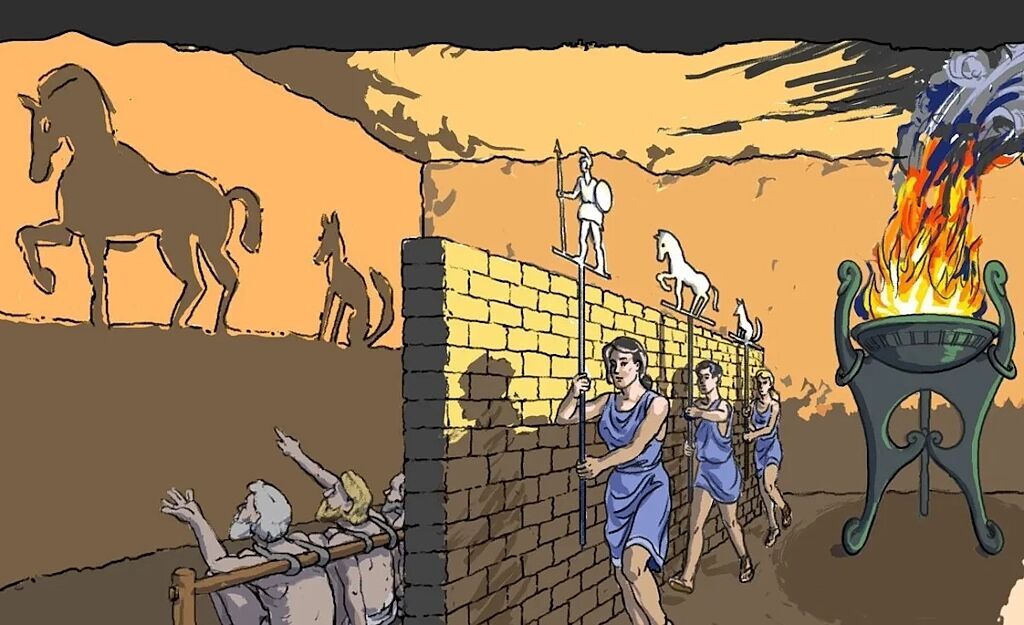
Plato's Allegory of the Cave
Pyrrho and later Skeptics like Sextus Empiricus questioned the certainty of knowledge, arguing that conflicting perceptions and beliefs make absolute knowledge unattainable, advocating suspension of judgement.
Augustine integrated Platonic ideas with Christian theology, arguing that divine illumination enables certain knowledge, as human reason alone is fallible. He emphasized faith as a source of understanding.
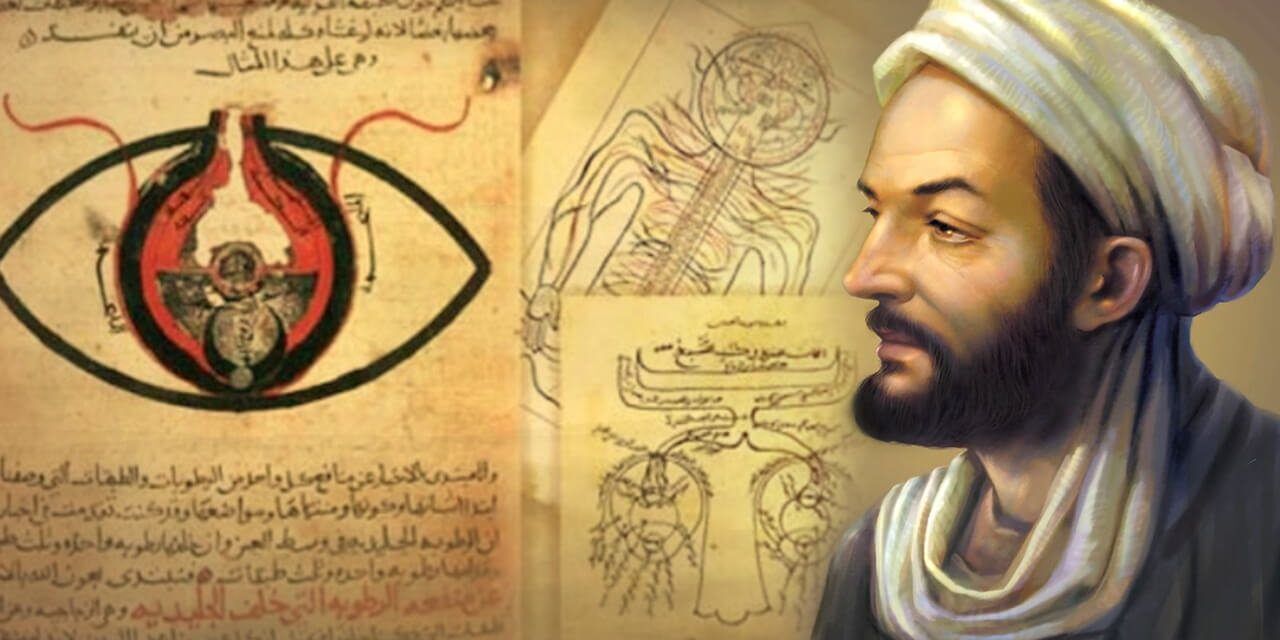
Avicenna (Ibn Sina)
Thomas Aquinas synthesized Aristotle with Christian theology, arguing that knowledge arises from sensory experience processed by the intellect. He distinguished natural knowledge (from reason) from revealed knowledge (from faith).
William of Ockham's nominalism challenged universal truths, emphasizing individual experience and skepticism about metaphysical claims, laying groundwork for later empirical approaches.
Rene Descartes sought certain knowledge to counter skepticism, famously declaring "Cogito, ergo sum" ("I think, therefore I am") in Meditations on First Philosophy. He argued that clear and distinct ideas, grounded in reason, provide foundational knowledge, establishing rationalism.
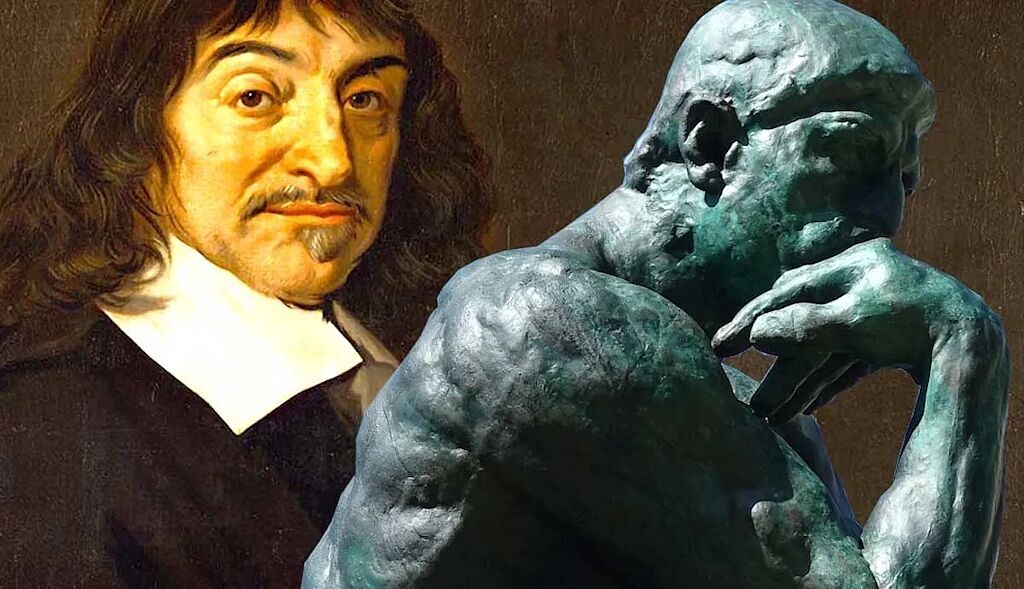
I think, therefore I am.
David Hume's radical empiricism and skepticism in A Treatise of Human Nature questioned causality and induction, arguing that knowledge is based on impressions and ideas, with no certainty beyond immediate experience.
In Critique of Pure Reason, Immanuel Kant revolutionized epistemology with his "Copernican turn," arguing that the mind actively structures experience through categories like space and time. Knowledge is a synthesis of sensory data and a priori concepts, neither purely rationalist nor empiricist.
Georg Wilhelm Friedrich Hegel viewed knowledge as a dynamic, historical process, unfolding through dialectical reasoning. In Phenomenology of Spirit, he argued that absolute knowledge emerges through the development of consciousness.
John Stuart Mill's empiricism, in A System of Logic, emphasized inductive reasoning and scientific method, building on Hume and Locke.
American philosophers like Charles Peirce and William James introduced pragmatism, tying knowledge to practical consequences. Peirce's "pragmatic maxim" linked belief to observable outcomes, while James emphasized experiential and functional aspects of truth.
Bertrand Russell and G.E. Moore emphasized clarity and logic. Russell's Problems of Philosophy explored knowledge by acquaintance (direct experience) versus description.
Ludwig Wittgenstein, philosopher
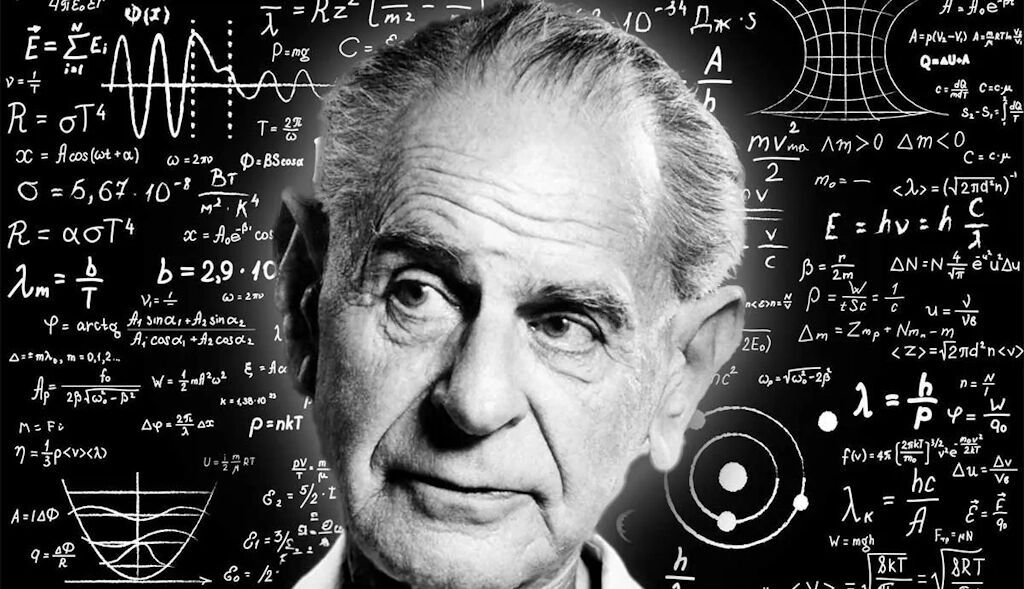
The Vienna Circle (e.g., Moritz Schlick, Rudolf Carnap) argued that meaningful knowledge must be empirically verifiable, dismissing metaphysical claims. This view faced challenges from Karl Popper, who emphasized falsifiability in The Logic of Scientific Discovery. A simple example that explains this conflict:
Take the theory "All swans are white."Popper used this to critique things like Marxism or Freudian psychoanalysis, calling them pseudoscience because they could explain anything (unfalsifiable), while Einstein's relativity made bold predictions that could be tested and potentially disproven (e.g., light bending during an eclipse).
Verifiability (Vienna Circle style): You could see thousands of white swans and say it's "verified." But that's not enough — you'd need to check every swan that ever existed, which is impossible.
Falsifiability (Popper's way): The theory is scientific because it can be falsified: Just find one black swan (which Europeans did in Australia), and it's disproven. Science advances by trying (and often failing) to falsify ideas, leading to better theories. The important point is that the theory CAN BE falsified, not that it has been, or is. Just the potential for falsification is enough. Anything stated in such a way that it is not subject to falsification cannot be scientific.
Karl Popper
The belief is true.
The person believes it.
The belief is justified.
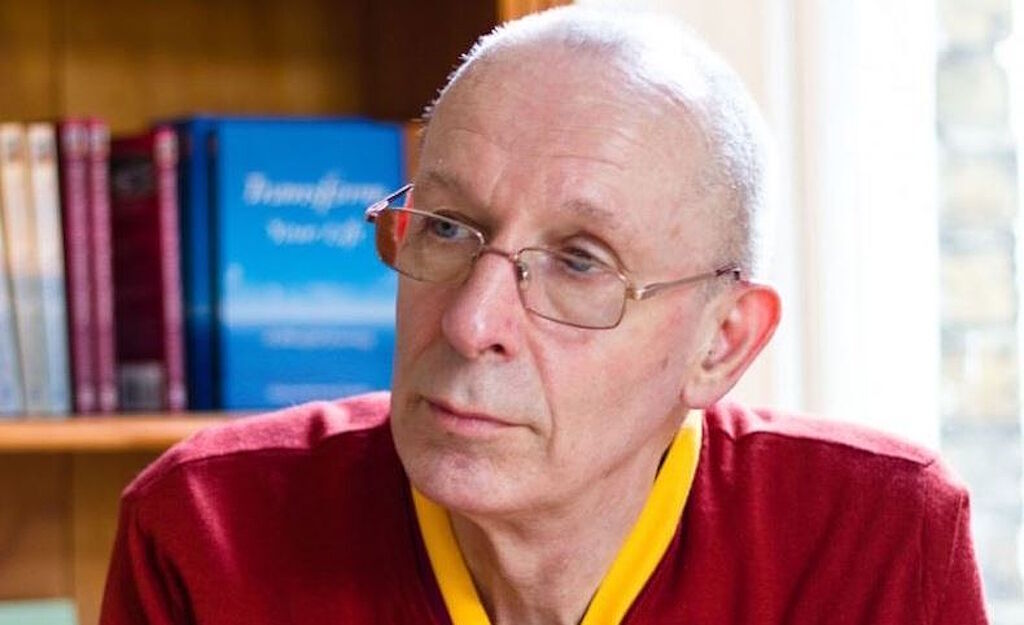
Gettier presented scenarios where these conditions are met, but the truth of the belief relies on luck rather than a connection between justification and truth. Therefore, according to Gettier, the JTB cannot be called 'knowledge'. Here is one of the classic examples:
The Job Applicant: Smith applies for a job and has strong evidence (justification) that Jones will get it (e.g., the boss told him). Smith also knows he has ten coins in his pocket. He forms the belief: "The person who gets the job has ten coins in their pocket." Unbeknownst to Smith, he gets the job, not Jones, and he, quite by coincidence, indeed has ten coins in his own pocket. His belief is true, justified, and believed, but it's true by luck, not because his justification (about Jones) was correct.
Edmond Gettier
Thinkers like Michel Foucault and Thomas Kuhn examined knowledge as shaped by power, culture, and paradigms. Kuhn's The Structure of Scientific Revolutions introduced paradigm shifts, while feminist epistemologists like Sandra Harding explored how gender influences knowledge production. And it seems that it was all downhill from there.
Recent epistemology explores contextualism (knowledge depends on context, e.g., Keith DeRose), virtue epistemology (focusing on intellectual virtues, e.g., Ernest Sosa), and Bayesian epistemology (using probability to model belief updates). Social epistemology, including work by Alvin Goldman, examines collective and institutional knowledge.
Current Main Theories
Many of the issues that exercised the ancients continue to plague the field. So really, if things haven't been sorted out in the past 2500 years, what's 40 years to write a book?! You can see what I mean by the following list of the currently argued main theories.
- Empiricism: Knowledge comes primarily from sensory experience. Key figures like John Locke and David Hume argue we gain knowledge through observation and experience, with the mind starting as a "blank slate" (tabula rasa).
- Rationalism: Reason is the primary source of knowledge. Thinkers like René Descartes and Immanuel Kant emphasize innate ideas or logical reasoning as foundations for certain knowledge, independent of sensory input.
- Constructivism: Knowledge is constructed through individual experiences and social interactions. Jean Piaget and Lev Vygotsky suggest we build understanding by actively interpreting the world, shaped by culture and context.
- Skepticism: Questions the possibility of certain knowledge. Pyrrhonian skeptics (e.g., Sextus Empiricus) and Descartes' methodological doubt challenge whether we can truly know anything, highlighting uncertainty or the limits of justification.
- Pragmatism: Knowledge is tied to practical consequences and utility. Charles Peirce and William James argue that beliefs are justified if they work in practice, emphasizing experience and outcomes over absolute truth.
- Coherentism: Knowledge arises from a coherent system of beliefs. Rather than a single foundation, beliefs are justified if they fit consistently within a web of interconnected ideas (e.g., W.V.O. Quine).
- Foundationalism: Knowledge rests on basic, self-evident beliefs that serve as a foundation for other justified beliefs. Descartes' "I think, therefore I am" exemplifies this search for indubitable starting points.
- Reliabilism: Knowledge is produced by reliable processes. Alvin Goldman suggests a belief is justified if it results from a process (e.g., perception, memory) that reliably produces true beliefs.
- Social Epistemology: Knowledge is inherently social, shaped by collective practices, testimony, and institutions. Thinkers like Alvin Goldman and Miranda Fricker explore how social factors influence what we know.
- Feminist Epistemology: Examines how gender influences knowledge production. Scholars like Sandra Harding critique traditional epistemology for male biases, advocating for "standpoint theory," where marginalized perspectives yield unique insights.
- Naturalized Epistemology: Knowledge should be studied scientifically. Quine argues epistemology should integrate findings from psychology and cognitive science to understand how we form beliefs.
As already mentioned, the study of knowledge is also, almost by definition, the study of Truth. How do we know what is true? In epistemology, knowledge is classically (Plato) defined as justified true belief (JTB). For a belief to count as knowledge, it must align with truth (correspond to reality), be believed by the individual, and be supported by adequate justification. Thus, truth is a core component of knowledge. But here things get a little sticky. There are different theories of truth!
- Correspondence Theory: Truth is when a belief matches reality (e.g., "Snow is white" is true if snow is actually white). The issue then becomes, how can we truly know reality and that what we know or think we know about reality is actually what reality is?
- Coherence Theory: Truth is when a belief fits consistently within a system of beliefs. That could be tricky if everything in the system is false.
- Pragmatic Theory: Truth is what works or proves useful in practice. This is not too bad. I think the Universe might be self-correcting and if something doesn't work or prove useful, try something else.
- Deflationary Theory: Truth is merely a label for statements we accept, without deeper metaphysical significance. This, unfortunately, appears to be the state of the world today with endless echo chambers.
In one subsection of my book, From Paul to Mark, I presented an analysis of Mark's Gospel which drew heavily on Joel Marcus's (Duke Divinity School) interpretation. Marcus argued that Mark's epistemology was rooted in an apocalyptic worldview where true knowledge is a divine gift, revealed to select individuals (the elect) and obscured from others by God's will. The text is grounded in Mark 4:11-12, where Jesus distinguishes between insiders (disciples) who receive the "secret of the kingdom of God" and outsiders who are deliberately blinded. This was connected to Daniel 10:20-21, Qumran texts, and Pauline theology (e.g., 2 Thess. 2:9-12), the result being a coherent framework where divine revelation trumps human reasoning or sensory experience, aligning with the apocalyptic tradition's emphasis on unveiling hidden truths.
Gettier problems were brought up in that text, but I did not explore whether the disciples' beliefs, even when true, fail as knowledge in the Gettier sense. The larger problems were, of course, that if knowledge depends on divine will, it's unclear how humans can verify or justify beliefs independently if human cognition is unreliable without divine intervention. The scenario clearly presented human agency in acquiring knowledge as being severely diminished and humans as, more or less, passive recipients. Another problem is: if justification is divine revelation, and only the elect receive it, how can one distinguish true revelation from delusion? (Assuming that numerous groups would claim divine revelation, as is the case in reality.) Also, in that text, I cite 2 Thess. 2:9-12, where God sends delusion to the unrighteous, complicating the reliability of perceived revelations! If God can send both truth and delusions, who is getting what?
In FPTM, I had other fish to fry so passed over the epistemological problems in favor of my goal: that the text was suggesting that there are different types of humans, some who can 'hear and see' and some who can't. I think that would be a very unpopular version of reality nowadays; not very DEI for sure.
The Markan text's claim that only those with "spiritual organs" can perceive truth risks epistemic closure, where only preordained individuals can access knowledge. This conflicts with epistemological principles like universal accessibility (DEI) and fails to explain how the elect can confirm their status without circularly relying on divine revelation. If truth is hidden from most humans and only revealed to the elect, how can it be verified? The text suggests demons and Satan also know the truth (e.g., Mark 1:24), which complicates the reliability of revelation, as malevolent beings share the same knowledge. Do the Elect have epistemic responsibilities?
Mark's epistemology diverges from traditional theories like empiricism and rationalism. Empiricism posits that knowledge arises from sensory experience, but Mark suggests human senses are unreliable without divine revelation (e.g., Mark 4:12). Rationalism emphasizes reason, yet Mark portrays human reasoning as limited, with even the disciples misunderstanding Jesus (Mark 8:17). Instead, Mark's epistemology aligns more closely with a form of divine reliabilism, where knowledge stems from a reliable divine process (revelation) but is contextually restricted to the elect. Unlike standard reliabilism, which evaluates belief-forming processes (e.g., perception) for general reliability, Mark's framework requires divine selection, raising questions about accessibility and verification.
Interestingly, Gettier's claims find an example in Mark's narrative. Peter's confession, "You are the Messiah" (Mark 8:29), is true and justified (based on Jesus's miracles and teachings) but flawed because Peter misunderstands the Messiah's suffering role (Mark 8:31-33). This resembles a Gettier case: Peter's belief is true but not knowledge, as its truth depends on Jesus's identity rather than Peter's incomplete justification. Similarly, the centurion's declaration, "Truly this man was God's Son" (Mark 15:39), is true and possibly justified (witnessing Jesus's death), but its status as knowledge is unclear without divine confirmation, given the apocalyptic emphasis on hidden truths. Mark's epistemology implicitly addresses this by suggesting that true knowledge requires not just justification but divine alignment, where the believer's understanding matches God's intent. However, this raises a problem: if justification depends solely on divine revelation, how can the elect verify their beliefs without circularly relying on God's will?
© Georg Pencz/The Metropolitan Museum of ArtThe Parable of the Sower
Mark's epistemology aligns with a correspondence theory of truth, where truth reflects divine reality. However, verification is problematic: demons also know Jesus's identity (Mark 1:24), suggesting supernatural knowledge isn't inherently trustworthy. The text's apocalyptic view — that full truth awaits the eschaton (1 Cor. 13:12) — complicates pragmatic theories, where truth is what works in practice. The disciples' partial understanding (e.g., Mark 8:17) lacks immediate utility, reinforcing the eschatological focus.
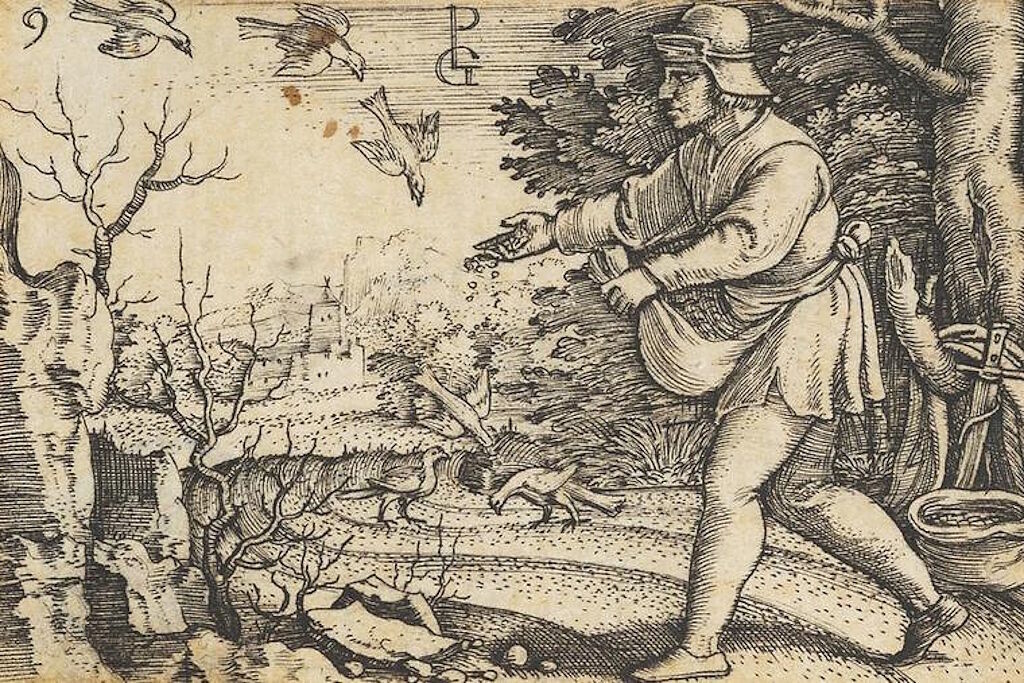
Marcus describes Mark's epistemology as a "collision of kingdoms" (p. 567), where God's kingdom, revealed through Jesus, opposes Satan's, which blinds humanity. The Parable of the Sower (Mark 4:1-20) illustrates this: the "word" (God's truth) flourishes in "good soil" but is thwarted by Satan's agents (e.g., worldly cares). The Parable of the Strong Man (Mark 3:23-30) reinforces this, depicting Jesus as plundering Satan's house, retrieving the elect. The unforgivable sin (blasphemy against the Holy Spirit) underscores the stakes: rejecting divine revelation aligns one with Satan. This cosmic battle peaks at the cross (Mark 15:39), where the centurion's recognition of Jesus as the Son of God marks the first human acknowledgment of the full truth. Marcus argues this signals the "turn of the ages" (p. 574), though false prophets (Mark 13:22) suggest Satan's influence persists. The elect must remain vigilant, aligning with the limited agency noted above.
The disciples' persistent incomprehension (e.g., Mark 6:52, 8:17, 14:68-71) highlights the limits of human knowledge, even among the elect. Peter's denials (Mark 14:68, 71) echo the "outsiders'" blindness, suggesting that divine revelation is imperfect until the eschaton. This aligns with Qumran texts (1QS 9:18), where even the righteous can be led astray. The partially healed blind man (Mark 8:24) symbolizes this, seeing "men as trees, walking," reflecting the disciples' incomplete grasp. (Marcus, J. (1984)"Mark 4:10-12 and Markan Epistemology." Journal of Biblical Literature, 103.4, pp. 557-74.)
The Idea of the World
More or less in the same spirit as the work of Timothy Williamson, Bernardo Kastrup's The Idea of the World (2019) presents a metaphysical framework of analytic idealism, positing that reality is fundamentally mental — a universal consciousness or "mind-at-large" (MAL) — and that physical phenomena, including the material world and individual minds, are dissociated expressions (or "alters") of this singular consciousness. Kastrup argues that what we perceive as the physical universe is the "image" of mental processes within MAL, akin to a dream, with empirical observations (e.g., quantum mechanics, neuroscience) better explained by idealism than materialism. Individual minds are localized dissociations of MAL, experiencing reality through a filtered interface, and true knowledge involves accessing the underlying mental reality beyond sensory appearances.
Kastrup's core claims reshape the foundations of epistemology:
According to Kastrup, the physical world is an extrinsic appearance of mental processes in MAL. Physical events are like desktop representations of deeper mental dynamics, not independent material facts. That is, physical phenomena are symbols of thoughts in MAL.
Kastrup further proposes that individual human minds are like dissociative identity disorder (DID) alters within MAL, with limited access to universal consciousness. True knowledge involves transcending the dissociative boundary to access MAL's intrinsic mental states, akin to "waking up" from a dream. There are limits to empiricism in Kastrup's model. Sensory data (the "desktop") is a filtered representation, prone to distortion. Neuroscience supports this: perception is a brain-constructed model, not raw reality.
Kastrup's ideas will be the topic of the next post. They are so sensible and compelling, I want to discuss them in detail because they play a role in arguments of my own that I will get to after. And yes, I AM circling around to the Hyperdimensional Control System hypothesis and what happens to epistemology in the face of marauding Overlords of Entropy.


Reader Comments
Quote, one part an analogy:
"Reality is the territory.
Truth is an accurate map of that territory.
A map can be true (accurate) or false (misleading), but the territory exists regardless."
only one thing is for certain (epistomologically speaking):
one day, sometime in the future, those truist humans among us will join forces with all the other likewise scientific, literate, and smartly advanced (and true) cultures, societies and civilizations scattered throughout space-time and effectively rule the ENTIRE universe...
we know this for a fact.
ned,
out
If one were to reimagine that "divine sources" are 5D human souls(with free will and "knowledge" able to bring will/beliefs into actual existence) instead of 7D God consciousness "divinity"(the only thing that can do that) vs. "providence" then things start to fall into place I think???
In Plato's allegory of the cave, there are prisoners bound by chains who watch the shadows on the cave wall cast from behind them by other individuals. This is a true depiction of life on earth and the world view of those chained. We are prisoners in many ways, like a human body, a human mind, human emotions, then with added elements of education and media distortion/shadows cast on the wall.
Our individual world view is our relationship/map to the reality we experience. That world view can include scientific theories, religious beliefs, relationships to family, trauma, cross roads where direction shifts, education, books, ideas, relationships to experts, authority, society, the connections we make from the information/experience we have, etc. Therefore, the formation of world view could be seen as entirely chance, or the result of choices, or a direction that is determined by some inner spark/reasoning or external force.
What is missing, in my view, from epistemology is the human being's self-knowledge of the current means of perceiving reality and whether a human being can develop or open other aspects of his/her being to perceive reality differently, more directly. .... more later.
Why is it important? Each person is centered in one card which means they have a dominant center influenced by the part. It is through this card that talents and direction are usually expressed. It means that different people, using the same words, mean different things. It means different people, using different words, can mean the same thing. By simply understanding this, you will no longer expect people to understand or agree with you. This is self-knowledge, or is it? At least this is one lens by which we can study oneself.
Another reason this is important is that “knowledge” is not only thinking. Each center or brain has a domain of activity and uses different languages. The emotional brain language is primarily music (color), though all art including poetry, sculpture, architecture, theater, painting have other elements of sound, color, resonance. We all respond to music, though usually only the music we grew up with. It can raise our state, lower our state, create sadness, create a frenetic energy. The moving brain for most people is simply spatial relationships and learned movements. It knows the map of the way to work; you don’t think about it. It knows how to wash and dry the body after a shower. At the intellectual end you have architects who can create forms and imagine buildings, and then the builders who follow the plans and build. There are also athletes who have tuned their body to perform whatever the sport requires. The instinctive brain is the animal brain. Its primary focus is the state of the body; it controls the heart, breathing, digestion, coughing, itching. It is concerned with survival, food, warmth, danger, reproductive sex. The intellectual part of this brain can also be tuned to be a gourmet who rates restaurants or a wine sommelier (expert).
Obviously, we have one body, so all of these centers interact, and the interaction can be synergistic or antagonistic. For example, if you are reading a book that has information that the instinctive brain determines is dangerous for its survival, you may suddenly become very tired and go to sleep. When we think of the highest human achievements in art, literature, architecture, music, sculpture, poetry, theater we are seeing the synergy of these centers.
This idea of centers is verifiable for any person who observes. The human being stores its experience in the moving/instinctive parts of centers. All of your moving center’s training/memory in riding a bicycle or driving a car is there, all of the maps of your house, garden and way to the market. You don’t think about these, you just do them. The same for the emotional center: all of your emotional experiences are stored there from music, friends, parties, concerts. The same for the instinctive center; you know the taste of toothpaste and honey, what is too hot or cold, a pin jab.
Why is Leonardo da Vinci called the Renaissance man? The Mona Lisa and Last Supper for the emotional center, his notebooks and studies into anatomy or flying for the intellectual center, and his many moving related inventions regarding flying, tanks or helicopters for the moving center. This suggests that truth will require more that one center at work, and that the intellectual center with words and ideas is not enough.
The only way to know they exist is to experience them. The problem is that all people have experienced them, but don’t realize what it means, what the value is or how to think about it. Your only real memory are moments of the higher emotional center or self-remembering; Self awareness in the moment of experience. Everyone has them, yet they don’t recognize that they were different. They happen. Try to parse through your memory of moments in your history, especially as a child or in your teens, and you will see this is accurate. Other moments, you simply were not “present”.
Higher intellectual center is being aware of reality outside of your Self. Again we have experiences of it, but we have no intellectual way to understand it. Where can we see such moments? For most of us, probably in moments of extreme danger like an automobile accident on the highway. In one such event, I “watched” as a car in-slow-motion passed on my left. That car was not in-slow-motion, my perceptive speed of processing had jumped to a much higher speed. This suggests that seeing reality involves a higher speed of processing than we use in everyday life.
What can the higher intellectual center see? Laws and how things are connected/interrelated. Gurdjieff’s enneagram, from one perspective, is the human mechanism, the law of three (3 brained beings with moving/instinctive combined) and the law of 7 (or octaves, the personality types ruled by endocrine glands).
All of what I wrote above and below is my being from the Fourth Way work.
The answers to your questions will simply be knowledge. Here is Grok AI:
" The Three "Bodies" and Their Fate at Death
Physical body (made of "Hydrogen 768" or denser matter): Decays and returns to earth. Its coarse energies nourish soil, plants, and the planetary food chain.
Kesdjan body (or "astral body," higher emotional center, Hydrogen 12–48): In ordinary humans, it forms incompletely and dissolves shortly after death (days to weeks). It cannot survive without a fully crystallized "higher being-body."
Higher being-body (or "soul," Hydrogen 6–12): Only develops through conscious "work on oneself" (self-remembering, non-identification). If crystallized, it becomes immortal and survives death independently."
In Search of the Miraculous "Man is a plural being. When we speak of man we speak of three men in one—physical, astral, mental... At death the physical body is annihilated... The second body, if it exists, can live after the death of the physical body, but not indefinitely." (Ch. 10)
How does Gurdjieff's work resonate with the Cs, Christianity, Sufism, Buddhism? It resonates, and at the same time Gurdjieff saw through the "pretense" or "image".
Hydrogen 6-12 would be compared to densities in the Cs vocabulary, in my view. They are not physical matter.
Reincarnation and karma are part of the mechanics of the soul's journey to oneness. A lifetime is a lesson on the journey.
Gurdjieff was brutal in his approach to students (at least in the beginning) tearing down "false personality". He focused on movement as a primary approach. He could manipulate other people's consciousness. This suggests to me that he was likely centered in the intellectual part of the instinctive center.
Ouspensky was an intellectual. He wrote books before he met Gurdjieff. His voluminous meetings record much of his thinking about the System. He abandoned the system, in my view, because he saw his presentation of it was an obstacle for his students to wake up.
SOTT Focus:NewsReal: Peacemaker Trump Ends 3,000 Years of War in the Mid-East!
Or so he'd like you to believe. Trump's bullsh*t reached unprecedented heights last week with his theatrical 'Mid-East Peace Deal' in Egypt, which was really just a declaration of intent signed by...