

© ZME Science/SORA
In the grand sweep of Earth's four-billion-year history, 300 years is barely a blink. And yet, that blink — our industrial era — has already reshaped the atmosphere, oceans, and sediments. If civilization collapsed tomorrow, would anything of us remain 100 million years from now? Could some alien beings visiting Earth in the future ever tell that this planet was inhabited by an advanced civilization? More startling still: if another civilization once existed on Earth long before us, could we even tell?
This question lies at the heart of the Silurian Hypothesis — a playful yet serious scientific proposition by NASA climate scientist Gavin Schmidt and astrophysicist Adam Frank, detailed in a 2018 paper in the International Journal of Astrobiology. The name nods to the Silurians, a fictional species of ancient intelligent reptiles from Doctor Who, but the premise is grounded in geology, astrobiology, and climate science.
"We are not however suggesting that intelligent reptiles actually existed in the Silurian age," the authors clarify in their paper, just to be sure no one misreads them. "Nor that experimental nuclear physics is liable to wake them from hibernation."
A Civilization Lost to Time?
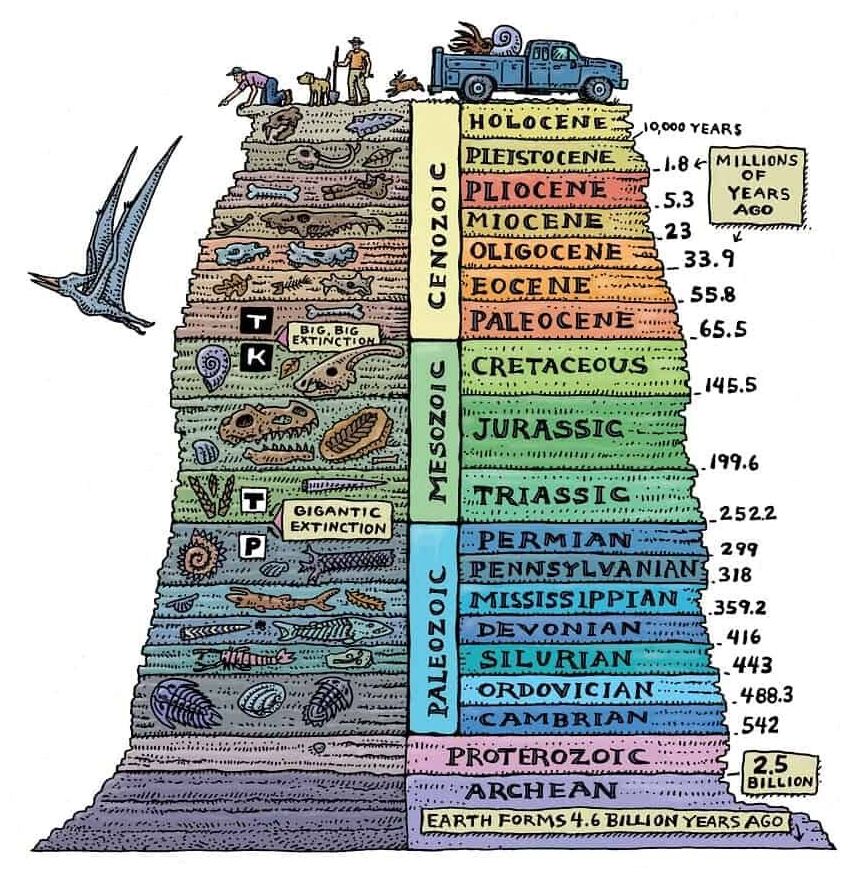
At its core, the Silurian Hypothesis asks: if an industrial civilization arose millions of years ago — say, during the Devonian or the Paleocene — would we find any trace of it today?
According to Schmidt and Frank, the odds are slim.
For one, the geological record is woefully incomplete. Ocean crust, where much sediment settles, recycles every 170 million years or so. On land, surface preservation is even rarer. "The current area of urbanization is less than 1% of the Earth's surface," the researchers note, and ancient surfaces that remain intact are scarcer still.
Even human fossils — just a few hundred thousand years old — are hard to come by. So, for a civilization that existed 10 or 100 million years ago, the chance of finding fossilized bones or a lost city is vanishingly small.
Yet, there's another way to detect such a presence: its planetary footprint.
Ghosts in the Sediment
© MeteorologíaenRed.
If a civilization had industry, it likely burned energy, changed land use, and altered the atmosphere. These changes could leave subtle markers in the rock record — what the scientists call "geochemical fingerprints."
Our own civilization, brief as it is, has already left such a mark. Carbon dioxide levels have surged, oceans have warmed and acidified, and plastic particles are raining into marine sediments. Persistent synthetic chemicals, like PCBs, and even radioactive isotopes from nuclear tests may linger for millions of years.
"The longer human civilization lasts, the larger the signal one would expect in the record," the authors write. But that raises a paradox: "The more sustainable a society... the smaller the footprint."
A long-lived, solar-powered civilization might leave hardly a trace. By contrast, a short-lived one — fueled by fossil carbon — would leave a distinctive isotopic spike, just as humans are doing now.
As they scoured Earth's geological past, Schmidt and Frank identified events that eerily resemble today's Anthropocene. Chief among them: the Paleocene-Eocene Thermal Maximum (PETM), a rapid global warming event 56 million years ago, triggered by a mysterious pulse of carbon.
During the PETM, global temperatures jumped by 5-7°C, ocean acidity rose, and mass extinctions rippled through the deep sea. Some metal levels spiked, and erosion intensified — features that mirror human-driven changes today.
There are others: Ocean Anoxic Events in the Cretaceous and Jurassic left behind black shale deposits and strange chemical signatures. In some cases, they also coincided with large carbon isotope anomalies — just like today.
Still, those ancient episodes are generally linked to volcanic activity or tectonic upheaval. To claim they came from a vanished civilization would require extraordinary evidence. Frank and Schmidt themselves don't really believe any industrial civilization existed prior to that of humans.
"We are aware that raising the possibility of a prior industrial civilization... might lead to rather unconstrained speculation," the authors caution. "Care must be taken not to postulate such a cause until actually positive evidence is available."
Why It Matters for Today — and for the Stars
This thought experiment may have real implications. It highlights how little we know about the long-term survival of civilizations — ours included. If industrial civilizations tend to collapse quickly, their geological legacy might be thin. We might never find a trace of them, just like countless human societies — along with their language, customs, stories, and inventions — have been lost across history.
It also reframes how we search for intelligent life elsewhere. The famous Drake Equation, which estimates the number of communicating civilizations in our galaxy, includes a term for how long such civilizations last. If advanced societies frequently self-destruct — or shift to sustainable models that leave little trace in the geological record — then the odds of detecting them plummet.
Frank and Schmidt urge scientists to think creatively: "Are there other classes of compounds that will leave unique traces in the sediment geochemistry on multi-million year timescales?" they ask. Could deep drilling on Mars or Venus reveal similar fingerprints?
The Silurian Hypothesis is not about proving an ancient lost civilization existed. As we've seen, it would be almost impossible to tell from very subtle geological traces. Rather, it's more about asking what signs civilizations leave behind — and what that tells us about our own.
"While we strongly doubt that any previous industrial civilization existed before our own," the authors conclude, "asking the question in a formal way... raises its own useful questions related both to astrobiology and to Anthropocene studies."



Reader Comments
This was a great article.
but ahhh yes... you're not really interested in fitting in here, eh ?
your profile note kind of gives that away: " not in the mood to share anything about myself " well, i'll give you the benefit of the doubt, Idon'tcare, because - well, why not ?
i'm interested in hearing what you have to say - not because i agree with you - imo it's not really great per se, but i will explain why the article's structure caught my eye, shortly, in a following comment.
anyway, mrs life just called me for dinner, i'm outta time; anyone read Oversoul 7 ?
... and hey idon'tcare there was a link to the Drake Equation in the article... for those in the audience that are shamed and to cognitively challenged to understand i am hoping you can tell everyone why that equation is nothing but a lump of post metabolized dog food ? here's your chance to redeem yourself.
bonus points for you idon'tcare , please briefly compare professor Drake's theory with Dewey Larson's main schtick for us, thanks.
good grief man, your explanation, in a nutshell, nailed it, thanks !
'During the PETM, global temperatures jumped by 5-7°C, ocean acidity rose, and mass extinctions rippled through the deep sea. Some metal levels spiked, and erosion intensified — features that mirror human-driven changes today.'
Then i thought fuck it.
The author of this piece is saying that the Earth experienced the exact features back then before any humans but today they are due to human activity. The author obviously didn't take any dinosaur farts into account.
you can hold your breath and the hiccups may go away, at worst you might belch ...but holding in a fart - could be acoustically entertaining at best; at worst, require a visit to the restroom
Way different than today.
I digress.
Planetary rotation generally prevents Hadley circulations from extending all the way to the poles.
Absorption of sunlight drives the circulation of the Hadley cells. What is global warming? The absorption of more than necessary sunlight.
Furthermore the width of the Hadley cell is fundamentally controlled by eddies. With there not being polar ice caps this means there was more water area on the planet making the Hadley Cell a single larger cell. There are 3 today due to more land exposure but once the land is covered the cells will merge back into a single Hadley Cell.
Not only was Earth smaller it was closer to the sun, most of the oceans were still contained within, as h+ densely packed into cold metallic 'storage' and oxygen as crystaline silicates created under the intense pressures inside a star, I'm guessing Neptune, though having lost its core its gas has mostly dissipated into space over the few million years of irs existence. So only shallow seas who's 'beds' are now mostly stranded on continental shelves, smaller than Mars and orbiting perhaps a little closer than Venus now does to the sun.
'Subduction' +/- 180°implies its opposite.
Plus it's not done, [Link]
Unlearning is a difficult and problematic process it's also quite liberating because once accomplished you only doubt what you believe everything else is just someone else's more or less honest attempt at a coherent description. Mine is honest but why should it be true?
Earth is continuously giving away matter, as well as acquiring new material. In the atmosphere, oxygen, hydrogen, and helium atoms absorb enough energy from the sun to escape the atmosphere. Rate of atmospheric escape is 82,700 tons. Rate of gain is 16,500 tons. A total loss of 66,100 tons per year. So the Earth is getting smaller not larger.
At some point that star encountered a larger star, hard to imagine if they're all going about the same speed. Here M54 comes in handy as the remnant of an older colliding galaxy the plane of which, perhaps coincidentally, aligns precisely with 'our' misorientation to the milky way. This may have been the source for a much larger star than earths parent body, and a close encounter either by gravity or EM precipitated both earths capture and its separation from its more nebulous atmosphere, leaving the newly encountered system with a highly charged iron cored rocky, and a coherent gas giant, pair of planetary companions.
Probably not the first or last such encounter. Such encounters may be marked by 'big big extinctions' or 'gigantic extinctions' here we need to apply a huge discount, not applicable to uniformitarian church members, I'd suggest something of the order of three O.O.M.s this would allow me to think non fossilised connective tissue of dinosaurs still existing is almost plausible.
Gigantic and big big events may have softened the elemental mix of the mantle and boiled the low specific heat metals in the outer core causing a massive release of protons/H+ and He+ in their proximity, initiating a cascade of exothermic reactions, these being responsible for 'G+BB' outgassing events which poisoned and altered the climate. Like many fires the fuel caused its own extinguishing, but the smaller transitions speak to sporadic or episodic reignitions. Using other bodies as a guide it seems that water (as steam?) was/is a major component of the outgassing process, one could imagine that released in oceanic quantities the atmosphere would expand and precipitation towards the poles would be miles deep with stratospheric temperature snow/hail.
Having played a few games of snooker the idea that debris from ?? could organise itself into a rotating plane travelling at 200+kps orthogonal to that plane breaks the elastic in my credulity; but I could be wrong, persuade me.
The water came/comes from hydrogen reactions within the planet/moons and outgasses as brine, mostly, at near supercritical temps(for water). The 'water' on comets is a sign that they are 'young', from near cores and are still outgassing hydrogen when charged with enough UV to precipitate reactions with oxygen in their rock.
Some comets are made of salt(sodium) and ice. I think Hale-Bopp's tail is sodium. Comets carry the building blocks of life on them. Any place they impact that is able to support life can become inhabited. Scientists believe Europa has extraterrestrial life forms because of this.
Most people see what they are told to see.
Civilizations last, not by leaving behind their bones or abandoned cities, they last because of word of mouth. Stories being passed down generation after generation. Human civilization didn't start doing that until around 12,000-13,000 years ago.