
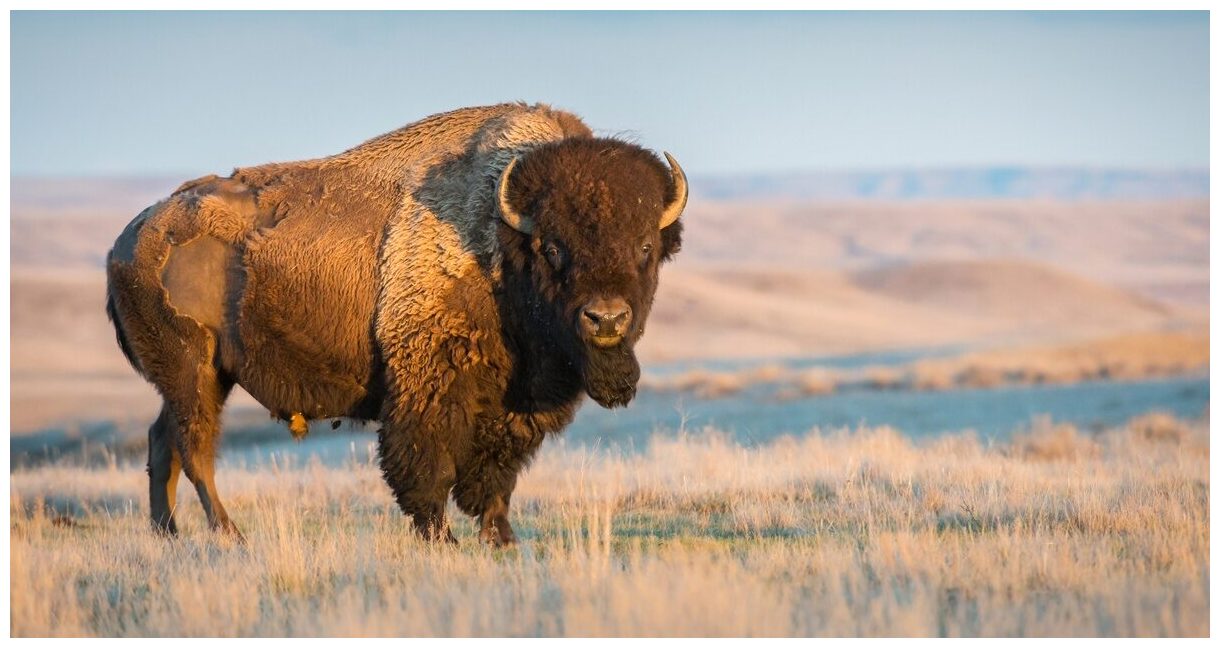
© Emory University“Bison were not just key to the economies of some Indigenous nations,” says Emory economist Maggie Jones, co-author of the study. “The bison were also important cultural and spiritual symbols.”
The mass slaughter provided a brief economic boon to some newly arriving settlers, hunters and traders of the Great Plains who sold the hides and bones for industrial uses.
In contrast, Indigenous peoples whose lives depended on the bison suffered a devastating economic shock — one that still reverberates in these communities today, an economic study finds.
The Review of Economic Studies published the findings by economists at Emory University, the University of Toronto and the University of Victoria. The researchers quantified both the immediate and long-term economic impacts of the loss of the bison on Indigenous peoples whose lives depended on the animals.
Changes in the average height of bison-related people is one striking example of the fallout. Adult height across a population is one proxy of wealth and health given that it can be impacted by nutrition and disease, particularly early in development.
Bison-reliant Indigenous men stood around six feet tall on average, or about an inch taller than Indigenous men who were not bison-reliant.
"They were among the tallest people in the world in the mid-19th century," says Maggie Jones, assistant professor of economics at Emory University and a co-author of the paper. "But after the rapid near-extinction of the bison, the height of the people born after the slaughter also rapidly declined."
Within one generation, the average height of Indigenous peoples most impacted by the slaughter dropped by more than an inch.
"That's a major drop, but given the magnitude of the economic shock it's not necessarily surprising," Jones says.
Reverberating effects
By the early 20th century, the paper shows, the child-mortality rate of bison-dependent Indigenous nations was 16 percentage points higher and the probability of a working-age male reporting an occupation was 19 percentage points lower compared with Indigenous nations that were never reliant on bison.
And income per capita remained 25% lower, on average, for bison-reliant nations compared to other nations through the latter half of the 20th century to today. The persistent gap could not be explained by differences in factors such as agricultural productivity, self-governance or application of the Dawes Act of 1887, which authorized the breakup of reservation land into small allotments parceled out for individual ownership.
The researchers find that limited access to credit was one factor that curtailed the ability of some bison-reliant nations to adjust economically following the near-extinction of the bison.
"One role of economists is to provide quantitative evidence that people can turn to when trying to design more effective policies," Jones says. "By providing data that benchmarks disparities among bison-reliant people and the sources and evolution of these disparities, we hope to support efforts to improve the situation."
The paper's other co-authors are economists Donn Feir (University of Victoria) and Rob Gillezeau (University of Toronto).
An overlooked economic shock
Jones' economic research focus includes history, labor and education. She uses quantitative tools from these areas to better understand the persistence of socioeconomic inequalities between groups in North America.
The economic effects of the bison slaughter are an overlooked piece of the history of Indigenous peoples that she and her co-authors decided to investigate.
For more than 10,000 years, bison served as the primary source of the livelihood for many Native Americans in regions of the Great Plains, the Northwest and the Rocky Mountains. Along with nutrition, the animals provided hides for clothing, lodging and blankets as well as bones for tools and implements. Nearly every part of the animal was used, including the brains to obtain grease for tanning hides and the stomach for creating bags and water containers.
Evidence suggests that bison-reliant Indigenous societies enjoyed living standards comparable to, or in some cases better than, their European contemporaries.
A gradual decline of the bison population started with the introduction of the horse and the arrival of Europeans. By 1870, however, mass slaughter of the animals began. Factors that drove the kill-off included the completion of the transcontinental railroad, improvements in European tanning technology that made bison hides more desirable and encouragement by the U.S. Army to eliminate the animals to help in their efforts to force Indigenous peoples onto reservations.
In some regions, the bison was eliminated in a little more than a decade. Jones and her co-authors describe the slaughter as one of the largest and most rapid losses of a critical industry in North American history.
"Centuries of human capital were built around the use of the bison, and within 10 to 20 years this economic underpinning disappeared," Jones says. "And many channels of economic adjustment were cut off for Indigenous populations."
Indigenous people were forced onto reservations, their movements were restricted and they were not allowed to become citizens of the United States until 1924, the authors note.
Drawing from existing data
Among the sources Jones and her colleagues drew on to quantify the impacts of the bison slaughter are data collected by anthropologists and published in the 15-volume Smithsonian Handbook on Native American Populations.
The economists defined nearly 24 Indigenous nations as "exposed to the slaughter," based on geographic location and whether bison served as their primary food source.
In their quantitative analysis of bison-reliant nations with Indigenous nations that were not bison-reliant, they controlled for factors such as differences in self-governance status of communities, differences in forms of agricultural productivity and the suitability of the land for agricultural production, the effects of the Dust Bowl and differential application of the Dawes Act.
To measure the persistent effects of the bison's decline on economic outcomes, the researchers drew from several sources: the Bureau of Indian Affairs (beginning in 1945), the U.S. Census (1980, 1990, 2000) and American Community Surveys (2007-2012 and 2015-2019).
The data showed that the income of formerly bison-reliant nations remained 25% lower than those of other Indigenous nations through 2019.
The researchers find relatively more favorable trajectories for bison-reliant communities that were located nearer to financial institutions in 1870 when the mass slaughter of the bison began.
"Proximity to a bank and access to credit appeared to be one important factor to help alleviate some of the financial hardship generated by the bison's decline," Jones says. "Many Indigenous communities are still located in banking deserts. That makes it more difficult to adjust to any kind of hardship that comes your way."
The researchers are now exploring the potential role of psychological trauma on the economic outcomes of bison-reliant nations.
"Bison were not just key to the economies of some Indigenous nations," Jones says. "The bison were also important cultural and spiritual symbols. You would expect a psychological impact when they were ripped away. That's an important part of the story that this paper didn't get to tell."



Reader Comments
👌
Over the last 3 or 4 centuries, there have been (or had been) essentially, two completely different Americas, functioning (in a manner of speaking) side-by-side....
One that was made 'rock-solid' (good as gold!) both financially and morally, through registration, application and full appreciation of various official documents--like the U.S. Constitution, The Declaration of Independence and The Bill of Rights. This was (and is) the America with a good and central and proverbially 'powerful and just' government...
And then there was that other America.
The one that was here before. For thousands and thousands and thousands of years.
And that other one had to go, 'cuz it really sucked.
Uh-huh.
ned,
out
Some forms of impact revealed here is new to me.
'True' spirituality lies in a sudden flash. An explosion. A loud noise. A big bang.
Followed by....ummm...ummm....ummm
Ummmmm.
Decay?
ned,
OUT
The bisons were killed to deprive the prairy tribes of their food, and thus break their resistance and their will.
That open score might also be settled in the near future.
Robbie Robertson
Knockin’ On Heaven’s Door | PFC Band Tribute to R…: [Link]
Beating the feet a lot then. They must of ambushed the buffalo.
Watching westerns of old you could be forgiven for thinking they had horses before others came a long.
What's water buffalo taste like?
The bison steaks are awesome but the trick is, much like venison, you can't overcook it or it'll taste like shit. It's very consistent unlike venison or other wild game.
* American Revolution
* French Revolution
* Industrial Revolution
The next time was March 2023.
Haïtian Revolution also was part of the last round.
Pluto is permanent transformation.
Aquarius is revolution, high-tech, community.
ALSO
The stars cannot but shine
Let alone really know the dynamics of their nation.
I will say this given the circumstances most people will act the same. Greed reigns in the hearts of men.
Oh, btw what was the average height of " white men" settlers??? What was their head size??
So get real. Live on a sovereign nation called "the Rez" then come back with your responses.
I was born on one end of the Gold Belt and since a few years live on the other extreme. (Funny how I realized that just recently). Both extremities very close-by 'Re'serves of course (does that name originate from 'servants'?) neat how Native Peoples always lived close to Gold.
Anyways, being around them daily makes my world feel right. Everywhere everytime we cross paths they make me smile. I have never met such pleasant folk, always willing for a laugh. Yet I also see firsthand what a broken people they have become, a people of a paralyzed soul. Profoundly distressing -- but broken as they are, they serve -- they've got their grab gripped to the whitemans' balls.
Karma's a bitch❣️
[Link]
Do you think there might be some spiritual energy wrapped up in this suffering?
Here - let me share a thought on that:
[Link] - Wild Idea Buffalo - Ranch in South Dakota
And if you want to read about this more, let me suggest this one:
[Link] - "Buffalo for the Broken Heart" - novel by Dan O'Brien.
~~~~
BK
I sent $1000 to the place in South Dakota where they were trying to get the Buffalo going back around 2005 maybe....can't remember for sure - it was the same time I read Dan O'Brien's book. I'll tell you this - when he met "Jill" I'm pretty sure this was after he got the Buffalo place started - she is the one who made the difference. They are good folk for sure and I can attest that the Buffalo meat is legit from them because they care.
Ken
Enjoy
[Link]
[Link]
[Link]
TeamWork makes the Dream work.
SOTT Focus:MSM Ignores Elephant in The Room, Gives Ridiculous Reasons For Major Increase in Vaccine-Related Health Conditions
In a previous article, I wrote about some alarming statistics showing increases in cardiovascular events among athletes, including heart attacks, strokes, and sudden deaths in 2021. The likely...A Buffalo pins an idiot to the ground in Yellowstone.
[Link]
Selfie with an alligator.
[Link]