
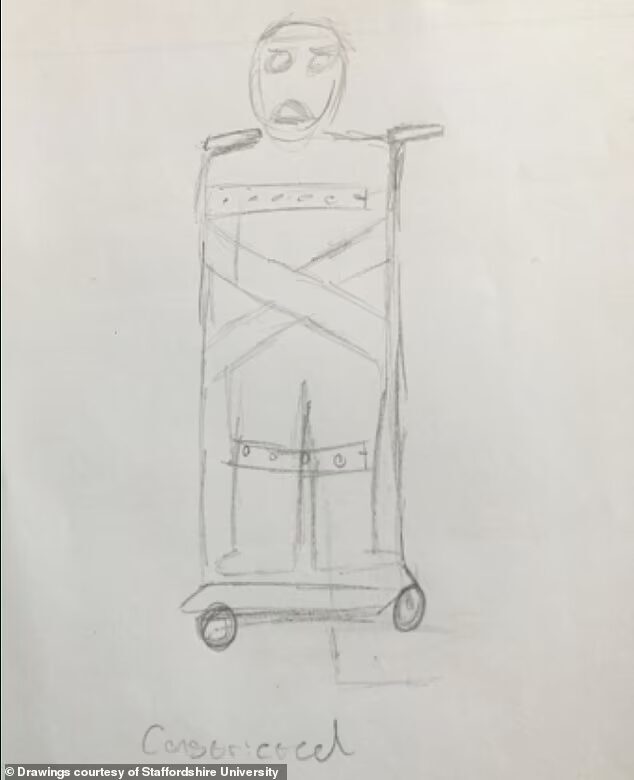
In a study by associate professor Dr Richard Jolley and colleagues, 68 children were asked to reflect on their experience during the Covid lockdowns through a drawing. One child drew a distressed figure with all four limbs strapped down to a bed and wrote 'constricted'.
In a study by Dr Richard Jolley and co-researchers Dr Sarah Rose, Dr Romina Vivaldi and Dr Claire Barlow, of Staffordshire University, 68 children between four and 14 were asked to reflect on their Covid experience and draw how it was making them think and feel.
One child drew a distressed figure with all four limbs strapped down to what looks like a hospital bed and wrote 'constricted'.
Another drew a personified Covid cell next to an upset image of themselves and captioned it: 'I think Covid is happy and he has stol my smile.'
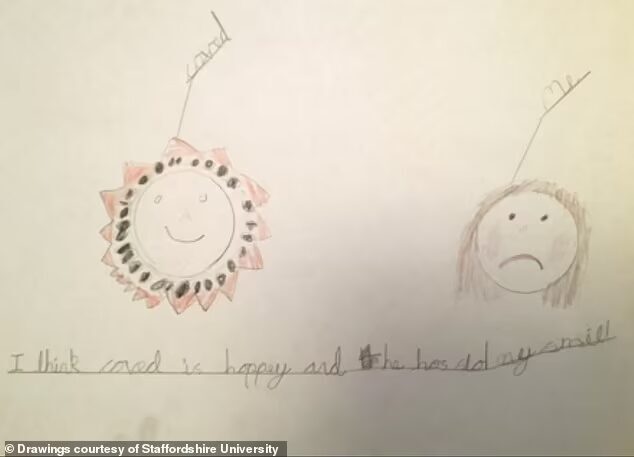
Another child drew a personified Covid cell next to an upset image of themselves and captioned it: 'I think Covid is happy and he has stol my smile'.
Meanwhile, other common themes included furniture and buildings while seven children presented death and loss in their work.
Dr Jolley, who carried out the study with his colleagues, told MailOnline: 'It really showed they knew what was happening.
'Unsurprisingly, they did communicate what we all were thinking about, in terms of our feelings and the separation [from] people, and what we weren't able to do [but also] what we were able to do.
'I think these drawings really reflected their own lives and what they thought they were facing and what they knew.'
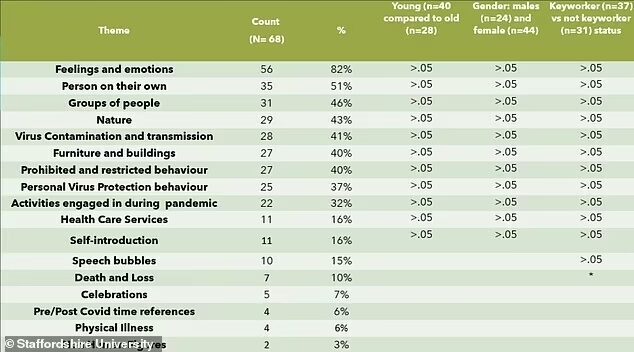
The study highlighted that impacts of the lockdowns on children included increased loneliness, reduced physical activity and decreased mental wellbeing.
Dr Jolley said it was important to provide children with a means of expressing themselves without having to make sense of things through language.
'We really wanted to hear the children's voice. Why did we want to hear it through pictures? Well, particularly for younger children, being able to draw what they feel out rather than try to verbalise it. Bear in mind we couldn't see the children face to face so it had to be done at a distance,' he said.
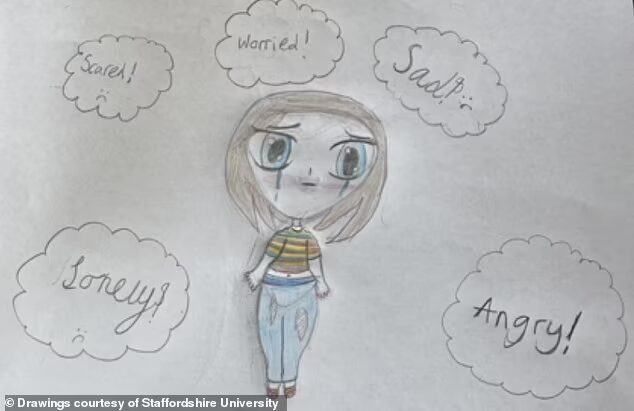
The study highlighted that the impacts of the lockdowns on children included increased loneliness, reduced physical activity and decreased mental wellbeing.
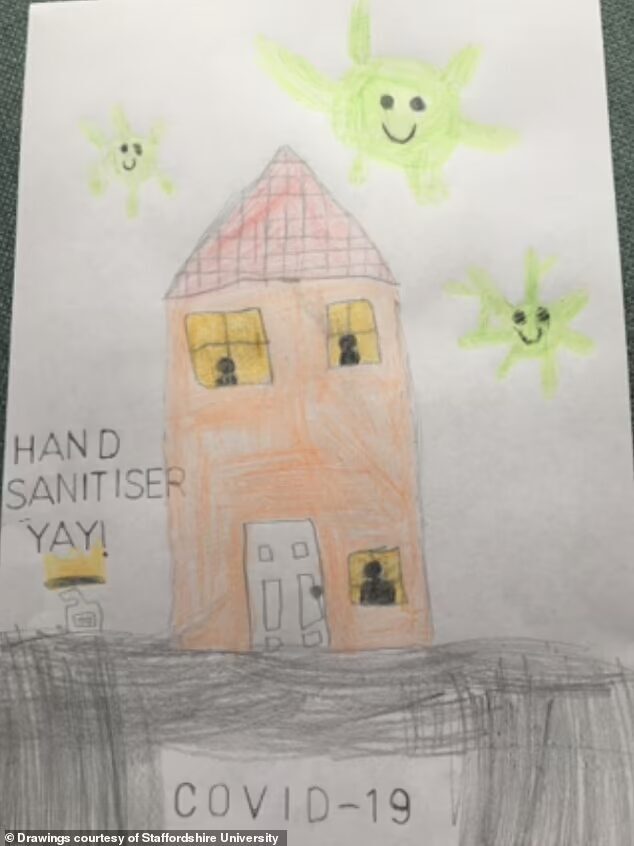
This child drew lonely silhouettes looking out of windows and personified germs surrounding a house.
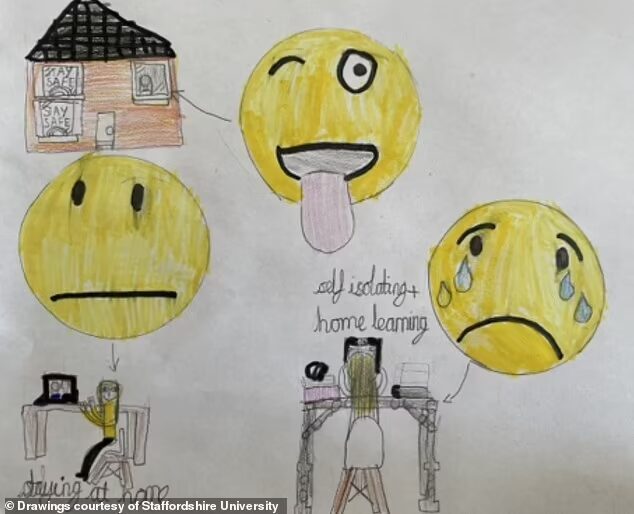
Dr Jolley added: 'This event for children really touched their feelings.
'They were prohibited, they were restricted - that's coming through.
'The premise of the project was that this was an unprecedented event and a very long...period for children, and we hadn't really had anything like it before.'
For further information on the project, Dr Jolley can be contacted by emailing r.jolley@staffs.ac.uk or calling 01782294887.






There is no need for children, with the new and improved scientific establishment now managing all the earth's resources, so very well.
Children do impose a very grave threat to this 'scientific establishment'.
They must be stopped.
ned....
......out