

© B. Ripperda et al., AJL, 2022A detail from the black hole simulation
That mystery was solved recently by a team of researchers that used a series of supercomputers to model the details of black holes' magnetic fields in far more detail than any previous effort. The simulations point to the breaking and remaking of super-strong magnetic fields as the source of the super-bright flares.
Scientists have known that black holes have powerful magnetic fields surrounding them for some time. Typically these are just one part of a complex dance of forces, material, and other phenomena that exist around a black hole.
That complex dance has been notoriously hard to model, even with advanced supercomputers, so trying to understand the details of what is happening around a black hole has proven exceptionally difficult.
Stronger computers can handle difficult computer problems, and, thanks to Moore's law, that is exactly what humanity has now.
Dr. Bart Ripperda, co-lead author of the study and a postdoctoral fellow at the Flatiron Institute and Princeton University, and his colleagues utilized three separate supercomputing clusters to produce the most detailed image of the physics going on outside a black hole event horizon.
Magnetic fields unsurprisingly played a major role in those physics. But more importantly, they played a critical role in developing flares. Specifically, flares formed when magnetic fields broke apart then rejoined back together.
The magnetic energy unleashed by these processes supercharges photons in the surrounding medium, and some of those photons get ejected straight into the black hole's event horizon, while others get ejected out into space in the form of flares.
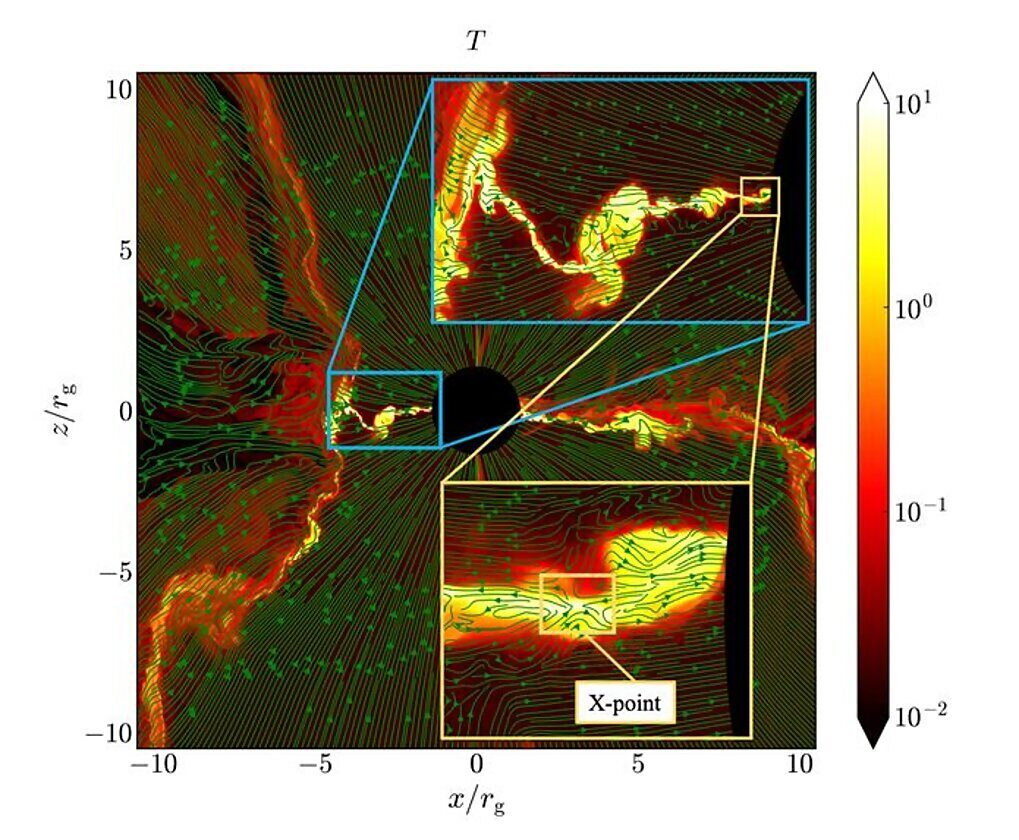
© B. Ripperda et al., Astrophysical Journal LettersSimulated black hole with magnetic field lines seen in green. Where they meet in specific patterns is sometimes the source of a flare.
The most accurate simulations in the world can't make up for an incorrect model, so previous simulations ignored basic features of black hole interactions.
With high resolution came greater understanding. The new simulations accurately modeled how the magnetic field process around the event horizon works.
First, the material collected in the accretion disk migrates towards the black hole's 'poles'. Migrating charged material like that is sure to affect magnetic field lines, which attempt to move with it.
Part of that movement process causes some of the magnetic field lines to break and potentially reconnect with a different field line. In some cases, a pocket of material is formed that is insulated from other external forces, but is eventually shot out towards the black hole itself or the rest of the Universe. This is where flares come from.
All those processes are difficult to simulate, even on a cluster of supercomputers. However, most simulations are built to fit the existing data the best.
Collecting data to test these simulations is still a long way off. But you can be sure that someone, somewhere, is already working on it.
More information: B. Ripperda, M. Liska, et al., Black Hole Flares: Ejection of Accreted Magnetic Flux through 3D Plasmoid-mediated Reconnection, 2022 January 14, The Astrophysical Journal Letters, Volume 924, Number 2











Black holes - I think they are full of viruses. And unicorns.