
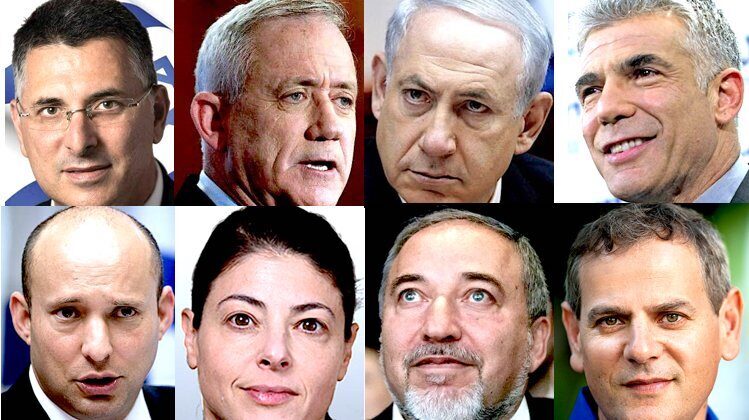
© Wikimedia Commons/picture-alliance/NurPhoto/Britanica/Miriam Alster/Flash90/Knesset.gov.il/Jackguez/AFP/Getty Images/Wikipedia/KJNTop: Gideon Sa'ar • Benny Gantz • Benjamin Netanyahu • Yair Lapid
Bottom: Naftali Bennett • Merav Michaeli • Avigdor Lieberman • Nitzan Horowitz
Bottom: Naftali Bennett • Merav Michaeli • Avigdor Lieberman • Nitzan Horowitz
Last-minute changes are still possible in the upcoming race for the Israeli parliament, especially given that both the left and the right are trying to create mergers, but the key players have already been outlined.
Here are the main elements that will take part in the race set for 23 March:
The Heavyweights
- Likud under Prime Minister Benjamin Netanyahu:
Its official campaign will likely capitalise on the party's domestic achievements including the launching of a mass vaccination programme that has already seen more than three million people inoculated, the intense gas drilling in the Mediterranean that is set to bring in billions of dollars in revenue to the Jewish state, and the launch of several big infrastructure projects.
On the international front, Netanyahu is likely to emphasize: that he is the only Israeli leader to have signed five normalisation agreements (with the UAE, Bahrain, Sudan, Morocco, and Kosovo), and he will also present himself as someone who can withstand pressure from the new US administration and who can combat Iran, the Jewish state's main rival.
Will Netanyahu manage to convince the Israeli public that he is the right person for the job? It's hard to tell, but several months ago a poll found that 41 percent of those asked believed he was the right fit for the position, as opposed to other players, who received much lower marks.
- New Hope under Gideon Sa'ar:
Although during his more than two decades in politics, he's filled a number of important posts, his name has never been associated with major reforms or overhauls.
Now, almost two months after the split, Sa'ar promises different leadership from what Israel has seen under Netanyahu.
Positioning himself as a man of his word, and a man who has always stayed away from corruption and shady deals, Sa'ar's campaign will highlight the difference between him and Netanyahu.
That won't be an ideological difference. Sa'ar is undoubtedly a hawkish politician and if elected he will stick to his conservative views which include the expansion of settlement activity and a hard line on the Palestinians. But he will present an alternative to what seems to be an allegedly corrupt government of Netanyahu and that might bring him 15 seats in the Knesset.
- Yesh Atid (Hebrew for There is Hope) under Yair Lapid:
This key player's mantra will be "No more Netanyahu", a tactic that has brought Lapid success in all previous rounds, even garnering him the title of Israel's opposition leader.
But he will also focus on reciting his promises of improving Israel's economy, health and education systems; its security, international standing and the protection of human rights.
In the past three election campaigns, Lapid managed to stick to his main promise and didn't budge under pressure, rejecting to sit in Netanyahu's government. But as the head of the opposition he failed to introduce reforms or improve people's lives and this is also the reason why his party has never managed to recreate its previous popularity that brought him 19 seats in 2013.
- Yamina under Naftali Bennett:
The outbreak of the coronavirus in late February changed that equation and Bennett soon positioned himself as a man who acts rather than talks. He was the one who toured towns and cities, inspected hospitals, and even established a professional coronavirus cabinet that united medical and economic experts to offer solutions to the current crises.
Will that be enough to secure a strong position in the next Israeli government? Current media polls predict that Yamina will be Israel's fourth-largest party with 12 seats and that it will be key to Netanyahu's re-election.
Secondary Players
- Ultra-Orthodox parties:
Neither of these parties presents a potential leader for PM. They are happy to take a secondary role as long as their interests are secured. And these include extensive funding for their religious institutions and status quo on matters relating to religion and the state.
- Yisrael Beitenu under Avigdor Lieberman:
He is unlikely to become the decisive factor in determining who will be Israel's next prime minister, as his party is projected to only get seven seats, but he will be the element that can prevent Netanyahu from forming a coalition.
- Labour under Merav Michaeli:
The way it stands now, the party is supposed to gain six seats in the Israeli parliament and local media believes the more spots it gets, the lower the chances of Netanyahu forming a government.
- Meretz under Nitzan Horowitz:
It won't play a major role in shaping Israel's domestic or international politics but it will boost the anti-Netanyahu bloc.
- Blue and White under Benny Gantz:
Yet, Gantz is not ready to give up. In the upcoming polls, he will try to pass the threshold and if he does, he is likely to enter the anti-Netanyahu bloc that might lead to Bibi's ouster.
- The Joint Arab List:
In the past, their union brought the list an unprecedented 15 seats in the parliament. Now their future looks bleak and reports suggest that Raam, which decided to break away from the union will not pass the threshold of 3.25 percent.
A similar fate will also await many other parties, who need to submit their official requests to participate by the end of Thursday.



It should be, "Israel's key players in upcoming polls: Parties come and go but feces remain unchanged"