
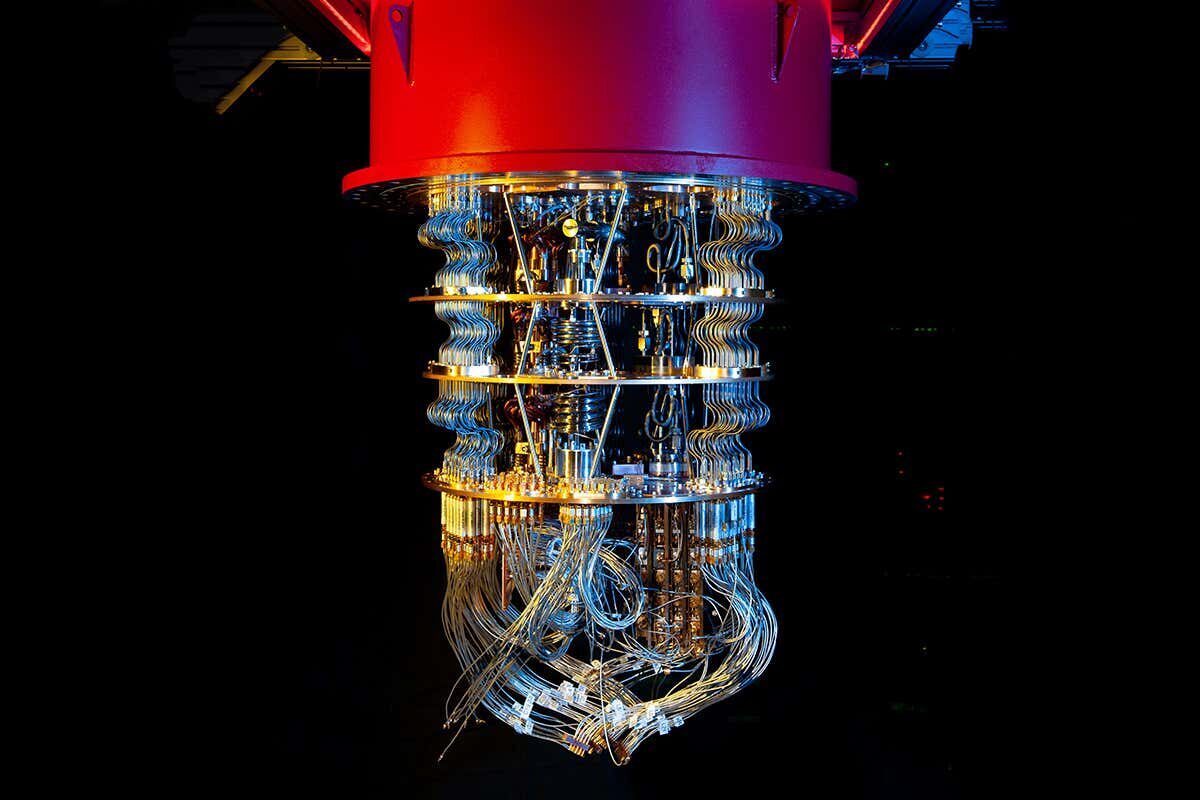
© JameA quantum computer at Google’s lab in California
Together with a team of collaborators, the Google AI Quantum team has used their 54 qubit quantum processor, Sycamore, to simulate changes in the configuration of a molecule called diazene.
As far as chemical reactions go, it's one of the simplest ones we know of. Diazene is little more than a couple of nitrogens linked in a double bond, each towing a hydrogen atom.
However, the quantum computer accurately described changes in the positions of hydrogen to form different diazene isomers. The team also used their system to arrive at an accurate description of the binding energy of hydrogen in increasingly bigger chains.

© WikimediaDiazene chemical structure
In some ways, it's the difference between knowing a casino will always make a profit, and predicting the outcomes of the individual games being played inside. Restricted to the predictable rules of classical computers, an ability to represent the infinite combinations of dice rolls and royal flushes of quantum physics has been just too hard.
Quantum computers, on the other hand, are constructed around these very same principles of quantum probability that govern chemistry on a fundamental level.
Logical units called qubits exist in a fuzzy state of 'either/or'. When combined with the 'maybe' states of other qubits in a system, it provides computer engineers with a unique way to carry out computations.
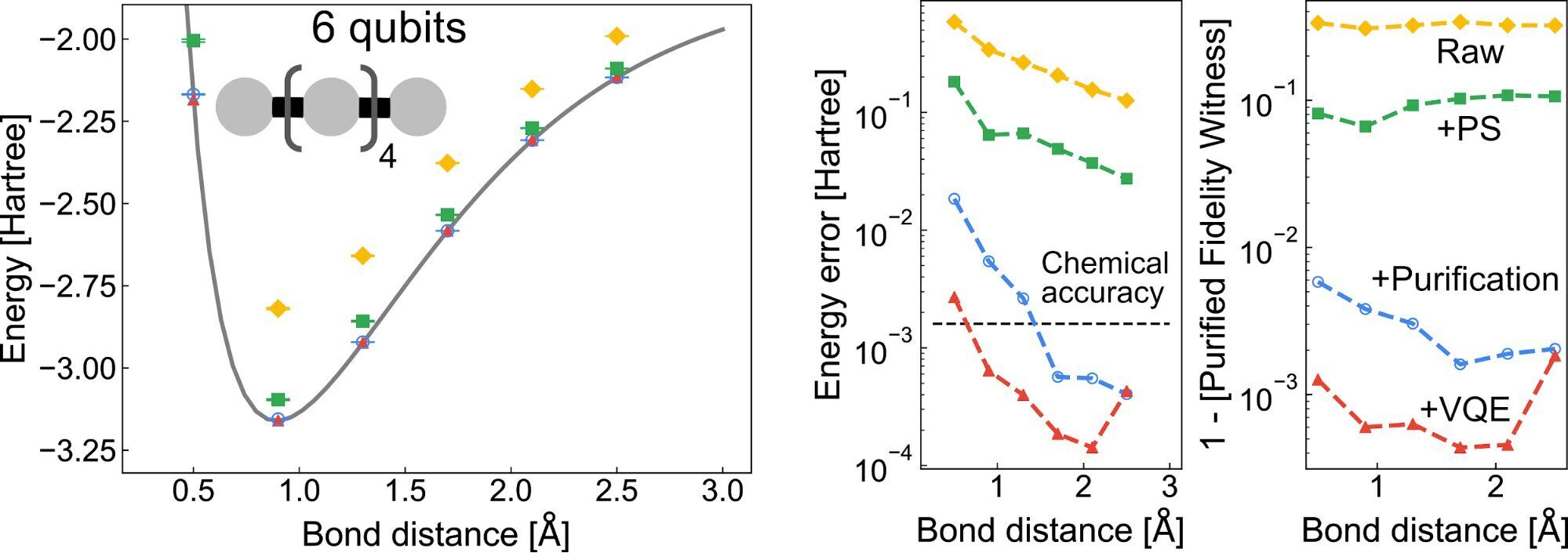
© GoogleLeft: The energy of a linear chain of Hydrogen atoms as the bond distance between each atom is increased. The solid line is the Hartree-Fock simulation with a classical computer while the points are computed with the Sycamore processor. Right: Two accuracy metrics (infidelity and mean absolute error) for each point computed with Sycamore. “Raw” is the non-error-mitigated data from Sycamore. “+PS” is data from a type of error mitigation correcting the number of electrons. “+Purification” is a type of error mitigation correcting for the right kind of state. “+VQE” is the combination of all the error mitigation along with variational relaxation of the circuit parameters. Experiments on H8, H10, and H12 show similar performance improvements upon error mitigation.
If we're to have a hope of modelling chemistry on a quantum level, we're going to need that kind of power, and some.
Just calculating the sum of actions that determine the energy in a molecule of propane would hypothetically take a supercomputer more than a week. But there's a world of difference between a snapshot of a molecule's energy, and calculating all the ways they might change.

© GoogleEnergy predictions of molecular geometries by the Hartree-Fock model simulated on 10 qubits of the Sycamore processor.
The team also pushed the limits on an algorithm designed to marry classical with quantum processes, one designed to iron out the errors that arise all too easily in the delicate world of quantum computing.
It all adds up to possibilities of increasingly bigger simulations in the future, helping us design more robust materials, sift out more effective pharmaceuticals, and even unlock more secrets of our Universe's quantum casino.
Diazene's wandering hydrogens is just the start of the kinds of chemistry we might soon be able to model in a quantum landscape.
This research was published in Science.
Mike McRae is a part-time Journalist at ScienceAlert. From classroom teacher to journalist, Mike has contributed to the CSIRO's magazines, The Guardian, the ABC, and Australian Financial Review, and joined ScienceAlert in 2016. He is the author of popular science books Tribal Science: Brains, Beliefs, and Bad ideas and Unwell: What Makes a Disease a Disease?, which reflect his strong passion for sociology and health.








willmight benefit you and I in the long runI work with high temperature reactions of organic chemicals and this ability to accurately predict not only energy levels but their biases (I am assuming) is amazing and will lead to reductions in emissions from recycling, energy from waste processes, smelting, you name it