
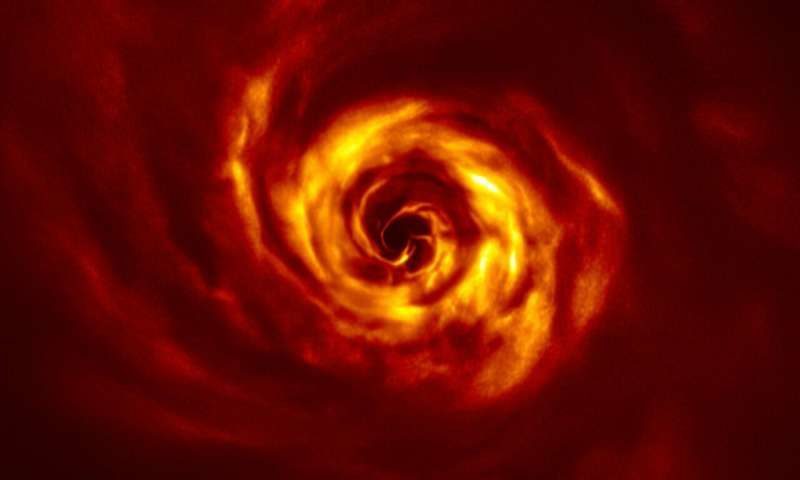
© ESO/Boccaletti et al.The disc around the young AB Aurigae star, where ESO's Very Large Telescope (VLT) has spotted signs of planet birth. Close to the centre of the image, in the inner region of the disc, we see the 'twist' (in very bright yellow) that scientists believe marks the spot where a planet is forming. This twist lies at about the same distance from the AB Aurigae star as Neptune from the Sun.The image was obtained with the VLT's SPHERE instrument in polarised light.
"Thousands of exoplanets have been identified so far, but little is known about how they form," says Anthony Boccaletti who led the study from the Observatoire de Paris, PSL University, France. Astronomers know planets are born in dusty discs surrounding young stars, like AB Aurigae, as cold gas and dust clump together. The new observations with ESO's VLT , published in Astronomy & Astrophysics, provide crucial clues to help scientists better understand this process.
"We need to observe very young systems to really capture the moment when planets form," says Boccaletti. But until now astronomers had been unable to take sufficiently sharp and deep images of these young discs to find the 'twist' that marks the spot where a baby planet may be coming to existence.
The new images feature a stunning spiral of dust and gas around AB Aurigae, located 520 light-years away from Earth in the constellation of Auriga (The Charioteer). Spirals of this type signal the presence of baby planets, which 'kick' the gas, creating "disturbances in the disc in the form of a wave, somewhat like the wake of a boat on a lake," explains Emmanuel Di Folco of the Astrophysics Laboratory of Bordeaux (LAB), France, who also participated in the study. As the planet rotates around the central star, this wave gets shaped into a spiral arm. The very bright yellow 'twist' region close to the centre of the new AB Aurigae image, which lies at about the same distance from the star as Neptune from the Sun, is one of these disturbance sites where the team believe a planet is being made.
This video starts by showing a wider-field view of the AB Aurigae system, and then zooms in to the inner part of the disc. This inner region includes the 'twist' (in very bright yellow) that scientists believe marks the spot where a planet is forming. This twist lies at about the same distance from the AB Aurigae star as Neptune from the Sun.
Observations of the AB Aurigae system made a few years ago with the Atacama Large Millimeter/submillimeter Array (ALMA, in which ESO is a partner, provided the first hints of ongoing planet formation around the star. In the ALMA images, scientists spotted two spiral arms of gas close to the star, lying within the disc's inner region. Then, in 2019 and early 2020, Boccaletti and a team of astronomers from France, Taiwan, the US and Belgium set out to capture a clearer picture by turning the SPHERE instrument on ESO's VLT in Chile toward the star. The SPHERE images are the deepest images of the AB Aurigae system obtained to date.
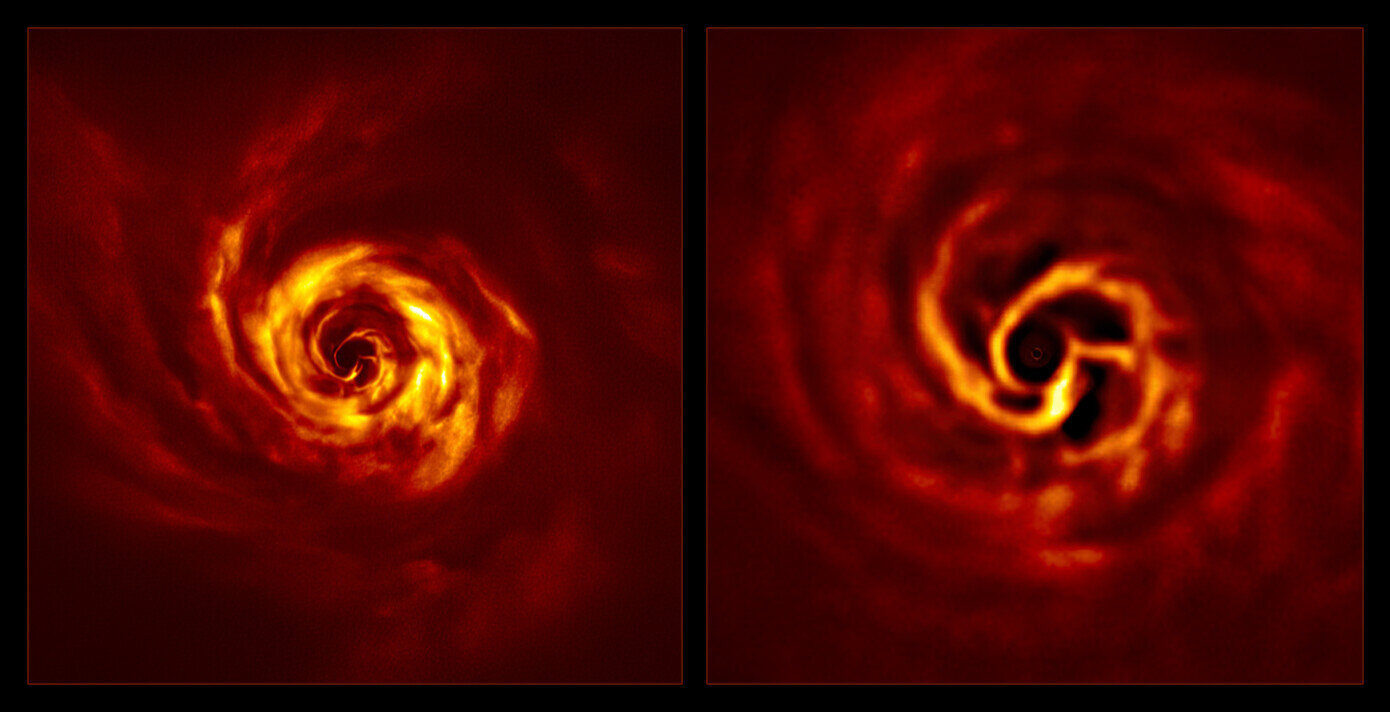
© ESO/Boccaletti et al.The image on the right, a zoomed-in version of the central part of the image on the left, shows the inner region of the disc. This inner region includes the 'twist' (in very bright yellow) that scientists believe marks the spot where a planet is forming. This twist lies at about the same distance from the AB Aurigae star as Neptune from the Sun.
ESO is constructing the 39-metre Extremely Large Telescope, which will draw on the cutting-edge work of ALMA and SPHERE to study extrasolar worlds. As Boccaletti explains, this powerful telescope will allow astronomers to get even more detailed views of planets in the making. "We should be able to see directly and more precisely how the dynamics of the gas contributes to the formation of planets," he concludes.
More information: Are we witnessing ongoing planet formation in AB Aurigae? A showcase of the SPHERE/ALMA synergy, Astronomy & Astrophysics (2020). www.aanda.org/10.1051/0004-6361/202038008



Reader Comments
to our Newsletter