
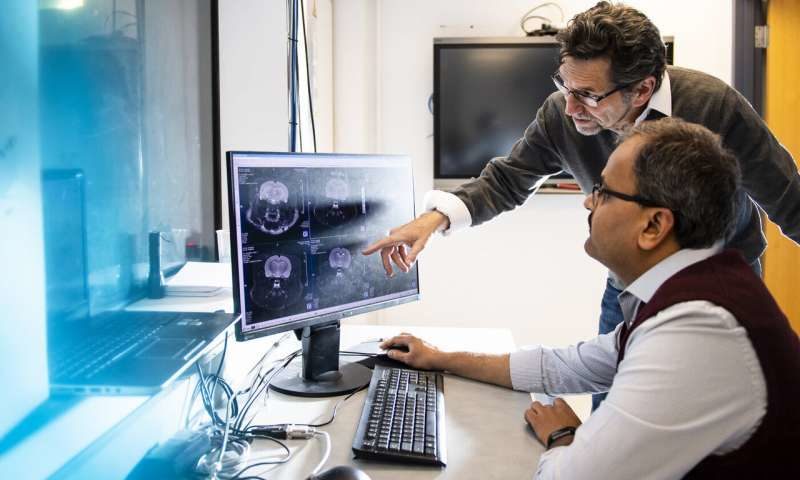
© Ruby Wallau/Northeastern UniversityPsychology professor Craig Ferris, Praveen Kulkarni, and their team oversaw the discovery of a rat that could see, hear, smell, and feel just like its peers, even though it was walking around with basically no brain.
This rat, named R222, did have a brain. But its brain, affected by a condition called hydrocephalus, had compressed and collapsed as it filled with fluid, and many of the functions that would ordinarily be carried out in the brain had relocalized to areas that weren't taken over by fluid.
This provided the tools for Ferris, a psychology professor at Northeastern, to investigate how powerful the brain remains, even when tight on space. This, he says, might even influence the ever-present goal of machine learning: How small can you be and still get the job done?
Pretty small, it turns out, at least in R222's case, but this efficient use of space is dependent on the brain's capacity to reorganize. This ability, known as neuroplasticity, is a widely documented phenomenon, but such an extreme example was rare, says Ferris.
In R222's case, he says, the processing of visual input "was distributed over much of the remaining brain, and the same thing with smell and touch." What at first the scans suggested to be a brainless rat was actually a rat with a brain that had been pushed out of the way and flattened like a pancake — and kept working.
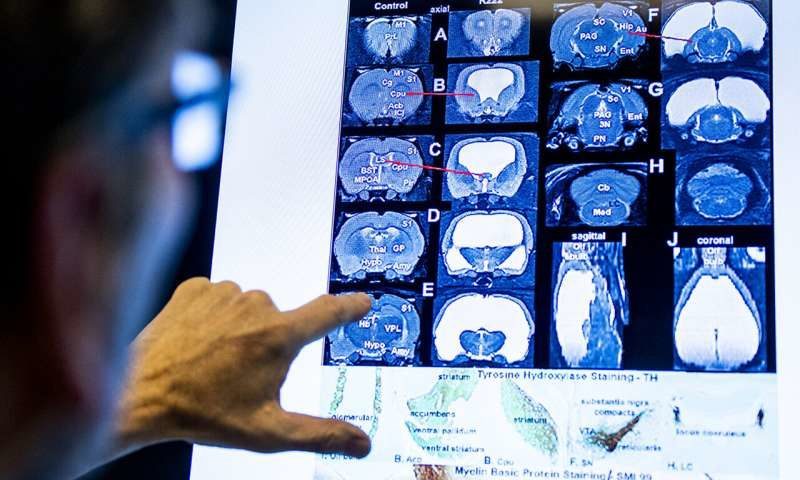
© Ruby Wallau/Northeastern UniversityCraig Ferris, professor of psychology, points at a scan of a normal rat's brain. In contrast, the important parts of R222's brain collapsed and relocated, concealing major glands and regions from even the most trained eye.
In Ferris's words, R222 was "one of nature's miracles," since living for two years (like living for more than 70 human years) is unlikely with such a severe deformity. Given that, he says, "we had this unique opportunity to try to understand how this animal survived," a feat made more impressive by the fact that R222 basically acted like any other rat: Successful adaptation to this extreme abnormality suggested the animal had it since birth.
First, though, the team had to measure just how similar R222 actually was to the other rats in the cohort. To assess memory, the researchers placed each animal in a Plexiglas box to observe how it responded to a new space and the objects within it. They then observed the rats navigating a maze in a further display of memory, as well as of spatial learning skills, and measured physical behavior as the animals walked a balance beam.
In all but one of these tasks, R222 performed just like the other rats.
The exception was exploring a novel environment — the other rats moved around and showed interest in their surroundings, and R222 stayed put. On its own, though, the latter behavior wouldn't indicate something debilitating, says Ferris; this failure to explore is common among anxious animals. So, beyond the possibility that it experienced heightened anxiety, R222 functioned normally — and, importantly, appeared normal on sight.
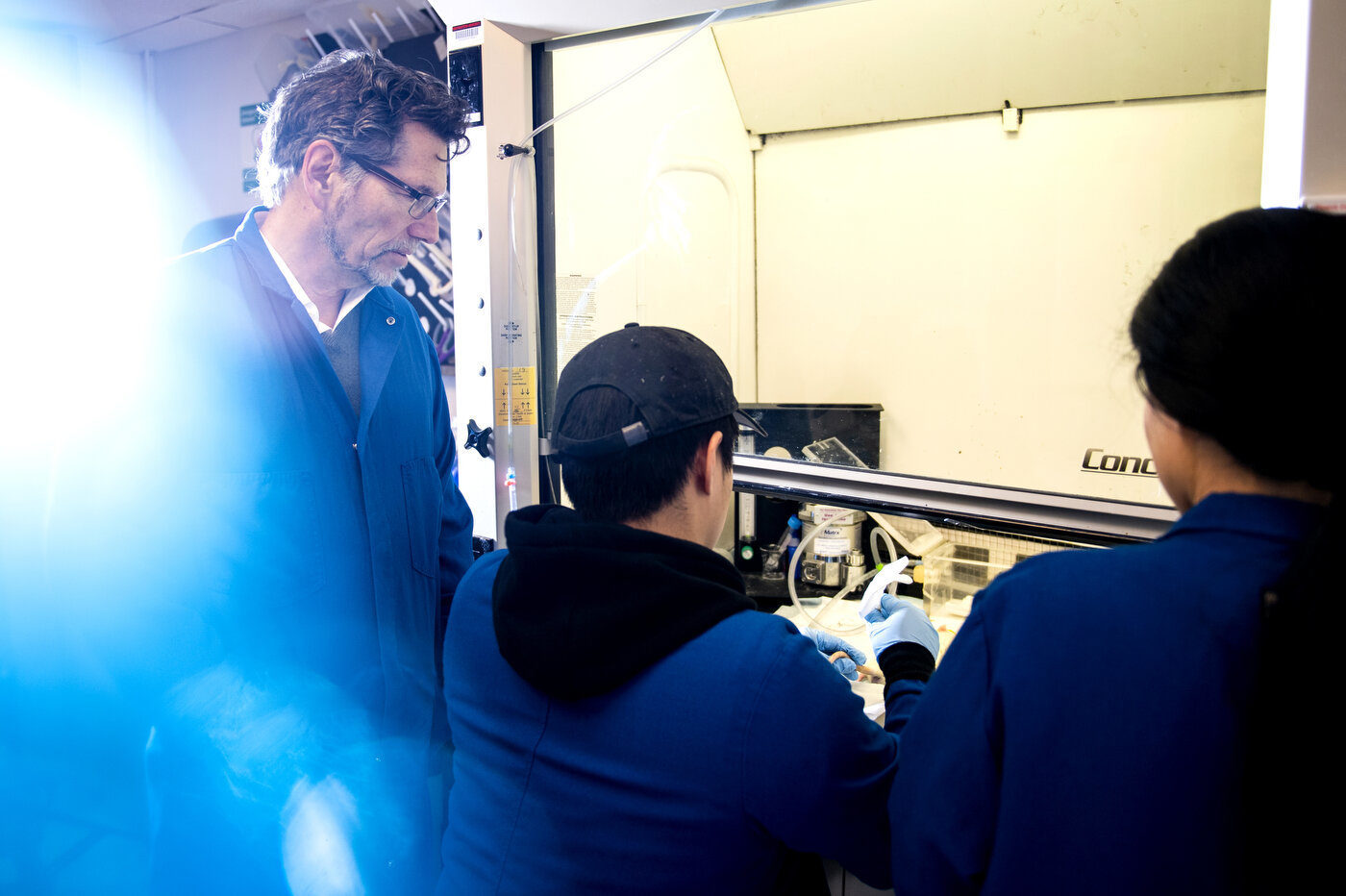
© Ruby Wallau/Northeastern UniversityIn the Center for Translational Neuroimaging, researchers study the brain’s role in disease. This includes aging, an area that became even more important to understand once the team received R222.
"The lower part of the brain stem had everything collapsed in it," says Ferris. "This animal just defaulted to what evolution gave it in the beginning, along with all the other animals, to help it survive."
For rats, that's enough; as Ferris says, "most of their life is spent working through their nose." But could humans, too, get by with less brain power?
It's possible, says Ferris. In fact, in a case to which Ferris and his coauthors make reference in their study, a neurologist found that having an IQ of 126 and a brain that's mostly fluid aren't mutually exclusive.
"One of the things I always get a kick out of is the hubris that we have about how highly organized our brain is — and how complex it is," Ferris says. "We've really focused so much attention on the cortex, and here you have these cases where you can almost eliminate the cortex — large portions of it — and it's not making a heck of a lot of difference."
More information: C. F. Ferris et al. Life without a brain: Neuroradiological and behavioral evidence of neuroplasticity necessary to sustain brain function in the face of severe hydrocephalus, Scientific Reports (2019). DOI: 10.1038/s41598-019-53042-3
Journal information: Scientific Reports











Comment: As detailed in the article Man living with 90% of his brain missing similar discoveries have been made in humans: See also:
- Science as we know it can't explain consciousness
- The 'hard problem' of consciousness - Could consciousness all come down to the way things vibrate?
- Cosmopsychism: Is the universe a conscious mind?
- Are brain injuries a hidden cause of criminal behavior?
Also check out SOTT radio's: