
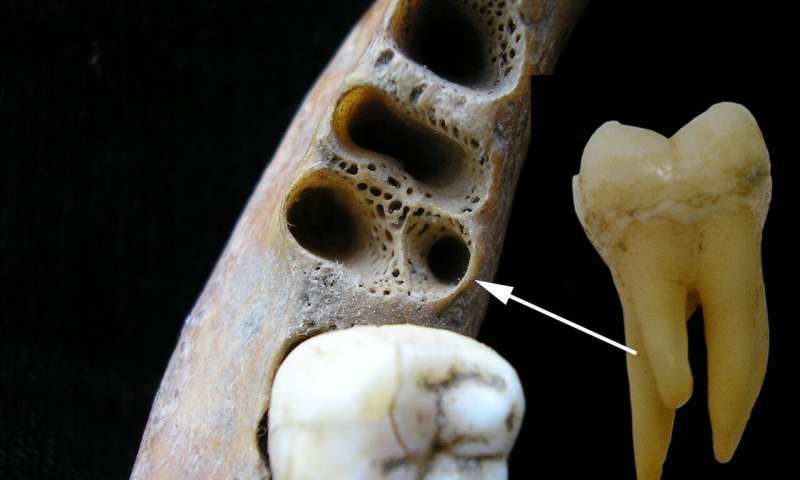
© Christen LeeThe three-rooted lower molar anomaly in a recent Asian individual. Left: tooth sockets showing position of accessory root; right: three-rooted lower first molar tooth. Credit: Christine Lee
The new research points to a different evolutionary path.
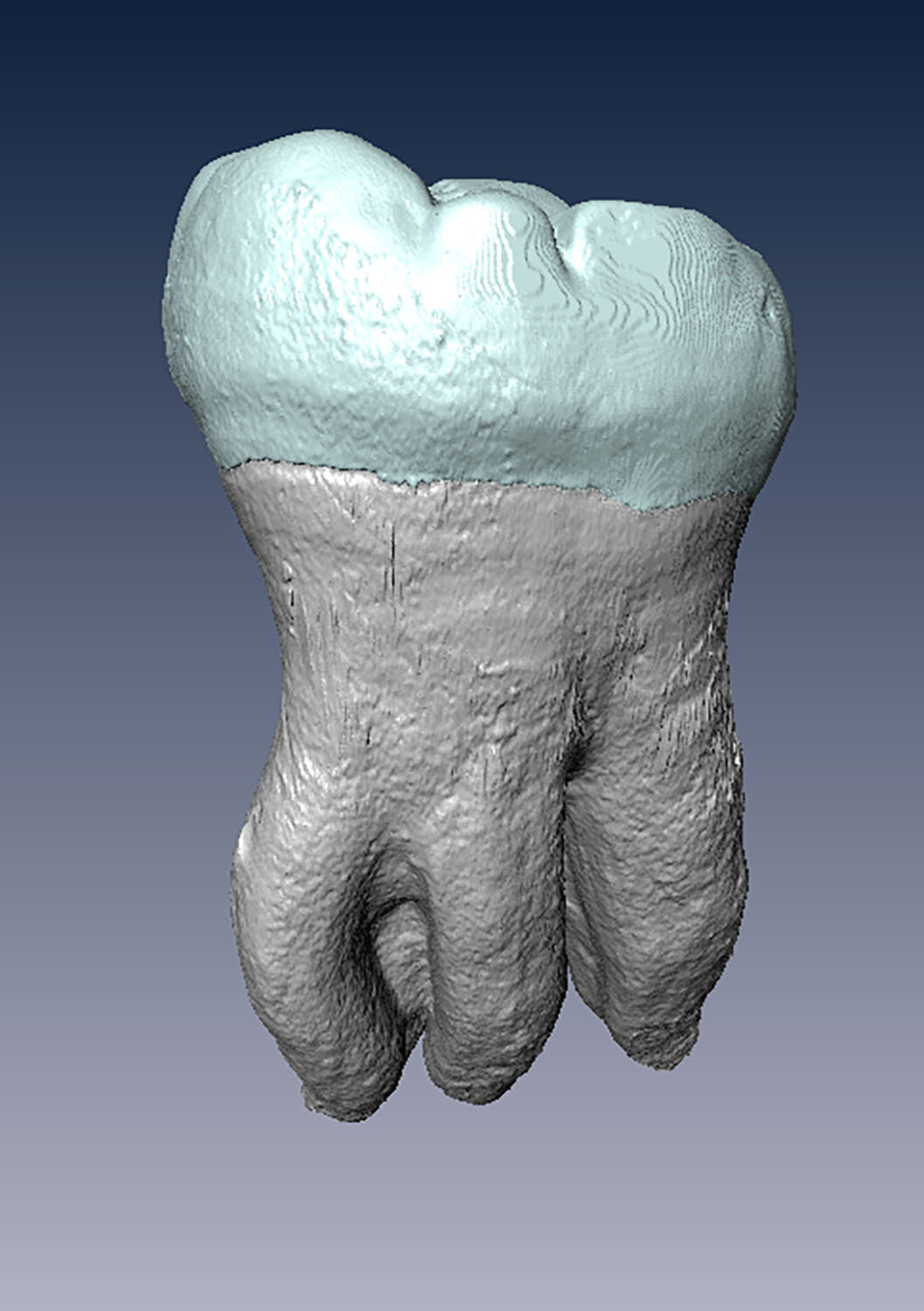
© Max Planck instituteThree-rooted lower second molar of Xiahe Denisovan individual. Credit: The Max Planck Institute
In a previous study, published in Nature, Bailey and her colleagues concluded that the Denisovans occupied the Tibetan Plateau long before Homo sapiens arrived in the region.
That work, along with the new PNAS analysis, focused on a hominin lower mandible found on the Tibetan Plateau in Baishiya Karst Cave in Xiahe, China in 1980.
The PNAS study, which also included NYU anthropologist Susan Antón and Jean-Jacques Hublin, director of the Department of Human Evolution at the Max Planck Institute for Evolutionary Anthropology, centered on the molar, with the aim of understanding the relationship between archaic humans who occupied Asia more than 160,000 years ago and modern Asians.
"In Asia, there have long been claims for continuity between archaic and modern humans because of some shared traits," observes Bailey. "But many of those traits are primitive or are not unique to Asians. However, the three-rooted lower molar trait is unique to Asian groups. Its presence in a 160,000-year-old archaic human in Asia strongly suggests the trait was transferred to H. sapiens in the region through interbreeding with archaic humans in Asia."



Comment: See more