
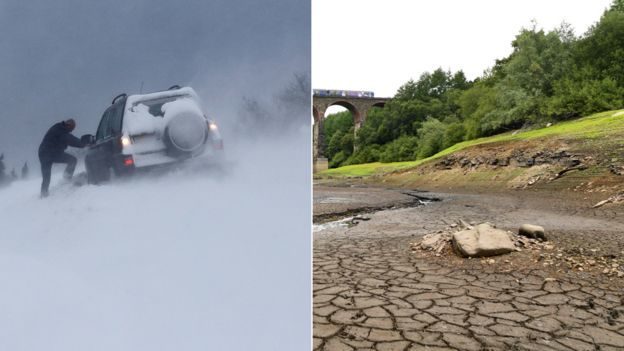
© REUTERS/PAThe UK's cold, wet winter was followed by the driest start to a summer on record
Consultancy CEBR said 2018's big freeze and heatwave would end up costing consumers about £7 extra per month.
It follows price warnings from farmers' representatives about peas, lettuces and potatoes.
Wholesale prices of other vegetables have already soared by up to 80% since the start of the year.
But the Centre for Economics and Business Research (CEBR) explained that these increases can take up to 18 months to fully have an effect on shoppers.
"So, while the worst of the recent heat may have passed, the cost to consumers looks set to climb," it warned.
The UK saw record temperatures in June, July and August which caused widespread drought and crop failures.
This, along with a "wet, cold and challenging" winter, particularly the cold spell caused by the Beast from the East, has put stress on farming costs and yields, CEBR said.
As a result, it said:
- Wholesale vegetable prices had jumped between March and July, with onion prices up 41%, carrots by 80%, and wheat for bread by a fifth
- The farm gate price of butter has climbed 24% since March, as hot weather hampered grass growth for grazing.
- Meat prices are set to rise due to a shortage of livestock feed.
'Effectively bare'
Tod Bulmer from Kenyon Hall Farm near Warrington said yields from his fruit and cereal harvest had been half of what he would normally expect.
He told BBC Radio 4's Today programme that the potential price rise would compensate "a little bit but not enough".
He added that the low yields meant dairy farmers were having to pay more for their feed.
National Farmers' Union president Minette Batters said the shelves for feeding livestock were "effectively bare" and that dairy farmers were having to rely on silage meant for winter use.
"Many farmers are looking at £60,000 of added costs," she said.
She added that she was still waiting on the government to deliver on a promise to take action.
Following a drought summit earlier this month with the NFU, Environment Secretary Michael Gove said the government would do "whatever it takes" to maintain food supplies.
Earlier this month, the Agriculture and Horticulture Development Board warned that livestock and vegetable prices would be a "little bit higher right the way through until next spring" because of weather issues.
Shortages of vegetables also helped drive food price inflation to 1.6% in July - up from the 1.2% in May and June, according to the British Retail Consortium and Nielsen.
A spokeswoman for the Department of Environment, Food and Rural Affairs said: "Food prices are affected by a number of factors aside from the weather, such as fuel costs, international commodity markets and exchange rates."
She said steps had been taken to help those affected, including allowing farmers to take more water from reservoirs and providing flexibility on funding.
She added that the hot weather had helped boost products such as soft fruits and wine.
But the CEBR said there was bad news for wine fans too, as severe hailstorms in the French wine regions of Bordeaux, Champagne and Cognac "have eliminated millions of bottles of product".



Comment: Farmers around the world are facing an endless torrent of extreme weather, from brutal cold and record breaking rainfall that delay planting, devastating drought that lead to lower yield, or destructive hail and early frost that completely decimate the crop:
- Price of potatoes to soar 900% in Belgium as drought and high temps kill crops
- "A threat to our livelihood": Record drought grips Germany's breadbasket
- Unusually cold winter and spring have Koreans worried about rocketing food costs
- Unprecedented drought in the Korea's kills 29 people, millions of livestock and decimates crops
- 70% crop losses due to extreme weather in Australia
- Italian farmers predict crop shortage because of heavy rains while El Niño causes Peru's grape exports to drop 11%
- Erratic seasons and extreme weather devastating crops around the world
- 'This is a crisis' - Unusually brutal winter doubles farmers' costs and endangers cattle in Montana
As more crops fail the likelihood of food price rises invariably increases. It is always best to be prepared. See also:- Daily habits of prepared people
- Preparedness is the ultimate act of optimism
- Are you prepping your diet?
- A good way to invest your money: Store large amounts of food, like now
- Top threats to your life when the SHTF and how to prepare for them
And do have a listen to the SOTT Talk Radio show that was devoted to this subject:Surviving the End of the World (as we Know it)