
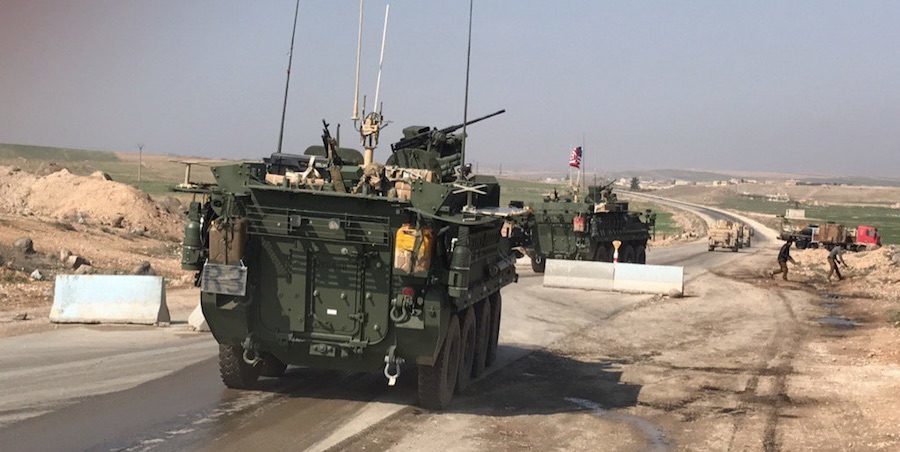
- This has been mentioned repeatedly: despite officially supporting Syria's territorial integrity, unofficially they try to strike back for their strategic failure at toppling al-Assad's government, which was unsuccessful mainly thanks to Russia and Iran. Washington repeatedly voiced its dissatisfaction with the way war in Syria went, along with anxieties regarding the consequences for the US, Israel and Saudi Arabia concerning the growing role of Russia and Iran in the region.
- The White House does not state this officially, as the US understands the tenuity of its positions in Syria, because as far as international law is concerned, this is just another case of US aggression against a sovereign state. On the other hand, the US couldn't care less about international law and sovereignty other than its own. But some things shouldn't be said as they are out loud or you'll look bad. You have to camouflage what you say, like inviting the unrecognized government of Rojava or inventing a non-existent UN permission to invade. The reporting mentioned above is useful because it demonstrates real US intentions, and not declarative ones. This is useful because it shows there is no point in hoping that the US wants to negotiate and offer "goodwill".
- Russia has led an informational and diplomatic campaign with the intent of driving the US forces out of Syria. The accusations by Russia's Ministry of Foreign Affairs and Ministry of Defense are officially supported by Syria. Turkey and are also interested in driving out the Americans out of Syria because the US is the main obstacle to ending the war. Besides having common goals linked to keeping al-Assad in power and keeping Syria's territory intact, Turkey and Iran pursue their own goals. Iran wants to secure the Shi'ite bridge between Tehran and Beirut (which may be hindered by the Syrian Kurdistan project), and Erdogan wants to weaken Kurdistan Workers' Party and stop the Syrian Kurdistan from forming under control of Kurdistan Workers' Party-affiliated organizations. Nobody wants to go to a full-fledged war with the US, but the now popular hybrid wars leave many avenues of combating the hegemon.
- For now, the main strategy is involving reasonable Kurdish Rojava leaders in the conversation, so that the Kurds will be represented in the negotiations allowing them to find contact points with al-Assad regarding the future of the Kurds as a part of Syria. That's why Russia put a stop to Erdogan's ambitious plans regarding Afrin and tries to persuade Turkey that the Kurds can be negotiated with. Nothing bad will come out of sitting with the Kurds, when you already sit down with much more radical organizations, which are considered "moderate terrorists" due to current political climate. Compared to them, some Kurdish groups are much more reasonable and legal, but only until the situation escalates past the point of no return.
- If negotiations with the Kurds fall through and the US is successful in cultivating Kurdish separatism, then Plan B comes into action. This entails pressuring the Kurds with the following:
- Syria, Turkey and Iraq can block the oil exports from Rojava, and ban imports to it, the very same threats previously used for trying to keep Iraqi Kurdistan in line. The US won't be able to provide Rojava with all necessary supplies by air.
- The Kurdish-Arab conflict can be escalated on the territories under the Kurdish control with the majorly Arab populace. This will sow disarray in Rojava, with possible creation of SDF opposed forces.
- The Kurdish groups involved in the US plans can be designated as terrorist organizations (this will also lead to improving Russia's and Syria's relations with Turkey).
- Russia can stop protecting Afrin. Iran and Iraq can block the border crossing at Faysh Khabur and cut economic and logistic ties between Iraqi Kurdistan and Rojava.
- The Syrian Army and Shi'ite units can do a repeat of Iraqi Kurdistan: they will make a deal with the reasonable organizations, and unreasonable ones will be crushed like Barzani.
- The final solution: they can "release the Kraken" by letting the Turkish Army into Rojava under the pretense of "fighting terrorism". This is an undesirable option, as it would make "friend Recep" stronger, but it isn't out of the question completely.
So far, Russia and friends are trying to persuade the Kurds that they shouldn't follow Barzani's example and risk a scenario they will regret. They can yell "America is with us" and photograph girls holding assault rifles all they want. When push comes to shove, the situation will escalate to a conflict completely out of the Kurds' depth. As far as the US is concerned, the Kurds are only a means to an end. This is a fact Washington doesn't even hide anymore. The US wants to use the Kurds as fuel for the continuation of the war in Syria. They have no concern over the losses experienced by the Kurds.
It would be best for everyone, including the Kurds, if Russia can make the Kurdish chiefs see the things the way Russia sees the situation. If al-Assad and Erdogan soften their stances regarding the Kurdish question, they may find a compromise that would satisfy all sides.
We'll see whether or not this is possible in 2018. Russia is not interested in prolonging the Syrian war. Moscow's efforts in Syria has demonstrated quite the opposite. Their successes should be secured diplomatically as soon as possible. The US will try to hinder progress in this direction. This conflict demonstrates that despite the military collapse of ISIS, Syria still has a lot of problems that will have to be solved with the help of Iran and Turkey. But nobody said it would be easy.
Originally appeared at colonelcassad blog. Translated from Russian.


Reader Comments