

© Sputnik/Igor BoykoReproduction of Atlantis painting (1979) by artist Vladimir Smirnov.
The latest survey was released this week, and for the first time a clear majority of American now professes to believe in a lost Ice Age civilization similar to Atlantis. Across the board, fringe history beliefs reached new heights. People write to me all the time to ask why I bother to talk about "crazy" topics like aliens and Atlantis. I am flabbergasted to report now that it is because more Americans now believe in Atlantis than do not.
The 2017 Chapman University Survey of American Fears Wave 4 found that 55% of Americans believe in Atlantis or another lost ancient super-civilization. Additionally, 35% now believe space aliens visited ancient people in the past. Such figures are simply astonishing, even after accounting for the fact that technically speaking Atlantis and aliens are not "paranormal" per se.
The numbers are unprecedented in reputable surveying, but they are the culmination of a clear upward trend. The numbers are growing compared to the 2016 and 2015 surveys, as the chart below shows:
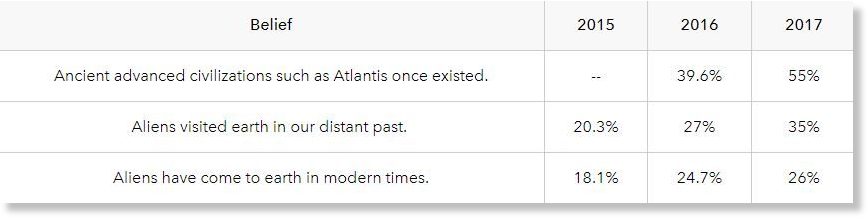
The usual caveats apply, of course: Some of the questions are a bit ambiguous and might include some who have different definitions of "advanced" civilizations, or who imagine that a single vacationing alien stopped by Earth in the Carboniferous period.
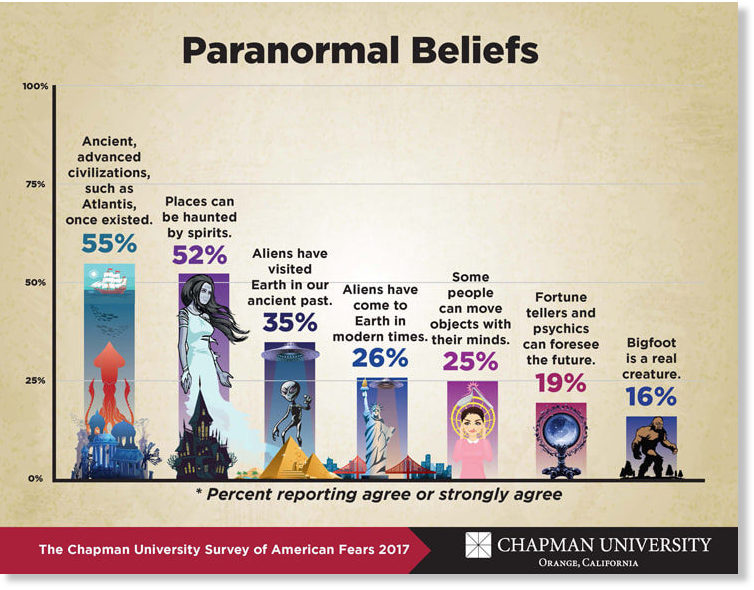
This raises the question of why the number of believers seems to be rising in a time when the number of cable TV shows devoted to ancient astronauts and lost civilizations has declined markedly from their 2011-2013 peak, and when even major book releases in the category, such as Magicians of the Gods, were relative disappointments. Surely 48 million Americans didn't suddenly develop a belief in Atlantis between 2016 and 2017. If they did, I do not want to live in a country where that many people are that easily influenced. That leaves us with a few potential answers. The survey might be flawed, oversampling believers each year. Or believers are more comfortable expressing their beliefs now than in past years, perhaps due to the rise of fake news and "alternative facts."
Or maybe the internet is actually radicalizing the public, and fringe claims spread through social media and via Putin's ancient astronaut and lost civilization propaganda in outlets like Sputnik and RT is succeeding in destabilizing public belief in the authority of science.
Comment: It's rather ridiculous for the author to both call Russia's news outlets "propaganda" and for him to put their news content squarely on Putin's shoulders. He appears to be totally brainwashed by Western fake media outlets who portray Putin as some supreme leader who has to time to direct all news that comes out of Sputnik and RT. Get a grip! People believing in ancient civilizations and alien visitations to Earth doesn't "destabilize public belief in the authority of science", it merely means that science has not adequately dealt with these issues. If public belief in the authority of science is waning, it's because science is corrupted and people realize that they are sick of being told lies that don't hold up to historical and archaeological scrutiny.
It seems difficult to imagine that tens of millions of people suddenly developed a belief in Atlantis, but whatever the cause, even if the survey over-counts believers by huge margins, the numbers are simply stunning. Fringe history is no longer fringe by volume, only by logic and reason, which is not really enough.
As in the past, Chapman University found that believers tend to be lower income, rural, and conservative-i.e., the History Channel's and Destination America's audience. Overall, women and racial minorities are more likely to believe in the paranormal, but because the results weren't broken down by question, we can't say whether there is a racial or gender difference between different beliefs.
I will confess to being shocked that a Graham Hancock-style lost civilization is now an accepted fact among a majority of Americans. I should not be, however. Anecdotally, it aligns with my own experiences. Most people I encounter who try to strike up conversations with me profess beliefs in either Atlantis or ancient astronauts, and it seems that this is not a fluke, only a total failure of public education and science advocacy.




Comment: The author calls the growing beliefs of Americans in Atlantis or aliens as a "total failure of public education and science advocacy", so clearly he thinks these ideas are nonsense. But what the other misses is that science has so far been totally unable to explain the discrepancies in what scientists and historians tell us about human's ancient past, and what the actual records and evidence shows. He is clearly invested in the official historical narrative, but as can be seen a majority of Americans no longer believe that the official story is the truth. That is not a failure, it is a testament to peoples' ability to think for themselves and ignore what "experts" and authority figures tell them. See also: