
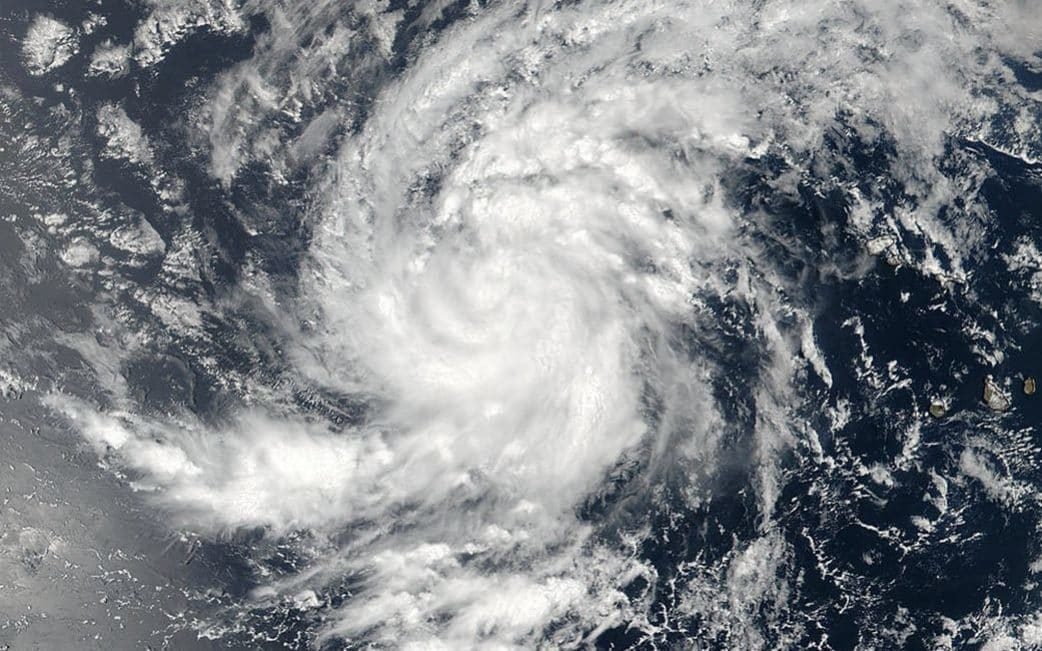
© NASAA handout photo made available by NASA shows an image acquired by the joint NASA/NOAA Suomi National Polar-orbiting Partnership (NPP) satellite of then Tropical Storm Irma in the Eastern Atlantic Ocean, on 30 August 2017
Such explosive strengthening is known as "rapid intensification," defined by the National Hurricane Center as having its wind speed increase at least 30 knots (35 mph) in 24 hours. "Irma has become an impressive hurricane," the National Hurricane Center said on Thursday, noting the rapid intensification, and saying "this is a remarkable 50 knot [58 mph] increase from yesterday at this time."
Hurricane Harvey underwent rapid intensification last week, just before landfall, which brought it from a tropical storm to a Category 4 hurricane when it moved onshore near Corpus Christi.Irma is a classic "Cape Verde hurricane," a type of hurricane that forms in the far eastern Atlantic, near the Cape Verde Islands (now known as the Cabo Verde Islands) and tracks all the way across the Atlantic.
Cape Verde storms frequently are some of the largest and most intense hurricanes. Examples are Hurricane Hugo, Hurricane Floyd, and Hurricane Ivan. Hurricane Irma is forecast to continue to strengthen as it moves westward over the next five days and the official forecast from the National Hurricane Center puts a dangerous Category 4 Hurricane Irma on the doorstep of the Caribbean by the end of the five-day forecast on Tuesday afternoon.
A strong high-pressure ridge to the north of Irma, over the Atlantic, is steering the storm to the west and limiting the wind shear in the upper levels of the atmosphere, which has allowed the storm to grow so quickly. Wind shear is like hurricane kryptonite, and prevents storms from forming or gaining strength. Unfortunately, Irma will remain in a low-shear environment for the next several days, so there isn't much hope that Irma will weaken any time soon.
There is considerable confidence that Hurricane Irma will track to the west through the weekend and then take a slight jog to the southwest early next week in response "to a building ridge [of high pressure] over the central Atlantic." From there the forecast becomes a lot less clear, with some major differences among some of the key models meteorologists use to forecast hurricanes, differences so drastic that in one instance Irma slides harmlessly back out to sea and in another it makes multiple disastrous landfalls in the Caribbean and likely the United States after that. The European model, or ECMWF, and the American GFS model have had some notable showdowns before, most notably with Hurricane Sandy.
With Sandy, the ECMWF correctly predicted a landfall in the northeast nearly a week ahead, while the GFS continually kept the storm offshore in what became a major black eye for the US weather modeling industry. There have been other examples where the GFS model has performed better than the European model, such as with a few major snowstorms in the northeast.Right now, the GFS has Irma taking a more northerly track that curves to the north before it reaches the Caribbean, thus making a US landfall much less likely. The European model keeps the storm tracking further west and into the Caribbean by the middle of next week.








Comment: Images of Irma's possible path:
Irma's path is still uncertain - normal for hurricanes while they're still traversing the Atlantic towards the coast. On average, there's a 194-mile margin of error in five-day forecasts. As usual, predictions are only as good as the models and initial conditions used to produce them. And no model is perfect. For example, here are the predicted tracks from Sept. 1st (NOAA):
Update (Sept. 3)
The Weather Channel reports that Irma has strengthened into a Category 3 hurricane. Additional strengthening is expected as Irma moves westward in the week ahead. Irma will move close to the Leeward Islands and Puerto Rico by the middle of this week, and then near or north of Hispaniola, the Turks and Caicos and Bahamas late week into next weekend.
One such fake forecast has been shared on social media almost 40,000 times. The official NOAA emblem was cut and pasted to make it look genuine. It depicts Irma's predicted path to impact the U.S.