

© Natural News
To understand the legal deficiencies in the organizational structure of the Clinton Foundation (the legal name of which is the "Bill, Hillary & Chelsea Clinton Foundation," hereafter "CF") it is necessary to consider (A) two types of corporate governance documents:
- Articles of Incorporation (originally filed with the AR Secty of State in 1997, AofI)
- Bylaws (Byl)
- State of Arkansas
- US Federal Law (IRS regulations, but also its policies as well as such instructions and conditions the IRS imposed on CF in making its initial determination of CF's status as what is known as a 501c3 non-profit).
Arkansas Corporate Law
As is typical of the corporate law of most states in the US, the corporate law of Arkansas allows for a corporation to be organized in a variety of ways and using a variety of terms in its organizational documents. Nevertheless, it is necessary for a corporation to have articles of incorporation filed with the Secretary of State, including any amendments thereto. As is typical of the corporate law of most states, a corporation is not required to specify much in its articles of incorporation and can rely on (a) statutory provisions to be deemed applicable to the corporation and/or (b) adopt bylaws providing such specifics as to board of director configuration (including subcommittees), officer appointments and such other organization matters as its incorporators or other duly authorized corporate officials deem appropriate.
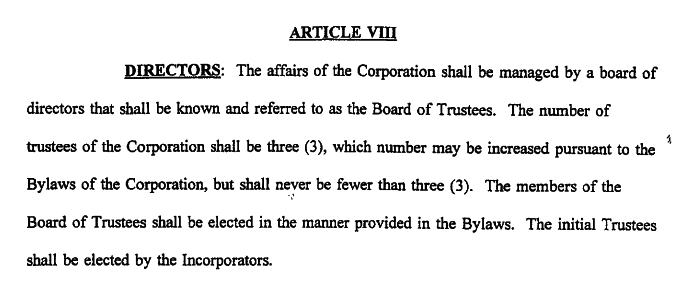
Notwithstanding that it was not required to do so, in its AofI, CF specified that it would have a board of directors that would be referred to as a Board of Trustees and specified that it would intially have three Trustees, but that though such number could be increased, it would never be fewer than three:
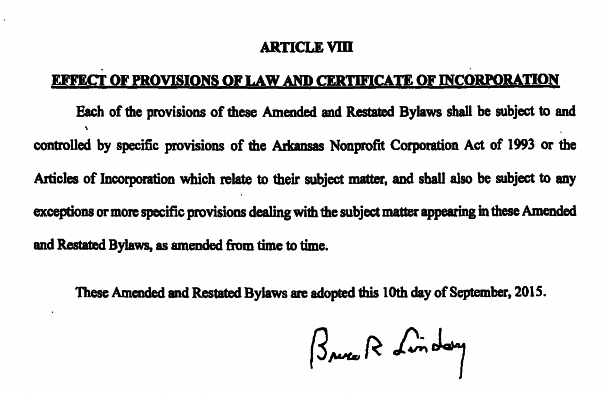
On June 27, 2017 CF filed its amended and restated bylaws with the State of NY (the A&R Byl). It is not clear what prompted this filing. It was possibly in response to an article in the Daily Caller on June 25, 2017 that publicized the fact that CF had changed its bylaws and disclosed such changes to other states; it is reasonable to speculate this led to an inquiry from NY state officials as to why such filing had not been made in NY since CF in fact has its corporate headquarters there. It is otherwise difficult to explain what prompted such a filing since the amendment and restatement dates from September 10, 2015:
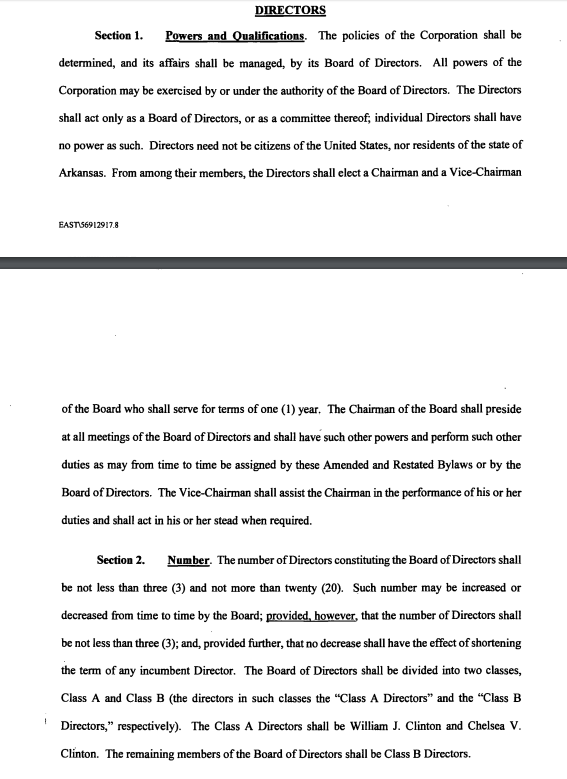
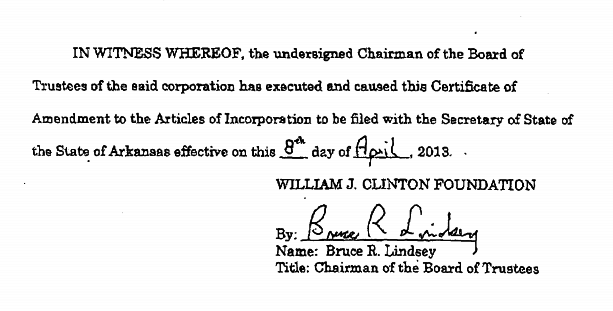
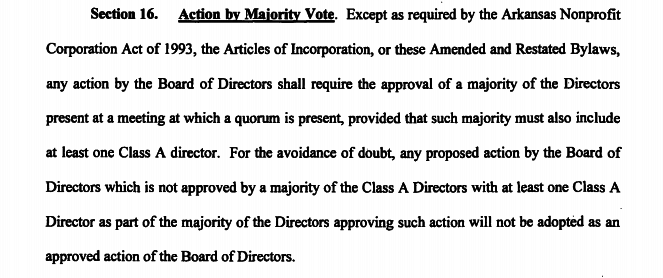
Because it is possible that the apparent problem (i) with the terminology "directors" versus "trustees" had been addressed in an amendment of the AoI that has not been disclosed it is not worth dwelling on that issue for now. By contrast, the problem (ii) with the Class A/B is significant. For regardless of how many Class B directors there are, the Class A directors have veto power over most significant actions by CF. This effectively results in a Board of Directors that consists not of three, but two 'directors' or 'trustees.'
See the provision for majority voting with the proviso that at least on Class A director votes:
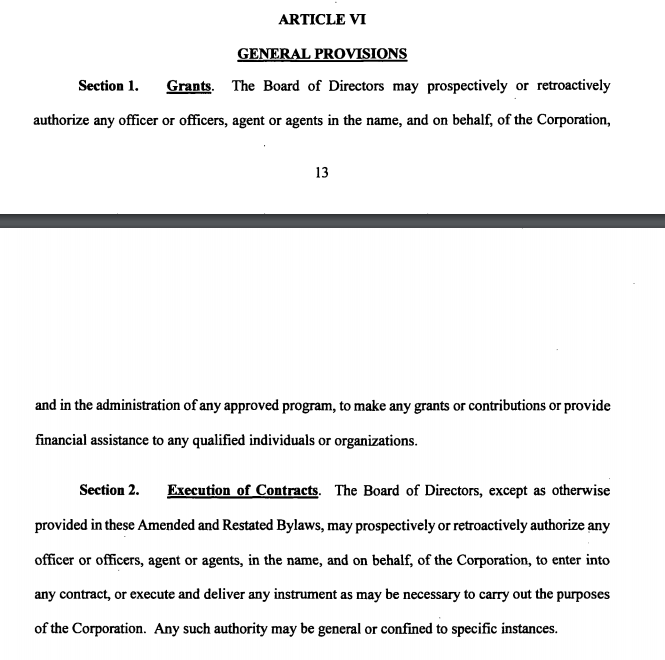
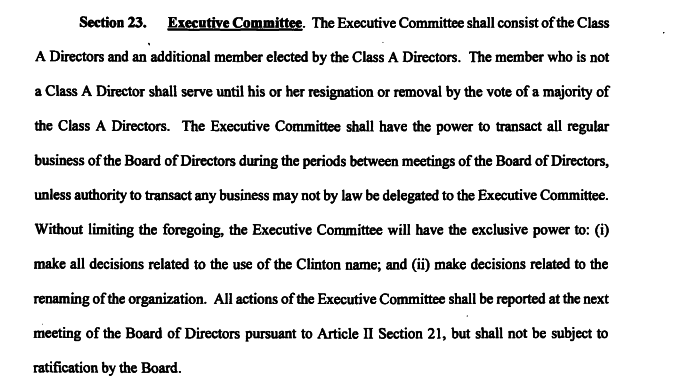
The power given to the Executive Committee (which consists only of Clinton family members (Bill & Chelsea) and a director appointed by a Class A director) essentially means CF is run by the Clinton family (note the final clause of Section 23 "not be subject to ratification" (emphasis mine: the "not" implies that even "retroactive authorization" is not necessary):
This is especially troubling given the unusual provision regarding gifts:

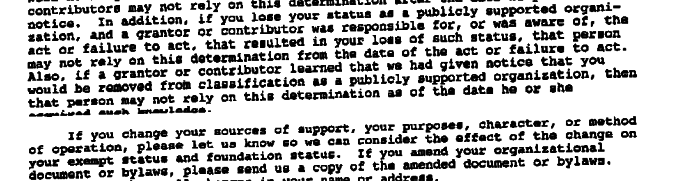
Quite apart from the substantive provisions of the A&R Byl, the apparent failure to amend the AoI to change the name of the Board of Trustees as well as the apparent failure to allow the IRS to review the A&R Byl could be used to argue that CF does not provide the limitation of liability a corporation otherwise can provide and/or that its corporate form does not satisfy relevant standards and provisions the IRS deems applicable in its determination of the non-profit status of a corporation. While the Board changes the A&R Byl purports to make by themselves do not appear to violate applicable law, it is apparent that such changes effectively constitute an amendment to the AoI. Such an amendment would have been required to be filed in AR. It therefore appears that CF used the bylaws as a mechanism to avoid disclosing the changes it was making.
Indepedent of the foregoing analysis regarding the motivation for using the bylaws to evade applicable diclosure requirements, the substantive provisions of the A&R Byl effectively merge the corporate identity of CF with that of Bill Clinton and his daughter. Such a merger of identity is all but acknowledged by the penultimate sentence of Section 23 cited above regarding the use of the Clinton name (query how this is to be interpreted given Hillary Clinton's presidential campaign) and the renaming of CF. The reality is thus that CF not only does not deserve to be considered a non-profit corporation, it does not even deserve to be considered a corporation.




Comment: Patricia Negron : "The Clinton Foundation has never been a legally registered entity. Other foundations that have made gifts to it are obligated to ask for their money back or they will be liable for the taxes due, penalties & interest."