
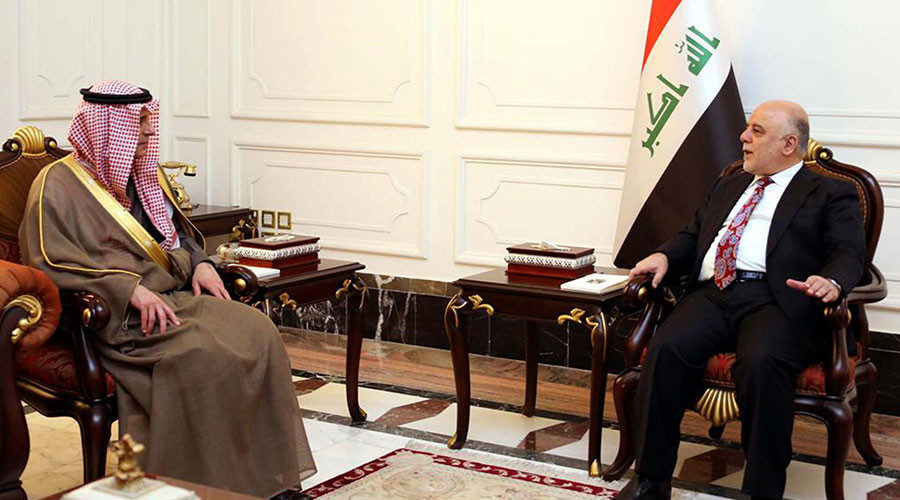
© HO / AFPIraqi Prime Minister Haidar al-Abadi (R) meeting with Saudi Foreign Minister Adel al-Jubeir in Baghdad.
During his trip, Jubeir met with Iraqi Prime Minister Haider al-Abadi and Foreign Minister Ibrahim al-Jaafari.
The visiting Saudi official congratulated Iraq "on the victories achieved against Daesh (Arabic acronym for Islamic State, formerly ISIS/ISIL) and pledged Saudi Arabia's support to Iraq in fighting terrorism," a statement by the Iraqi PM's office said, as cited by AFP.
Jubeir also said that Riyadh was ready to assist Baghdad in maintaining stability in areas already liberated from the terrorists.
Iraqi forces, backed by the US-led coalition, are currently storming the main IS stronghold in the country, Mosul, retaking the city's airport earlier this week.
The Saudi minister praised Baghdad for its international stance, saying that "the whole region is heading toward compromise and Saudi Arabia sees Iraq as an important player to have on its side."
"Iraq's neutrality could [lay the ground] for Iranian-Saudi rapprochement," Jubeir said, according to the statement.
Saudi Arabia and Iran have been main geopolitical rivals for decades as the Sunni and Shia nations struggle for the leading role in the Arab world.
Riyadh and Tehran currently have no diplomatic relations after they were severed when Iranian protestors demolished two Saudi missions in the country in January 2016.
The Saudi minister also complemented al-Abadi as the PM "never indulged in aggressive rhetoric against Saudi Arabia."
Jubeir held talks with his Iraqi counterpart, al-Jaafari, who stressed that the current visit was "the first by a Saudi foreign minister since 2003" when Saddam Hussein was toppled.
In Baghdad, the top Saudi diplomat announced that Riyadh is planning to appoint a new ambassador to Iraq.
Saudi Arabia reopened its embassy in Baghdad after a 25-year break in 2015, but its first ambassador, Thamer al-Sabhan, was asked to leave shortly afterward. Al-Sabhan angered local politicians and militia leaders by commenting about Iranian meddling in Iraqi affairs and alleged persecution of Sunnis in the country.



Reader Comments
Watch out Iraq, these are slime bags your dealing with, who are seeking the subjugation of your sovereignty, male no mistake.
Hang on a sec there. I was under the impression the Saudis were supporting and paying ISIS ???? Something seriously smells with this approachment IMHO.
And claiming " [lay the ground] for Iranian-Saudi rapprochement ," Is this guy for real ???
The whole World knows of Saudi complicity in the evil attacks against Iran over the last 20 years or so, and now out of the blue, this creep claims they seek "rapproachment" ?
I hope the Iranians have got someone watching their backs, as should the Iraqis as well, whilst the "rapproachment" is underway, the knife slips between the shoulder blades easily.
Things the don’t teach you in any schools …
Shakyamuni offering fruit to the devil (from the life of the Buddha) from The Jami‘ al-Tawarikh of Rashid al-Din [Link]
Rashid al-Din Fadlallah ( circa 645–718 AH/ 1247–1318 AD) was a Muslim convert from a Jewish family in Hamadan. His father was an apothecary and he himself trained as a physician, entering the service of the Ilkhan Abaqa (r 1265–1282). On Ghazan’s accession in 694 AH (1295 AD), he gained an enduring position at the summit of state affairs, until rivalry provoked by the Mongol system of dividing power among viziers led to his disgrace and execution in 1318. Enormously rich, Rashid al-Din Fadlallah endowed pious institutions throughout the Ilkhanid domains. Among these, his multi-functional funerary complex, the Rab‘-i Rashidi, at Tabriz, which included a scriptorium to produce and distribute copies of his works, was the most splendid. Yet he was not merely a great administrator: his interests included theology, agriculture, horticulture and especially history, and he was commanded by Ghazan to compile a history of his reign. This was presented to his successor, Öljeytü (r 1304–1316), who commanded him, as a memorial to Ghazan, to enlarge the work to provide a history of all the peoples with whom the Mongols had come into contact.This was the Jami‘ al-Tawarikh (‘Compendium of Chronicles’), which was to be in four parts: (1) the history of the Mongols from Jenghiz Khan to the death of Ghazan; (2) a history of Öljeytü, followed by a long universal history from Adam, the biblical patriarchs and the ancient kings of Persia to the Prophet Muhammad and the caliphs; (3) the ‘Five Dynasties’ of the Arabs, the Jews, the Mongols, the Franks and the Chinese; and (4) a geographical compendium. The history of Öljeytü and the geographical compendium are lost, and the principal illustrated section appears to have been the world history, now in two different fascicles (one in Edinburgh University Library, the other the Khalili manuscript), which were haphazardly rebound in the 18th century. Together they comprise about half a manuscript of 400 folios or so, recording the history of the non-Mongol peoples of Eurasia. The very possibility of its compilation reflects the cosmopolitan culture of early14th-century Tabriz, where texts in Latin, Arabic, Persian, Syriac, Mongolian, Chinese and Sanskrit were available and everything from Chinese handscrolls to Old Testaments and Gospels from northern Europe could be used as appropriate illustrative material.Interestingly, for some of the scenes from the life of the Prophet Muhammad, the painters had recourse to adaptations of Christian scenes, which suggests that illustrated copies of the life of the Prophet may not have been available. They made great use of chinoiserie motifs, and their use of wash and line rather than opaque watercolour gives a superficial similarity to recently excavated Yuan tomb-paintings in Inner Mongolia. However, their elongated figures, expressive features and mannered gestures are more in the tradition of later Byzantine painting. The use of silver (now oxidised) for the modelling of faces and their features is likewise very un-Chinese.
Why don’t the Fraudi’s & Israhell have conflict ?
Why does Israhell use a Lunar calendar vs. a Solar calendar ? Why does Hebrew & Arabic write from the right vs. the left side ? [Link]
Schools are for Fish in a Mason’s Jar.
The esoteric system is all based upon the ultimate motive. Ultimate motive is the service of truth itself, a complete dedication to the service of the realities of existence.
Man's status in the natural world is determined, therefore, by the quality of his thinking.
Wisdom is given to no man until he asks for it.