
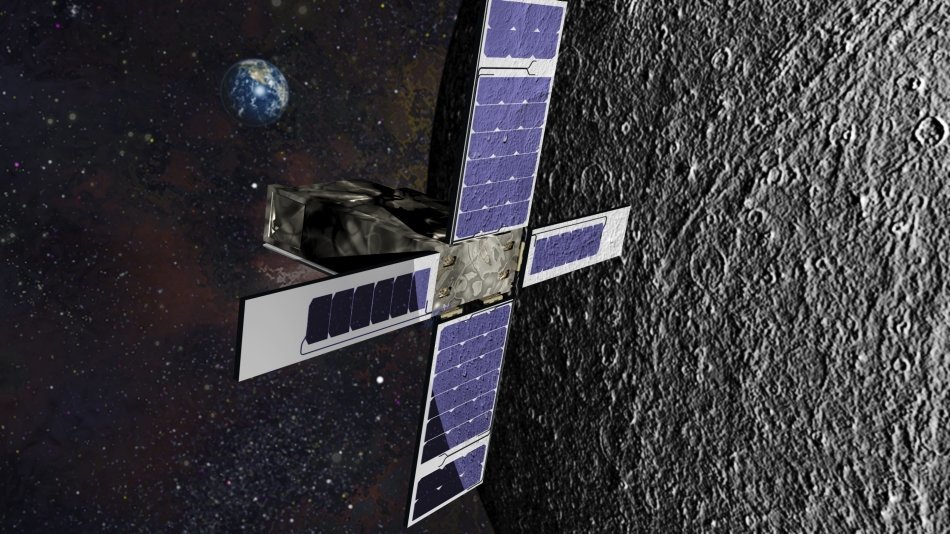
© lockheedmartin.comArtistic rendering of the SkyFire cubesat orbiting the moon.
On Monday, Lockheed announced that NASA has given final approval for SkyFire, securing its slot aboard the first Exploration Mission (EM-1). The primary mission, scheduled for September 2018, will be a test of NASA's Space Launch System (SLS) and the Orion Multi-Purpose Crew Vehicle. SkyFire and other "cubesats" will be part of the secondary payload.
Also known as U-class spacecraft, "cubesats" are space probes that consist of one or more 10-centimeter (3.9 inch) cubes.
"SkyFire's lunar flyby will pioneer brand new infrared technology, enabling scientists to fill strategic gaps in lunar knowledge that have implications for future human space exploration," John Ringelberg, Lockheed Martin's SkyFire project manager, said in a statement.
"The CubeSat will look for specific lunar characteristics like solar illumination areas," added James Russell, principal investigator on the SkyFire program. "We'll be able to see new things with sensors that are less costly to make and send to space."
If the technology proves successful, SkyFire could be used as a cost-effective probe to analyze other planets before human explorers arrive - from analyzing soil conditions to figuring out the most livable location and the best landing sites, the Bethesda, Maryland-based company said.
The focus on inexpensive mini-satellites is somewhat of a departure for Lockheed Martin, known as a mammoth military contractor behind such mega-projects as the $1.5 trillion F-35 Lightning II Joint Strike Fighter or the $362 million Freedom-class Littoral Combat Ship. Most of the development team is drawn from "early-career engineers in partnership with the University of Colorado Boulder," Lockheed noted in the statement.
SkyFire is the result of public-private partnerships NASA has been developing as part of its NextSTEP (Space Technologies for Exploration Partnerships) program.




First of all the name: Skyfire? Where is that coming from? Ya know people, they tell you things and names aren't accidental and neither is this one. Now expect a gullible explanation for that name, obviously, but that aside pay attention to what it's implying.
Connect the dots, they are there I assure you, I assure you, and you're not going to like what you see if you can
bring yourselves to see it. Let's wake up a little and ask real questions as opposed to gulping down pig swill for a change.
"SkyFire is the result of public-private partnerships NASA has been developing." Really? How so?
Needs expansion. What public partnership? Private tax free organizations hence free looting of the public treasury?
Unclear what this means and where the money is coming from. Big old hole there. These things don't just happen.
There's a lot of money and R&D going into micro satellites. Now why? I mean really why? Look at what the article says; "SkyFire could be used as a cost-effective probe to analyze other planets before human explorers arrive."
What a load of stinking diapers. Could be a cost effective: What costs? Refer back to the bottomless pockets here.
Like they care what it costs. It isn't about money or we would be seeking out contractors on Youtube for homebrewed plywood and duct tape models. It's about something else, now what is it?
The big lie, what a whopper this one is, and yet again it's telling you....it's telling you....