
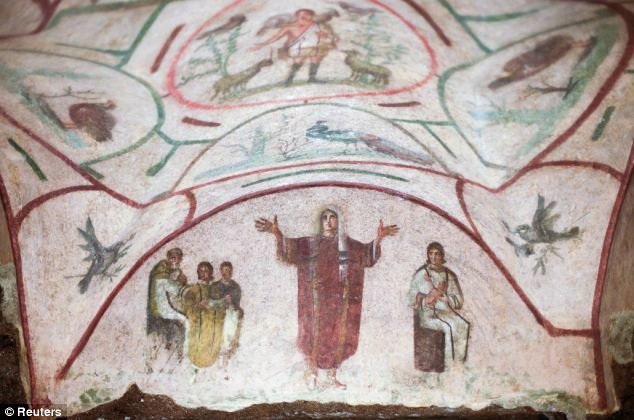
Newly restored Italian frescoes have revealed what could have been women priests in the early Christian church. The female pictured in this fresco has her arms outstretched as if holding Mass.
The frescoes, dating back to between 230 to 240 AD, are housed inside the Catacombs of Priscilla of Rome and were unveiled by the Vatican this week.
Proponents of a female priesthood have said that the frescoes prove there were women priests in early Christianity.
The Vatican, however, has responded by saying that such assertions are sensationalist 'fairy tales'.
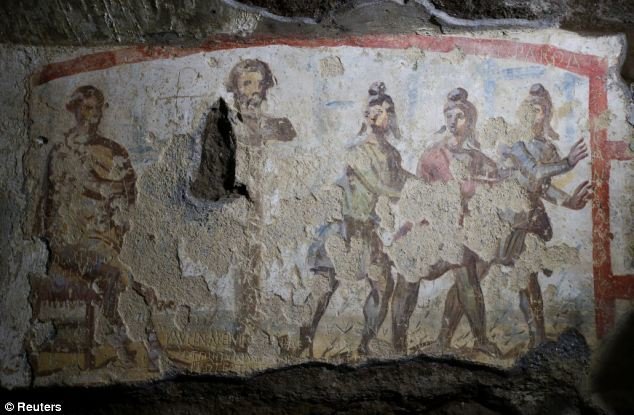
A fresco depicting women celebrating the Eucharist is pictured inside the catacomb of Priscilla in Rome. The catacomb, used for Christian burials from the late 2nd century through to the 4th century, reopened on Tuesday to the public after years of restoration.
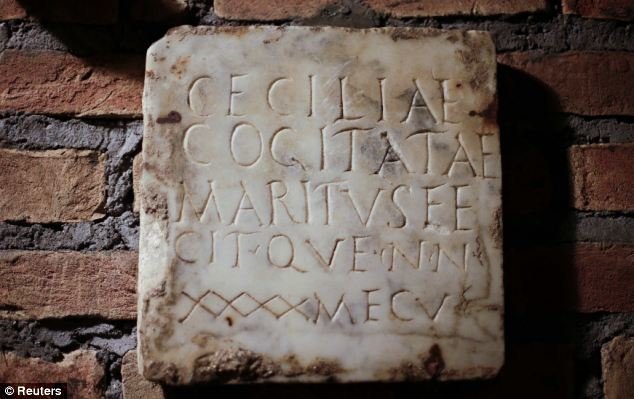
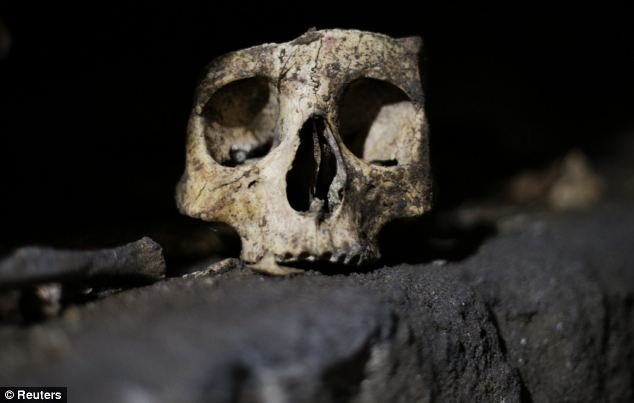
A skull is pictured inside the catacomb of Priscilla in Rome. Lost for centuries after its entrances were sealed in ancient time, the catacombs were re-discovered in the 16th century and plundered of many gravestones, sarcophagi and bodies.
Cardinal Gianfranco Ravasi, the Vatican's culture minister, opened the 'Cubicle of Lazzaro' which is a tiny burial chamber featuring 4th century images of biblical scenes, the Apostles Peter and Paul, and one of the early Romans buried there in bunk-bed-like stacks as was common in antiquity.
More controversially, the catacomb has two scenes said by proponents of the women's ordination movement to show women priests.
One fresco in the ochre-hued Greek Chapel features a group of women celebrating a banquet, said to be the banquet of the Eucharist.
Another image, in a room called the 'Cubiculum of the Veiled Woman,' shows a woman whose arms are outstretched like those of a priest saying Mass.
She wears what the catacombs' Italian website calls 'a rich liturgical garment'. She also wears what appears to be a stole, a vestment worn by priests.
The Association of Roman Catholic Women Priests holds the images up as evidence that there were women priests in the early Christian church - and that therefore there should be women priests today.
But Fabrizio Bisconti, the superintendent of the Vatican's sacred archaeology commission, said such a reading of the frescoes was pure 'fable, a legend.'
Even though the catacombs' official guide says there is 'a clear reference to the banquet of the Holy Eucharist' in the fresco, Bisconti said the scene of the banquet wasn't a Eucharistic banquet but a funeral banquet.
He said that even though women were present they weren't celebrating Mass.
Bisconti said the other fresco of the woman with her hands up in prayer was just that - a woman praying.
'These are readings of the past that are a bit sensationalistic but aren't trustworthy,' he said.
Asked about the scenes, Ravasi professed ignorance and referred comment to Bisconti.
The Vatican has restricted the priesthood for men, arguing that Jesus chose only men as his apostles.
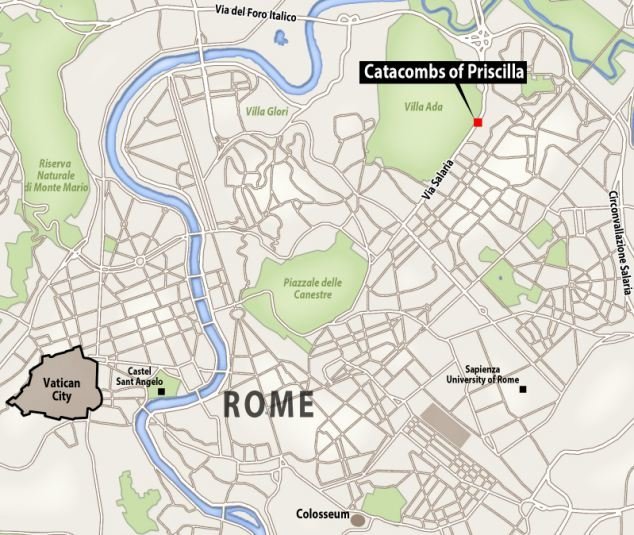
The catacombs of Priscilla, on Rome's Via Salaria, have been fully reopened after a five-year project that included laser technology to clean some of the ancient frescoes
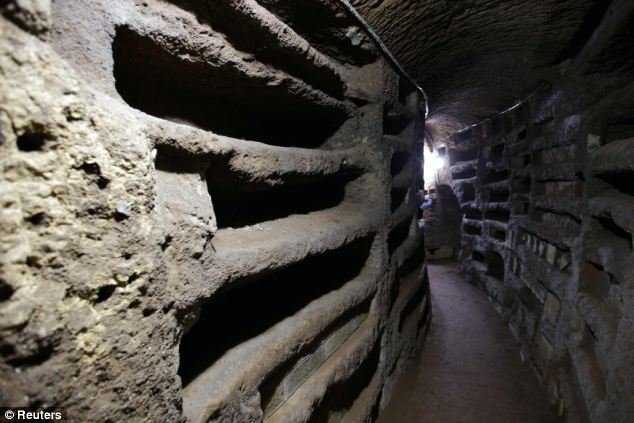
Dug from the second to fifth centuries, the catacoms are a complex labyrinth of underground burial chambers stretching miles beneath the northern half of Rome.



There were deaconesses in the early church. Some are even named in the epistles. Deaconesses helped with the catechizing and baptizing of women converts. With cultures that often separated women this was necessary. Actually the practice was never proscribed in the Orthodox Church. It fell out of use. Deaconesses often were appointed to run women's monasteries and thus the office was mostly subsumed by the abbess. Women also oare known to have preached the Gospel and some are venerated to this day with the title "Equal to the Apostles." These include Ss. Mary Magdalene, St. Photini (The woman at the well), and later St. Nina of Georgia.
But as far as status goes, liturgical rank never really gives status. Holiness does. And so a bag lady saint may have greater "status" in the way you look at it, than a pope or a patriarch. Different way of thinking, folks. Being in charge is not the easy way to theosis.