

© ReutersGet the message: A protester makes his feelings known outside Goldman Sachs headquarters in the financial district of New York

This is actually spot on; it is also the only thing the Atlanta Fed does get right in its entire taxpayer-funded "analysis."
However, as the chart below shows, when it comes to participation rates within the age cohort, while the 25-54 group should be stable and/or rising to indicate economic strength while the 55-69 participation rate dropping due to so-called accelerated retirement of baby booners, we see precisely the opposite. The Fed, to its credit, admits this: "participation among the prime-age group declined considerably between 2008 and 2013."
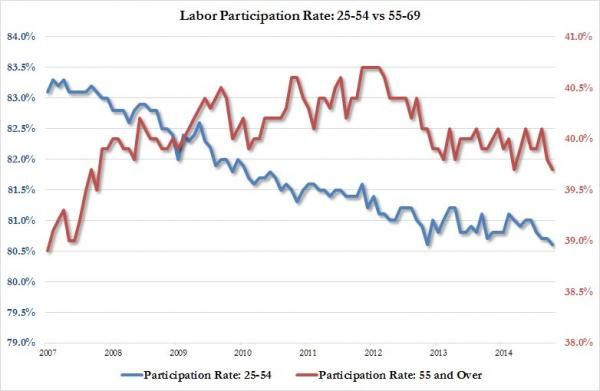
And there you have it: there are nearly 100 million working-age Americans who could be in the labor force, but are not "mostly" because they don't want a job.The decrease in labor force participation among prime-age individuals has been driven mostly by the share who say they currently don't want a job. As of December 2014, prime-age labor force participation was 2.4 percentage points below its prerecession average. Of that, 0.5 percentage point is accounted for by a higher share who indicate they currently want a job; 2 percentage points can be attributed to a higher share who say they currently don't want a job.
Nothing about the lack of job demand as mega corporations continue to lay workers off in droves instead of hiring, instead using every last dollar of free cash flow to buyback their own stock to boost executive compensation instead of growing their company and hire more workers.
Nothing about the collapse in small business formation - that driver of 80% of US employment - as firm exit rates are now greater than firm entry rates
Nothing about the inability to get a job in a world in which the rest of the global is lapping the US in educational and labor skills.
Nothing about the US economy never having left the post-2008 depression where $4.5 trillion in Fed credit was created just to boost the S&P to all time highs and never making it to the actual economy (until the helicopters finally start paradropping of course)
Nothing about millions of aging, 55 and over, Americans refusing to retire or quit their job simply because they have no return on their savings to fall back on thank to the Fed's ZIRP, thus keeping the labor pipeline clogged and preventing younger Americans from getting promoted and achieving better paying jobs.
Nothing about a Millennial generation encumbered with $1 trillion in debt, that is so terrified of its job prospects and having to pay down its debt, it choose instead to keep rolling and piling on to this debt by remaining in college indefinitely
Nothing about the perverted incentive structure of a welfare state that makes it more attractive to collect generous government handouts which end up punishing hard work.
None of that.
You see, it is because Americans "mostly don't want a job."
Which, incidentally, is why the same old Fed tools will be used and abused in hopes of kicking the can down a few more months at at time, be it QE 4, 5, 100, or ever more negative rates, both of which are coming.
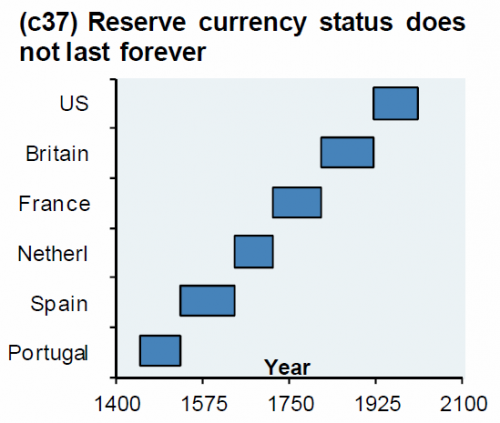
How long will this continue? Now that is a very simple question: it will continue until the dollar loses its reserve status, just like the pound before it, and the livre before that, and the guilder before that, and so on.




The Problem
The above chart illustrates the history of Canada’s federal debt; obviously something went terribly wrong after 1974. Over a 108 year period (1867-1974) the accumulated debt shows as nearly a flat line growing to only $21.6 billion. But around 1974, the debt began to grow exponentially and, over a mere 39 years, it reached over $600 billion in 2013.
So, what happened around 1974? In that year
To achieve that goal, the Committee discouraged borrowing from a nation’s own central bank interest-free and encouraged borrowing from private creditors
the Basel Committee was established by the central-bank Governors of the Group of Ten countries of the member central banks of the Bank for International Settlements (BIS), which included Canada. A key objective of the Committee was and is to maintain “monetary and financial stability.” To achieve that goal, the Committee discouraged borrowing from a nation’s own central bank interest-free and encouraged borrowing from private creditors, all in the name of “maintaining the stability of the currency.”
The presumption was that borrowing from a central bank with the power to create money on its books would inflate the money supply and prices. Borrowing from private creditors, on the other hand, was considered not to be inflationary, since it involved the recycling of pre-existing money. What the bankers did not reveal, although they had long known it themselves, was that private banks create the money they lend just as public banks do. The difference is simply that a publicly-owned bank returns the interest to the government and the community, while a privately-owned bank siphons the interest into its capital account, to be re-invested at further interest, progressively drawing money out of the productive economy.1
Paul Hellyer,2 also notes that lobbying by the banks and adoption of monetarism — the idea that “markets know best” and should be without regulation, and that public services should be privatized — took hold.
So, around 1974, the Government of Canada began to borrow all of the monies to cover its shortfalls from the private sector at interest rather than creating money through the Bank of Canada interest-free. In other words, since 1974, the Bank of Canada has not been acting in the best interest of its shareholders: the people of Canada......continued
[Link]