
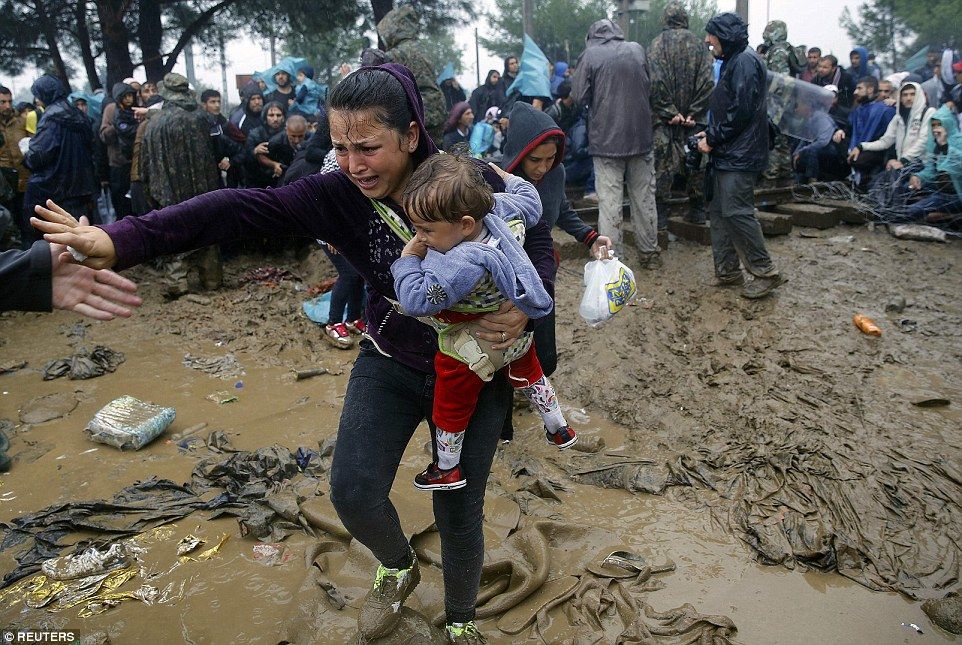
Swamp: A Syrian refugee carries her baby as she traipses through the mud to cross the border from Greece into Macedonia during a rainstorm
At least 7,000 people, including many parents lugging young children, braved downpours and scuffles with police to cross Greece's northern border into Macedonia.
Greek border police said it as the largest single wave of refugees they had seen so far.
Despite wrapping themselves up in garbage bags of every kind, the migrants were soaked to the skin, their trainers caked with mud and hats dripping with rain.
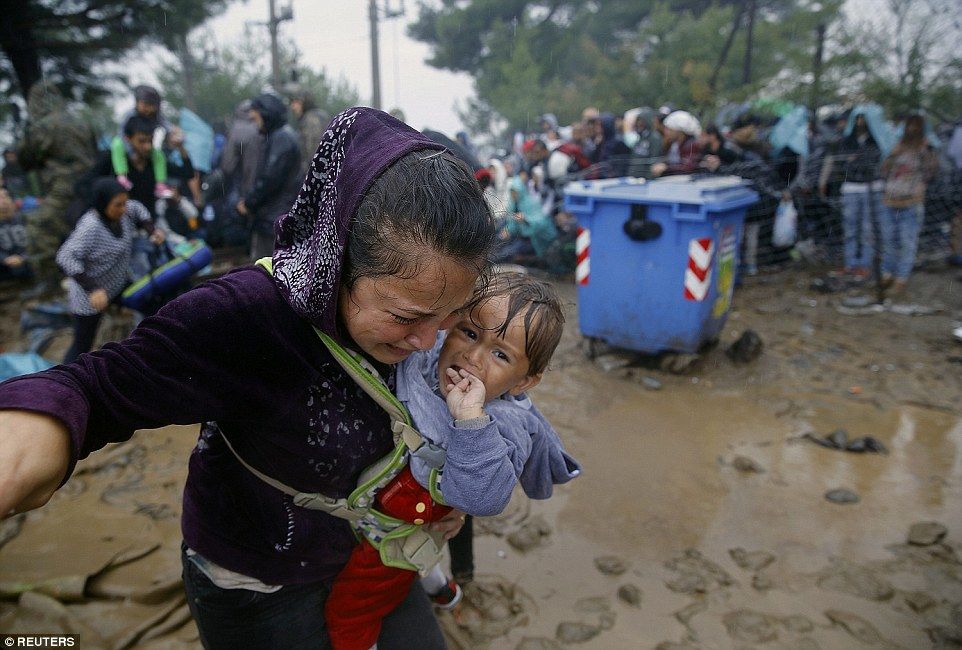
At least 7,000 people including parents lugging young children braved downpours and muddy fields to cross from Greece into Macedonia
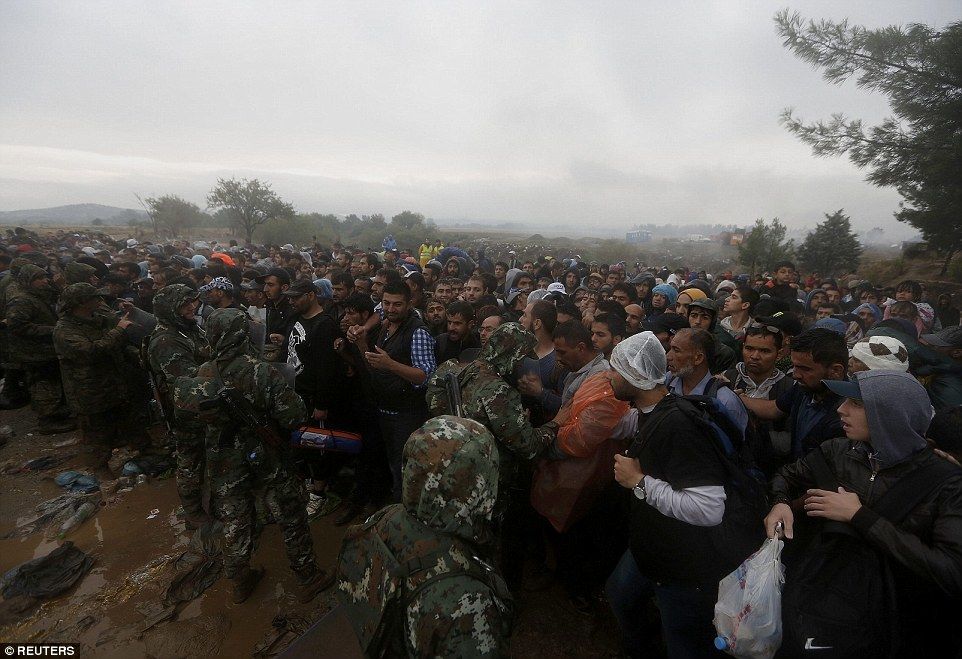
Stand off: Macedonian soldiers try to keep migrants and refugees under control before they cross the border line from Greece into Macedonia

A migrant falls down as he tries to pass a police cordon at the border between the northern Greek village of Idomeni and southern Macedonia
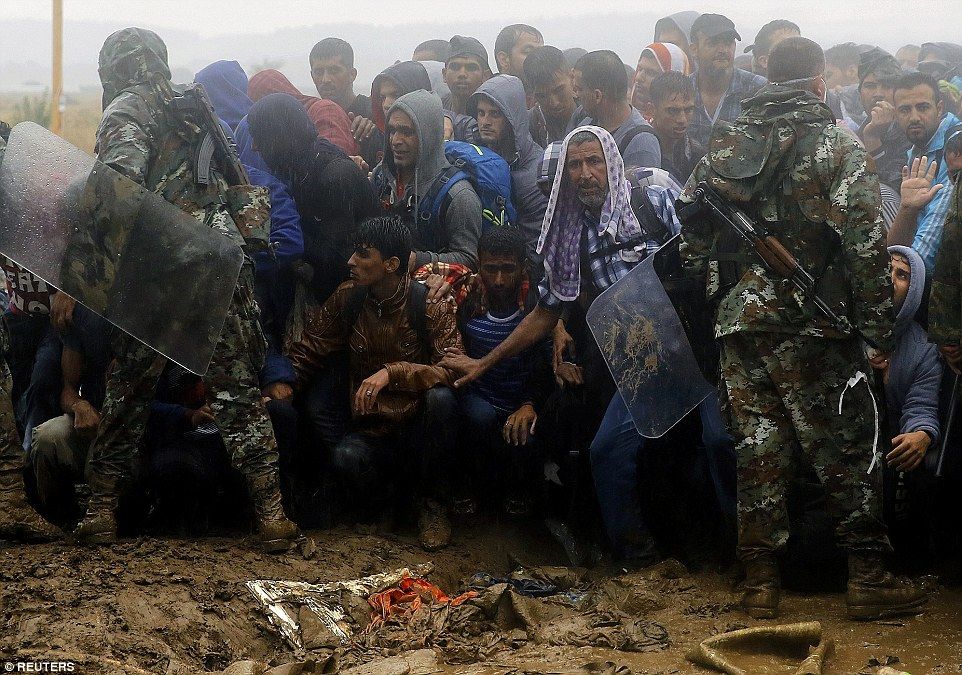
Forcing them back: Macedonian soldiers try to keep migrants under control before they cross the border line from Greece into Macedonia
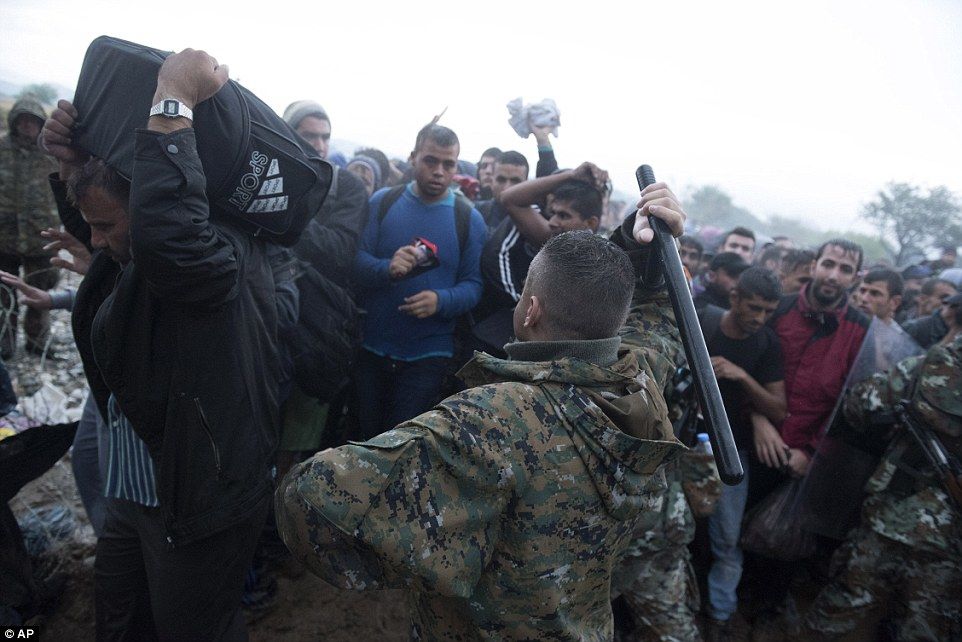
A Macedonian border policeman scuffles with migrants as they wait to pass in heavy rainfall from the northern Greek village of Idomeni
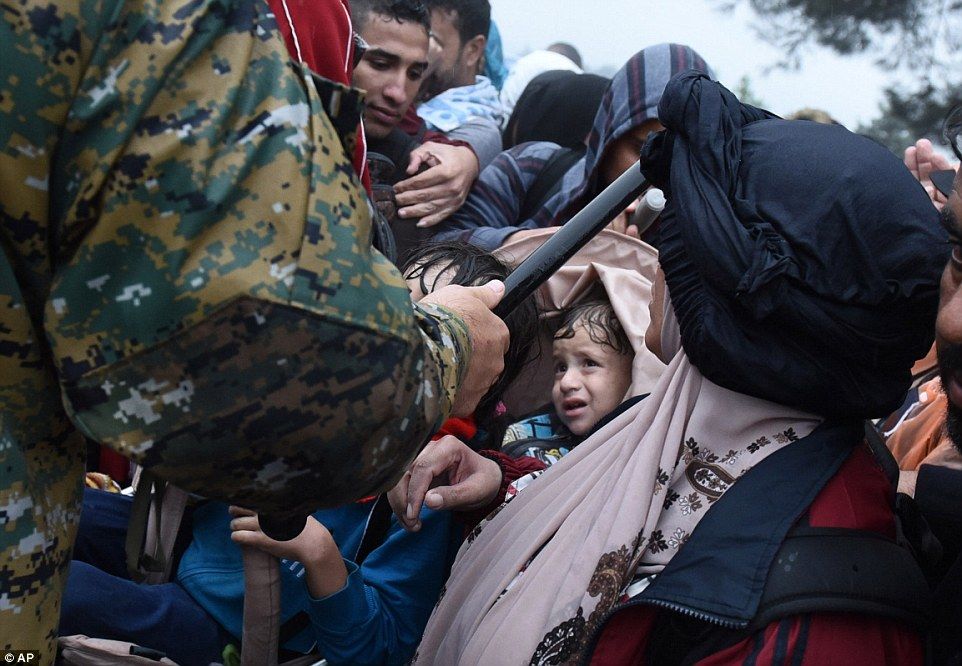
A Macedonian policeman brandishes a baton while asking refugees to stay back as they wait to pass across the border from Greece
By early afternoon, all had crossed but thousands more were on their way, heading to the Greek mainland in ferries from the country's overcrowded eastern islands.
Foreign Minister Nikola Poposki today said Macedonia was considering building a Hungarian-style border fence to stem a rising influx of migrants.
In an interview with Hungarian business weekly Figyelo, he said Macedonia will probably also need 'some kind of a physical defence' though this would not be a long-term solution.
'But if we take seriously what Europe is asking us to do, we will need that, too. Either soldiers or a fence or a combination of the two,' said Poposki.
Earlier, hundreds of migrants continued to pour into Hungary overnight, slipping through its flimsy border fence under the cover of darkness to avoid police.
Hungarian police captured a record 3,321 migrants yesterday, the highest daily figure so far this year, above the 3,313 detained last Thursday, data published on its website showed.
The new arrivals brought the numbers of refugees and migrants looking to move on towards western Europe from Serbia through Hungary to nearly 22,000 this month alone.
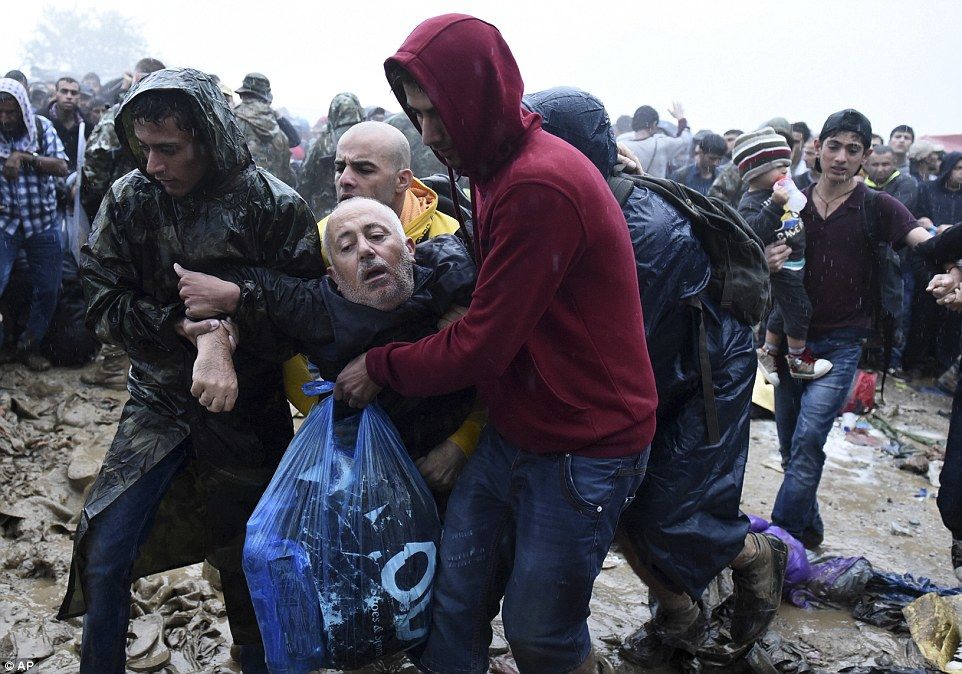
Two men lift a migrant, helping him step by step, while some parents raised their children in the air so police would let them through first
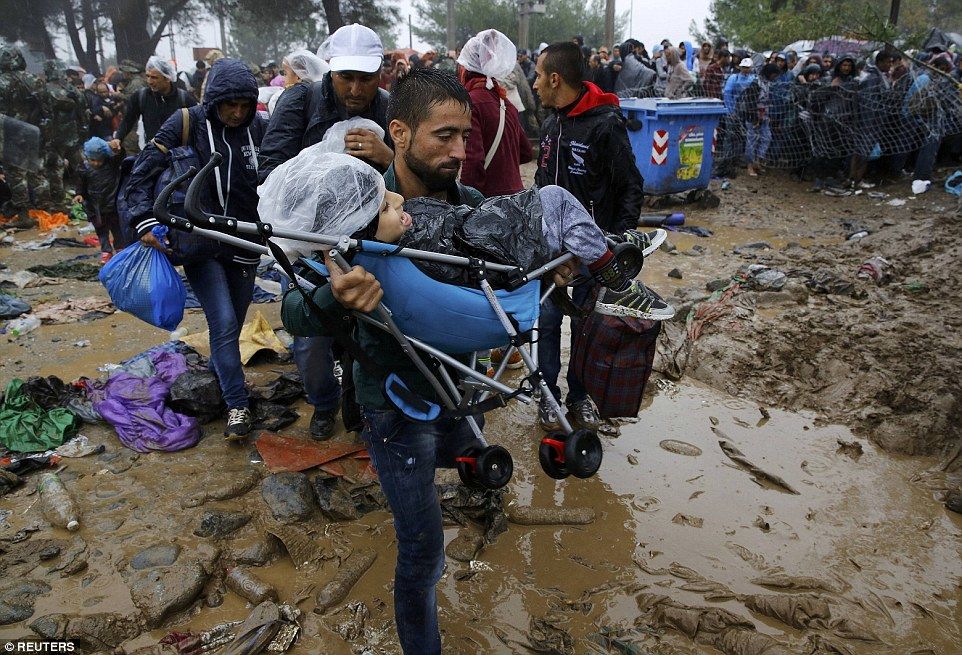
Desperate: A Syrian refugee walks through the mud carrying a child in a pram as he cross the border from Greece into Macedonia
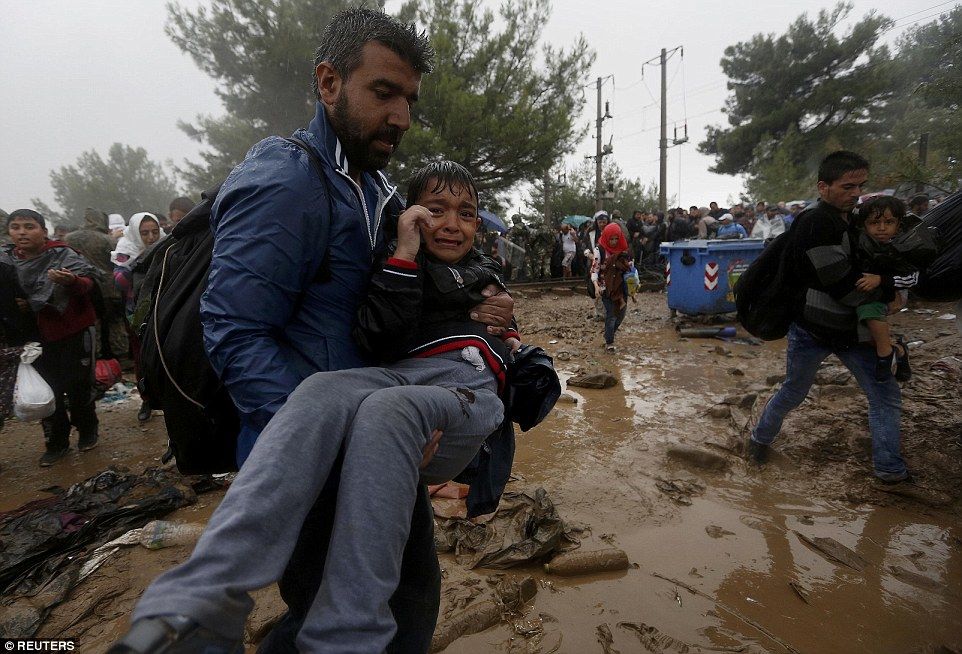
Deluge: A Syrian refugee carries his child through the mud as they cross the border from Greece into Macedonia during a rainstorm
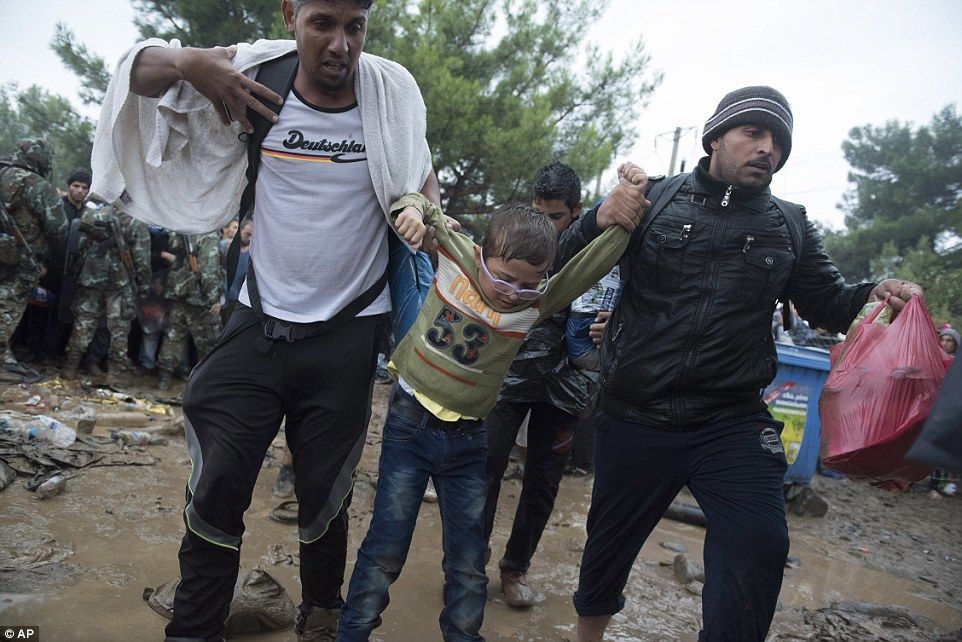
All hands on deck: Two men carry a boy as they pass from the northern Greek village of Idomeni to southern Macedonia
The proposal will be the first item to be discussed at a government meeting on September 15, Janos Lazar told a weekly news conference.
The new bills make crossing a border fence which is under construction a criminal offence and allow authorities to fast-track the assessment of asylum applications at the border.
Leaders of the United Nations refugee agency has warned that Hungary faces a bigger wave of 42,000 asylum seekers in the next 10 days and will need international help to provide shelter on its border.
Officials from the U.N. High Commissioner for Refugees said it was sending tents, beds and thermal blankets to Hungary's border with Serbia, where frustrated groups from the Middle East and Africa have ignored police instructions to stay put and instead marched on a highway north to Budapest.
Commissioner Antonio Guterres accused the entire European Union of failing to see the crisis coming or take co-ordinated action, even though the 28-nation bloc of 508 million people should have enough room and resources to absorb hundreds of thousands of newcomers with ease.
There was needless suffering in the migration crisis 'because Europe is not organized to deal with it, because the European asylum system has been extremely dysfunctional and in recent weeks completely chaotic,' Guterres said.
He told a news conference in Paris that it appeared 'clear that if Europe would be properly organised, it would be a manageable crisis.'
Comment: ...the suggestion being, of course, that management of the crisis is best left to the Eurocrats.
The EU has struggled, in part, because front-line nations such as Hungary and Greece have not put enough facilities in place to house a human flow averaging 2,000 to 3,000 a day.
Meanwhile, the vast majority of people try to push deeper into Europe and seek refugee protection in Germany, the nation accepting the greatest number by far.
In Austria, about 3,700 people poured across the border from Hungary today alone, a police spokesman said, a big increase in the flow of migrants that will put extra pressure on Austrian authorities trying to arrange onward transport to Germany.
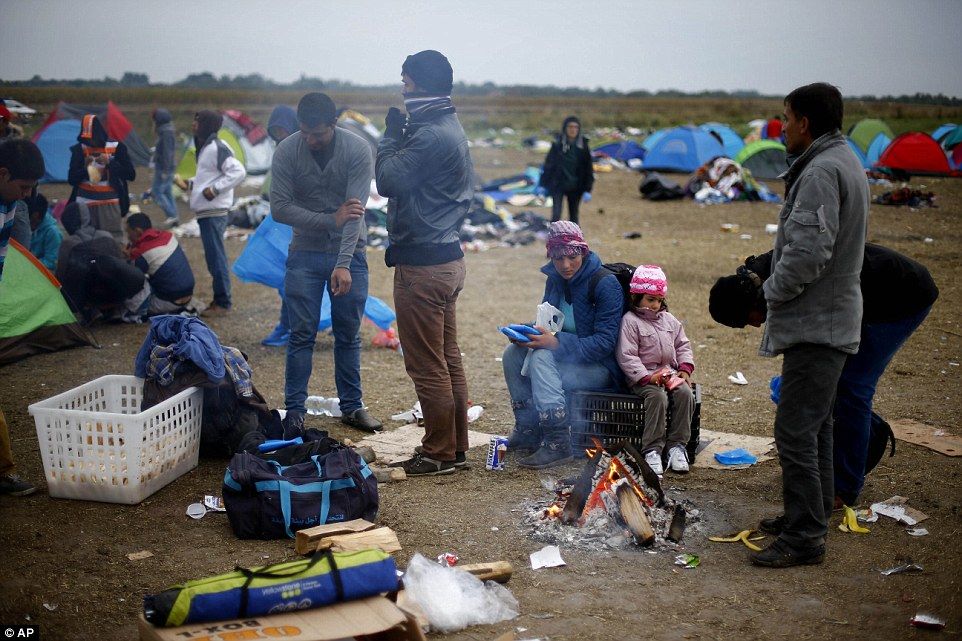
Migrants keep warm next to a fire at a temporary holding centre near the border line between Serbia and Hungary in Roszke
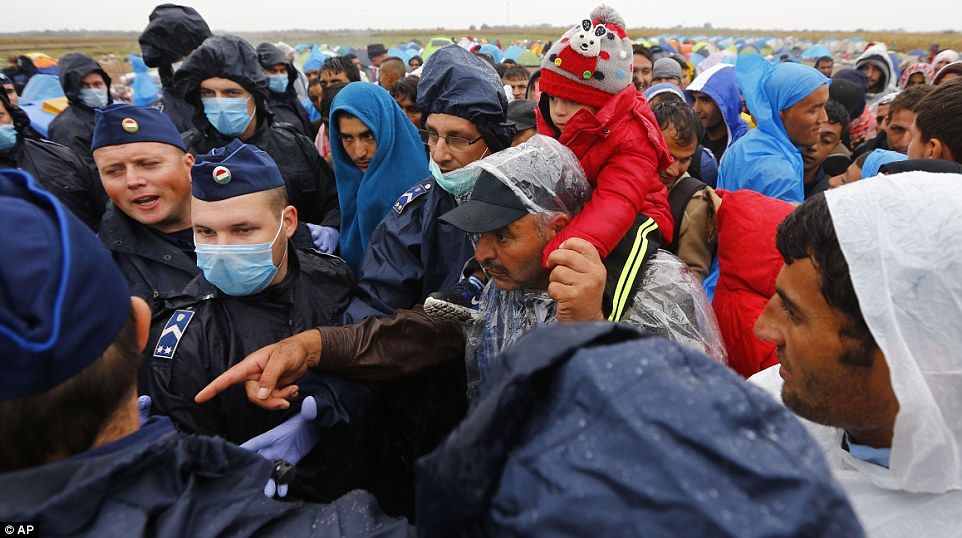
Migrants wait for a bus that will take them to the centre for asylum seekers on the southern Hungarian border in Roszke
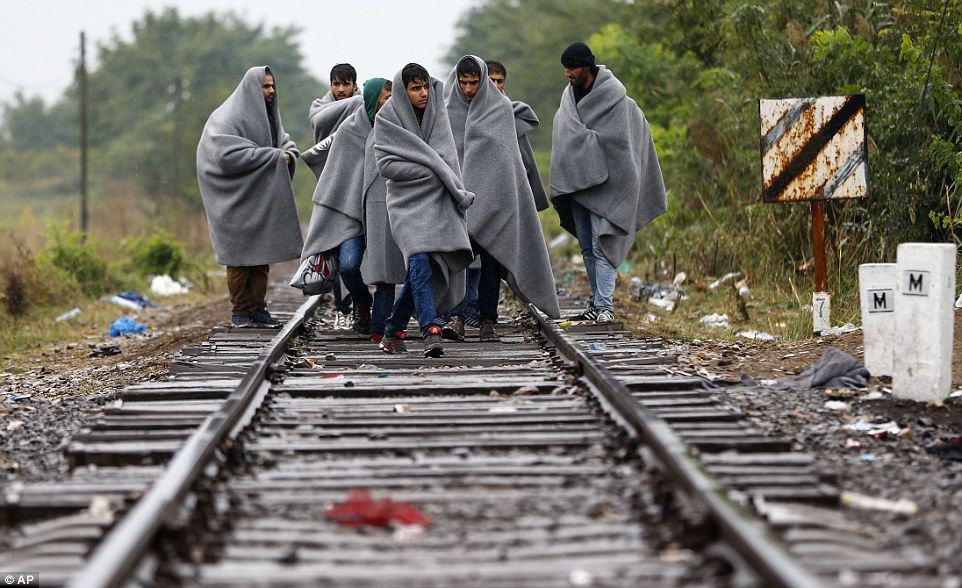
Trying to keep warm: Migrants cross the Serbian-Hungarian border at the railway track near Roszke, southern Hungary
Germany already expects to take in 800,000 this year, and Vice Chancellor Sigmar Gabriel said Tuesday it could take a further one million over the next two years.
Many other EU members have yet to follow Germany's lead, and Hungary's government instead is focusing on building a border fence to block the route from Serbia.
It plans a series of get-tough frontier security measures that it hopes to start enforcing September 15, although international observers are skeptical.
The UNHCR's refugee coordinator for Europe, Vincent Cochetel, told a Budapest news conference that Hungary could not cope on its own with the coming, even bigger volume of asylum seekers.
He said 42,000 people - 30,000 in Greece, 7,000 in Macedonia and 5,000 in Serbia - were likely to enter Hungary in the next 10 days, requiring greater international help.
'We need better co-ordination to make sure we don't have chaos at the border,' he said, chiding Hungary for allowing people to be left overnight 'in a very dire situation.'
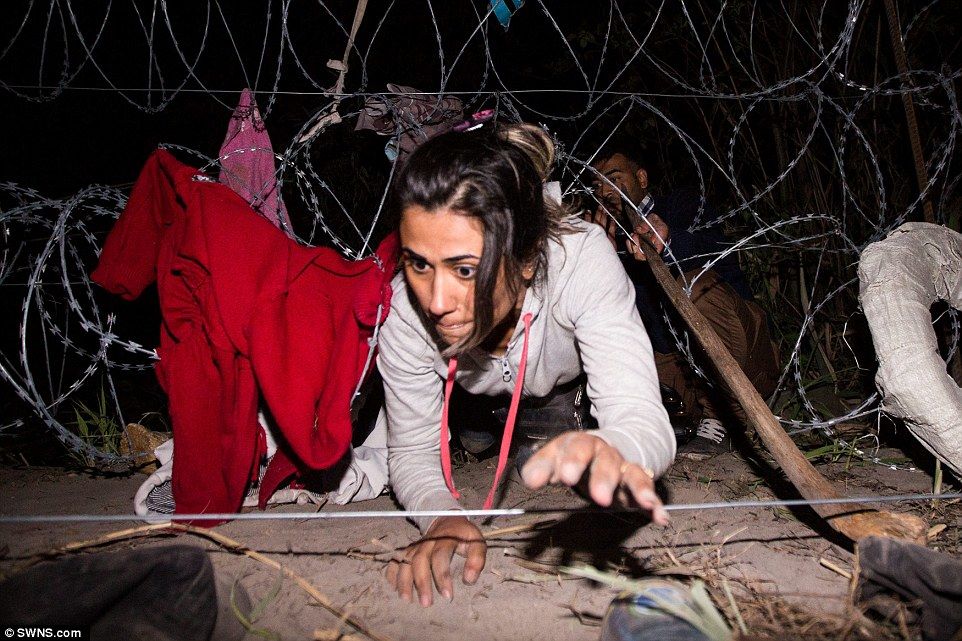
Stealth: A migrant woman crawls through the razor-wire fence on the Hungarian border with Serbia under the cover of darkness to evade police
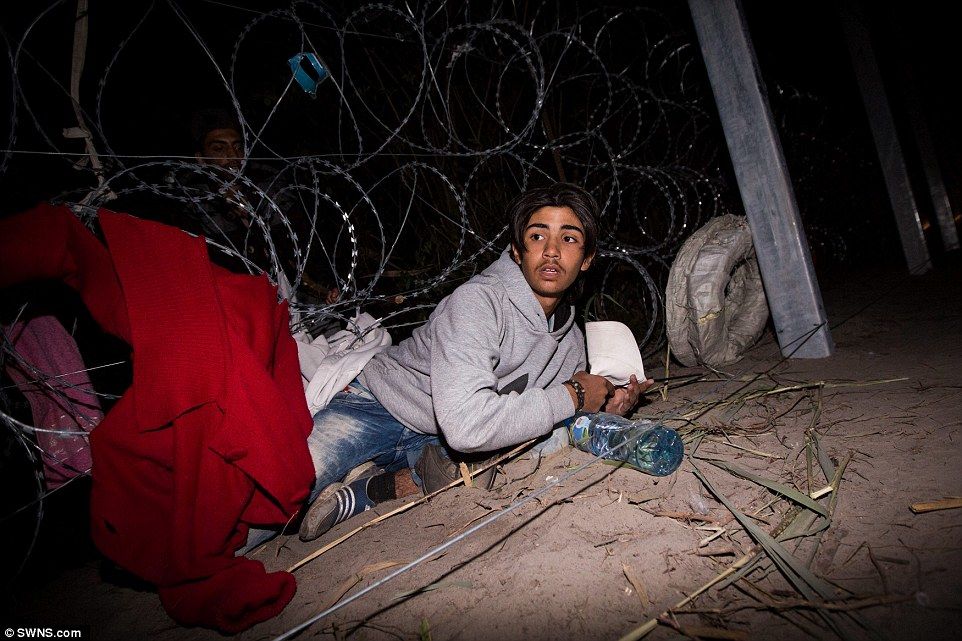
Hungary's government is focusing on building a 12ft-high border fence to block the route from Serbia which due to be finished next week
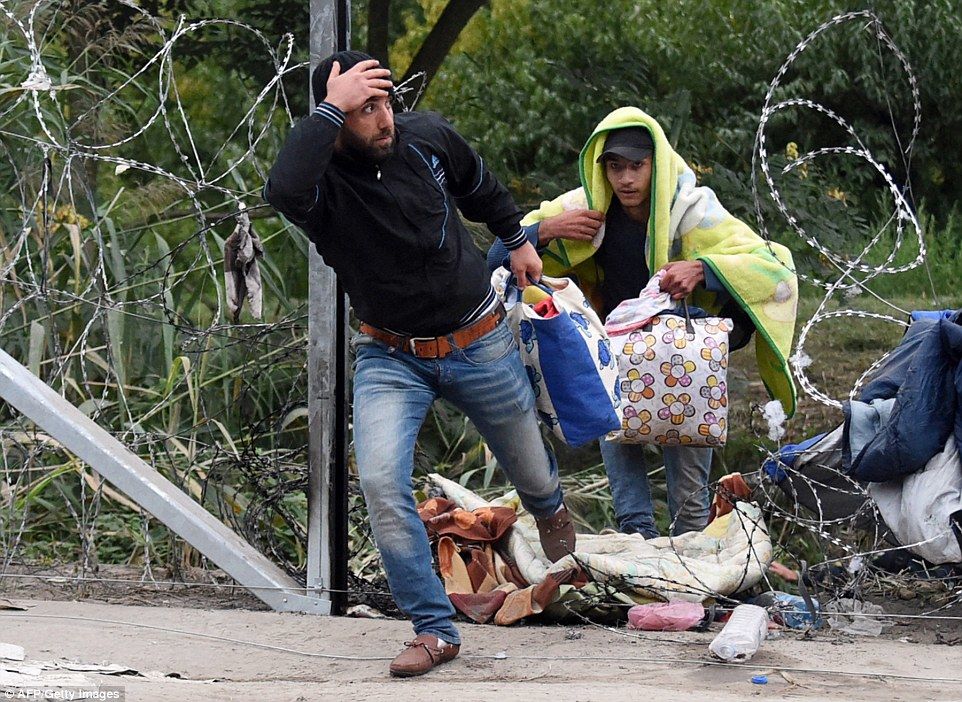
Making a break for it: Migrants cross through a hole in the barbed-wire fence and run into the forest at the Hungarian-Serbian border
Officers have found it increasingly difficult to keep them within a designated field. Some have pushed through police lines and walk north deeper into Hungary, while others head south back to Serbia where camps are sometimes better organized.
On Monday, a few hundred people broke through police lines near Roszke and, despite being hit with pepper spray, made it onto the main highway linking Serbia with Budapest.
It happened again Tuesday night following a day of scuffles with officers in which one man was injured amid a stampede.
'We've been here for two days, and the Hungarian government only brings one bus?' said a Syrian man, who gave only his first name, Ali.
'We're asking to go back to Serbia and they are not giving us this right. We're asking to go to Budapest and they are not giving us this right. Why? Why?'
The government has given little aid, leaving volunteer groups to provide food and water instead. The field near Roszke has become strewn with garbage.
At Budapest's main international train station, more than 300 people - mostly asylum seekers - queued for tickets.
Last week, Keleti station became an open-air refugee camp when Hungary briefly stopped migrants from taking trains to Austria and Germany.
Authorities are once again letting these travelers take trains deeper into the EU, although they often ride in separate carriages from other passengers.
Nada Mahmod, a 30-year-old from Syria, delayed her departure from Keleti because she could not find her 14-year-old son, Mohammad Diar, for days.
Her agony ended with a reunion Tuesday, and they boarded a train together.
'We lost him in the forest. He went with another group,' she said, showing his photo in desperation hours before he was located.
'Police in Hungary don't help. Everybody else helps. Not the police.'
About 7,000 people arrived in Vienna between early Monday and early Tuesday, and 'almost all of them continued on to Germany,' according to police spokesman Patrick Maierhofer.
Austrian Chancellor Werner Faymann said countries opposed to taking in refugees under an EU-wide quota system plan backed by Germany and France should suffer financial penalties.
In Geneva, the U.N. special representative on international migration said too many countries wanted to give financial aid but no places for refugees to live.
'Buying your way out of this is not satisfactory,' said the official, Peter Sutherland. Even so, U.N. members had not provided nearly enough funding for existing relief efforts, he added.
Poland, the largest of the EU's eastern members, has agreed to accept 2,000 refugees, saying it has too many economic problems to take more.
In addition, officials have said that as a predominantly Roman Catholic country, Poland would have trouble integrating Muslims. Prime Minister Ewa Kopacz said it would accept only those who have no hostility toward Poland.
Comment: Good old Poland can always be counted on to collaborate.
In Greece, the coast guard said its patrol vessels picked up nearly 500 people in small boats in the eastern Aegean Sea near the islands of Lesbos, Samos and Kos and the islet of Agathonissi.
More than 15,000 were on Lesbos awaiting screening before they could board a ferry to the Greek mainland.
Although Greece is an EU member, migrants have for years freely left its dysfunctional asylum system and headed north through Macedonia and Serbia into Hungary and, from there, to Western Europe.

[Link]