
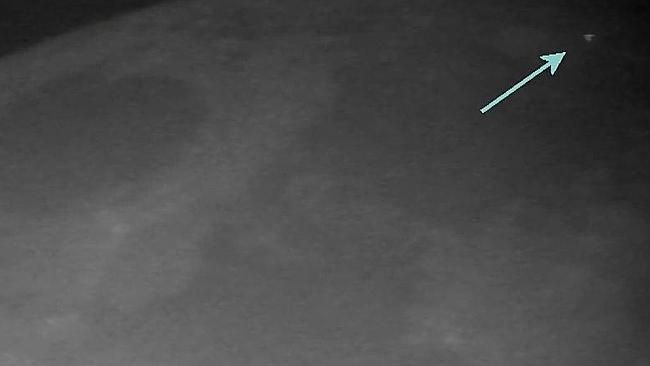
© IAADeep impact ... A fridge-sized asteroid makes impact with the moon in September 11th, 2013.
The rare episode was seen by Jose Maria Madiedo, a professor at the University of Huelva, Britain's Royal Astronomical Society (RAS) said.
On September 11 last year, Madiedo was operating two lunar-observing telescopes when he spotted a flash in the Mare Nubium, an ancient, dark lava-filled basin.
The flare, which occurred at 20:07 GMT, was briefly almost as bright as the northern hemisphere's Pole Star, the RAS said. It would have been visible to the naked eye to anyone who happened to be looking at the Moon at that moment in good viewing conditions, the RAS said. There followed a long afterglow, lasting another eight seconds -- the longest and brightest ever seen for a lunar impact.
"At that moment, I realised that I had seen a very rare and extraordinary event," Madiedo told the society.
Madiedo and colleagues calculate that the rock had a mass of around 400 kilos (1,000 pounds), with a diameter of between 60 centimetres (two feet) and 1.40 metres (56 inches).
It hit Mare Nubium at around 61,000 kilometres (38,100 miles) per hour. Madiedo has posted two clips on Youtube ( and h).
The speed was so high that the rock turned molten on impact and vaporised, leaving a thermal glow visible from Earth as a flash, and bequeathing a 40-metre (130-feet) crater in the Moon's pocked surface.
The impact energy was equivalent to an explosion of around 15 tonnes of TNT, more than triple the largest previously seen event, claimed by NASA in March 2013.
Madiedo's team calculate that rocks of this size may strike Earth about 10 times more frequently than was generally thought.
Earth, though, is protected by its atmosphere and asteroids of this size burned up as dramatic "fireball" meteors.
By way of comparison, the rock that exploded above Chelyabinsk, Russia, on February 15 2013, is believed to have measured about 20 metres (65 feet) across and weighed some 13,000 tonnes. It is considered to have been at the lower end of medium-sized asteroids.
The Spanish observation is published in the RAS journal Monthly Notices of the Royal Astronomical Society.







Many times I think about an old star wars famous quote “that’s no moon, it’s a battle station” and often consider that the moon would be a perfect location for a fortified military compound strategically located and guarded by troops to help hold earth captive .. and with these possibilities you got-to-wonder if some if not all of these impacts are not targets in celestial wars ….