
© Rare.us
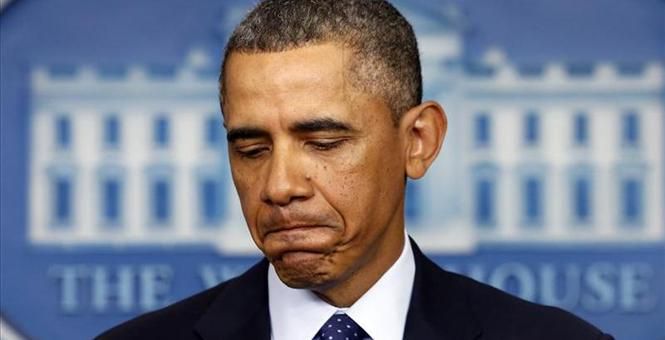
That was fitting - 2013 was far from the most wonderful of Mr. Obama's five crisis-filled years. And though he held out hope as he parried with reporters for more than an hour that "2014 can be a breakthrough year for America," he offered little hint of new ideas or strategies to advance his once-ambitious agenda past hostile Republicans.
"The end of the year is always a good time to reflect and see what can you do better next year. That's how I intend to approach it," Mr. Obama said. "I am sure that I will have even better ideas after a couple days of sleep and sun."
It was as if the president could already smell the exhaust fumes of Marine One, which within hours would whisk him and his family from the South Lawn of the White House on the beginning of their annual holiday trip, a full two weeks in Hawaii. "I know you are all eager to skip town and spend some time with your families. Not surprisingly, I am, too," he said.
Mr. Obama, from his opening remarks, stressed the economy's signs of growth, and he said that building on such progress is "going to be where I focus all of my efforts in the year ahead." But while he could cite specifics about improving economic indicators on employment, growth and deficits, he did not give details about his agenda, even as he said that "2014 needs to be a year of action."
The impression conveyed was of a president as manager, one without much of an agenda or the political wherewithal for new initiatives that could make it through a Congress where Republicans are more determined than ever to thwart him before next year's midterm elections. He ends the first year of his second term - typically the best chance for policy achievements before lame-duck status sets in - with his approval ratings having hit a record low and many Democrats disillusioned by the controversies over the health insurance law and disclosures about widespread intelligence surveillance of phone records.
From the news conference's first question - "Has this been the worst year of your presidency?" - Mr. Obama offered a sobering review of a year that had begun, after his decisive re-election, with the expansive language, high hopes and summons to political unity contained in his second Inaugural Address. "For now decisions are upon us," he said in wrapping up that speech, "and we cannot afford delay."
Eleven months later, Mr. Obama was prepared as reporters drilled him on the disappointments he has suffered since that January celebration. He laughed at that first question, and said that reporters had chronicled "at least 15 near-death experiences" during his tenure. He maintained a game face, if a haggard one, as he acknowledged the frustrations and failures on immigration, budget policy, gun violence and health care that were part of his second-term agenda - one that, while ambitious, was not nearly as sweeping as his first.
The closest that Mr. Obama came to making news was in hinting that he may support a review panel's recommendation to curb the National Security Agency's collection of telephone records by allowing telephone companies - not the government - to hold the data until intelligence officials need access on a case-by-case basis.
Several times he sought to reflect optimism about policy prospects for the year ahead, but - ever the pragmatist - not too much.
The Republican-controlled House might have stopped the Senate's bipartisan bill to overhaul the immigration system and provide a path to citizenship for about 11 million people who are in the country illegally, but Mr. Obama cited "indications" that it would act on immigration legislation in 2014. "And the fact that it didn't hit the timeline that I'd prefer is obviously frustrating," he added, "but it's not something that I end up brooding a lot about."
Months of talks with Senate Republicans in the first half of the year failed to yield an elusive grand bargain on the budget that would reduce annual deficits while increasing public investments. So he was left to applaud Congress for sending him a far more modest two-year deal this week, though "it's not everything that I would like, obviously."
"It's probably too early to declare an outbreak of bipartisanship, but it's also fair to say that we're not condemned to endless gridlock," he said. Yet Mr. Obama sounded purposely unconvincing when he suggested that congressional Republicans surely would not put up a fight over the next budget deadline - the need to increase the government's borrowing limit by March - as they have threatened to do.
"Now I can't imagine that, having seen this possible daylight breaking when it comes to cooperation in Congress, that folks are thinking, actually, about plunging us back into the kinds of brinkmanship and governance by crisis that has done us so much harm over the last couple of years," he said.
Mr. Obama volunteered his disappointment that Congress did not pass a law to require background checks for gun buyers, a priority after the school massacre in Newtown, Conn., a year ago. Yet he made no suggestion of reviving that cause in the face of opposition from the gun lobby and lawmakers in both parties.
A year ago, administration officials defended the relative paucity of new ideas for the second term by saying that the president would be putting into effect his first term's achievements, chiefly his hallmark Affordable Care Act. Yet on Friday, Mr. Obama was once again forced to acknowledge that his administration had bungled the Oct. 1 introduction of the website where Americans shop for the health insurance that the law requires them to have, even as he boasted of improvements since then.
There are, he said, "a couple million people, maybe more, who are going to have health care on Jan 1."
"And that is a big deal," he added. "That's why I ran for this office."
"It's not that I don't engage in a lot of self-reflection here," Mr. Obama said at another point about the health insurance program. "I promise you, I probably beat myself up, you know, even worse than" reporters do.
"But," he said, "I've also got to wake up in the morning and make sure that I do better the next day and that we keep moving forward. And when I look at the landscape for next year, what I say to myself is: We're poised to do really good things."
"Psychopaths are conscious of being different. They see normal people as inferiors - "others" - to be used and discarded when they are no longer needed. But like a predator among its prey, psychopaths must disguise themselves to evade detection. If they made their motives known, others would be horrified. So, from an early age they learn to fit in by copying normal human reactions and behaviors. They learn when it is appropriate to cry, show grief, guilt, concern, and love. They learn all the facial expressions, common phrases, and social cues for these emotions they do not feel. And as such, they deceive others with false displays of sadness, grief, guilt, concern, and love, and they manipulate our reactions to get what they want. That's how a psychopath is able to con you out of money by playing on your sense of pity and compassion. Normal people, unaware of the differences between psychopaths and themselves, assume that these displays of emotion are evidence of actual emotion, and so the psychopath succeeds in going unnoticed, like a wolf in sheep's clothing. "[T]he truly talented ones have raised their ability to charm people to that of an art, priding themselves on their ability to present a fictional self to others that is convincing, taken at face value, and difficult to penetrate."
From: Ponerology 101: The Psychopath's Mask of Sanity

I especially like the line about how the Republicans stopped any bi-partisan budget that dealt with immigration reform for the '11 million illegals'.
Notice how this paragraph insinuates that bi-partisanship would have led to terrible, horrible legislation which would have been the Democrats' fault Then notice how the next paragraph states that it's the fault of the Democrat Obama because he can't enact a bi-partisan budget.
In other words, the Republicans are heroes because they didn't compromise, and Obama is a villain because he didn't compromise.
"Months of talks with Senate Republicans...failed to yield an elusive grand bargain on the budget.."
Why oh why does there have to be a Grand High Exalted Mystic Bargain?
The obvious answer is that the Democrats are in control of the Senate and the White House, so that means that the Republicans must be consulted on any and all national topics, even though they are not in power precisely because the voters decided that they shouldn't be, because a lot of them are bat-shit crazy -- yet who still show up in the media, over and over again, spouting their crazy talk and pushing the agenda of the PRICs (People really in charge).
Obama is described as weary, with haggard face and sobering thoughts. Everything in this article is negative about him, even the occasional back-handed compliment. This is nothing but a Xmas hit piece. Ho ho ho.
Obama is just a tool and a fool of the Illuminati, just in case any of you have already judged by my words that I am some sort of Dem-apologist. Nothing could be further from the truth. Both parties are full of tools and fools and crazies and psychos (except for Barbara Lee of Oakland, CA). I merely wish to point out the 1-sided nature of this article's agenda.
Meanwhile, another purpose for this article then pops up - continuing the cover-up of the lies about the most obvious fake news that the PRICs (People really in charge) use to brain-wash the public.
"background checks for gun buyers, a priority after the school massacre in Newtown..."
Good work, Jackie and the NYTools -- you Iluminati fools. Keep pushing the bullshit, keep flinging that propaganda that this obvious hoax of a concocted catastrophe actually occurred. Why don't you add a photo to this article of Emilie Parker sitting on Obama's lap, the one taken days after she supposedly died?