
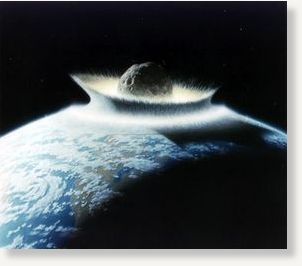
Users can type in the size of their hypothetical asteroid, its speed, what it will hit, its angle of entry and even how far they are from the blast, the Daily Mail reported.
For those who cannot visualise how big their asteroid could be, there is even a helpful drop-down menu of pre-set sizes which include 'school bus', 'humpback whale', 'Empire State Building', all the way up to the ominous-sounding 'small planet'.
The website's algorithms then calculate what the effects of the asteroid's impact would be on the earth's axis, whether there would be a fireball - and what chance of surviving any bystanders would have.
It even tells you how far you should be from the impact to avoid being buried in the material thrown up from any crater that is left behind.
The website, called Impact Earth!, is the brainchild of scientists from Purdue University in the US and Imperial College London.
It is an update of a calculator which was originally devised in 2004 and based on scientifically-sound calculations.
The new version includes extra elements such as the height of resulting tsunami waves and it comes with an entertaining animation that shows the asteroid hurtling from space towards the earth.
The asteroid is identical to the Hartley 2 comet that NASA's Deep Impact spacecraft flew by last week.
Imperial College's Gareth Collins told the BBC: "One of the major new additions is the estimates for tsunami wave height at a given distance away from an ocean impact."
On average, an object about the size of a car will enter the earth's atmosphere once a year, producing a spectacular fireball in the sky.
An asteroid collision with the earth is believed to have wiped out the dinosaurs.




So far, the models I see used in all of the impact simulations I can find online are as naive as childrens bed-time stories.
Impact science is still assuming that most catastrophic impact events consist of the kinetic impact of a single large bolide. And that’s the only kind of impact event the online simulation programs consider.
Yet the majority of dangerous objects in Earth crossing orbits are fragile things like short period comets, and debris, of the Taurid complex. And if a person wants, they can quickly Google up images of fragmented comets like SW-3, or Linear. Both are typical daughters of the Taurids.
In spite of the facts that the largest impact event in recorded history was the airburst of a small Taurid family object. And that there is no reason to assume that it was an isolated event; or even a big one on the grand scale of such things. The available simulations you can play with online do not consider airburst phenomena, or the very real potential for a much larger, geo-ablative version of the Tunguska event.
They also fail to consider cluster impacts.
In spite of numerous images of extremely fragmented objects in the Taurid Complex, in short period, Earth-crossing orbits, like the ones mentioned above, none of the simulations to date consider the possibility of a cluster event, or very large, multiple airburst impact event. And none of the simulations consider what might happen of only the first fragments on the leading edge of a large cluster of comet fragments like that falls into cold atmosphere. Allowing the rest to fall into the already superheated impact plumes of the ones that fell before them, and just crank-up the heat, and pressure.
But the amount of material that is estimated to have fell when the debris of the Taurid progenitor hit just a few thousand years ago, is something like 1.1 billion tons. I wonder what a supersonic, and hyper-thermal, storm front, hundreds of miles wide, like a giant tsunami of thermal impact plasma, and rising to the full depth of the atmosphere, might do to the ground as it rushes across the terrains downrange during, and after, the impacts of a large cluster of smaller fragments like we see in the images of comets Linear, or Schwassmann-Wachmann 3.