

© L. Calçada/ESOBeta Pictoris b, the youngest known planet outside our solar system, in an artist's conception.
Probably only a few million years young, Beta Pictoris b is already fully formed, despite standard models that say such a planet should take ten million years to reach "adulthood," researchers say. The planet breaks the record once held by the planet BD 20 1790b, which clocked in at 35 million years old.
The new planet is also nearer to its parent star than any other known planet outside our solar system - about as close as Saturn is to our sun.
Located about 63.4 light-years from Earth, that star, named simply Beta Pictoris, is similar to our own star. And like Beta Pictoris b, Beta Pictoris is relatively young - about 12 million years old, compared with the sun's 4.5 billion years.
First Direct Evidence of Youngest Planet
Previous pictures - including Hubble Space Telescope images released in 2006 - had revealed that an orbiting disk of dusty debris, likely created by the collisions of young asteroids and planets, surrounds Beta Pictoris.
A gap in the disk, which resulted in a ring around the star, had suggested that a Jupiter-like "gas giant" planet was sweeping through. But the existence of the planet wasn't confirmed until the European Southern Observatory's Very Large Telescope captured the new pictures in 2009.
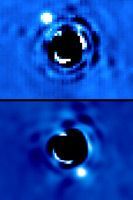
© Lagrange et al.The planet Beta Pictoris b (white) is shown orbiting its host star in 2003 and 2009.
The infrared pictures make clear that Beta Pictoris b, which is about nine times more massive than Jupiter, is not only a real exoplanet - a planet outside our solar system - but a fully formed one.
"It's the first time we have direct proof of the time scale to form a planet - the first proof to say a planet can form rapidly," said study leader Anne-Marie Lagrange of the Astrophysics Laboratory of Grenoble in France.
Beta Pictoris a Boon to Planet Hunters?
Lagrange believes that stars with debris rings make "nice places to look for planets."
She's not convinced, though, that all rings around stars are proof of planets. By gravitationally yanking out masses of debris from a disk, a flyby from a nearby star could also create rings, she said.
Separating planet-neighboring rings from the other types of rings should get easier after 2012, when the Atacama Large Millimeter Array (ALMA) radio telescopes - more sensitive than current arrays - are scheduled to go online in Chile.
When it comes to planet hunting, Lagrange added, the pace of technology has been impressive.
"We are just now starting to be able to make direct images of exoplanets," she said. "We get very different information now, and in a few years' time we may even be able to look inside the atmospheres of these planets."
The new planet study appears in this week's issue of the journal Science.



Reader Comments
to our Newsletter