

© iStockConstruction workers in ancient China used sticky rice to make a super-strong mortar for city walls and other structures that even withstood earthquakes. Chemists now have discovered the ingredient in sticky rice that made the mortar so strong.
Bingjian Zhang, Ph.D., and colleagues note that construction workers in ancient China developed sticky rice mortar about 1,500 years ago by mixing sticky rice soup with the standard mortar ingredient. That ingredient is slaked lime, limestone that has been calcined, or heated to a high temperature, and then exposed to water. Sticky rice mortar probably was the world's first composite mortar, made with both organic and inorganic materials.
The mortar was stronger and more resistant to water than pure lime mortar, and what Zhang termed one of the greatest technological innovations of the time. Builders used the material to construct important buildings like tombs, pagodas, and city walls, some of which still exist today. Some of the structures were strong enough to shrug off the effects of modern bulldozers and powerful earthquakes.
Their research identified amylopectin, a type of polysaccharide, or complex carbohydrate, found in rice and other starchy foods, as the "secret ingredient" that appears to be responsible for the mortar's legendary strength.
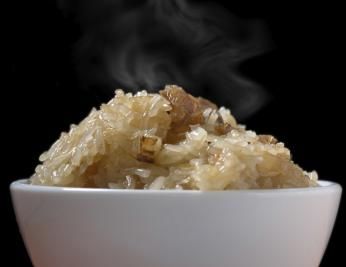
© iStockConstruction workers in ancient China used sticky rice to make a super-strong mortar for city walls (right) and other structures that even withstood earthquakes. Chemists now have discovered the ingredient in sticky rice that made the mortar so strong.
To determine whether sticky rice can aid in building repair, the scientists prepared lime mortars with varying amounts of sticky rice and tested their performance compared to traditional lime mortar. "The test results of the modeling mortars shows that sticky rice-lime mortar has more stable physical properties, has greater mechanical strength, and is more compatible, which make it a suitable restoration mortar for ancient masonry," the article notes.
The American Chemical Society is a nonprofit organization chartered by the U.S. Congress. With more than 161,000 members, ACS is the world's largest scientific society and a global leader in providing access to chemistry-related research through its multiple databases, peer-reviewed journals and scientific conferences. Its main offices are in Washington, D.C., and Columbus, Ohio.



Reader Comments
to our Newsletter