A new view of archival Webb telescope data reveals
small asteroids in the main asteroid belt are more numerous than we thought.
Astronomers have
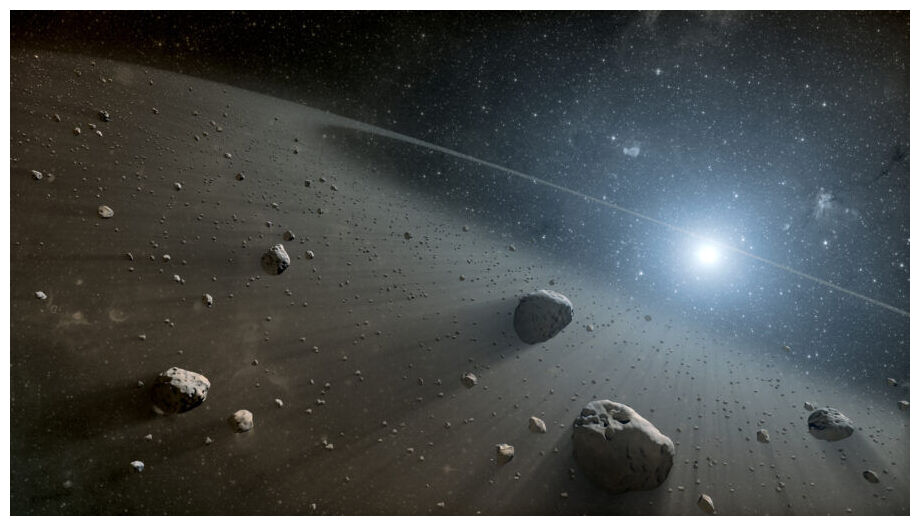
uncovered an unexpectedly large population of small main-belt asteroids thanks to a new analysis of images from the James Webb Space Telescope. The finding could change calculations of the impact rate on Earth from such bodies, which range from house-size to the size of a stadium.
These are by far the smallest objects ever imaged so far away. Artem Burdanov (MIT) and colleagues applied a computationally intensive shift-and-stack method to Webb's archival images. From the telescope's sensitive infrared detectors, the team was able to accurately determine the sizes of small objects, ranging from about 10 to 500 meters (30 to 1,600 feet) across. An early release of their results appears in
Nature.Larger main-belt asteroids, whose orbits are between those of Mars and Jupiter, tend to remain in relatively stable orbits. However, gravitational interactions more frequently perturb smaller ones, which may enter the inner solar system to become potential impactors.
The high number of small objects now found in the main belt — more than an order of magnitude greater than expected — could affect calculations of the frequency of such impacts.