Fireballs
S


Fireball 4

Meteor fireball over North Carolina and other states on February 23

mmmmmm
© Shutterstock/Triff
We received 18 reports about a fireball seen over Kentucky, North Carolina, Ohio, South Carolina, Tennessee, Virginia and West Virginia on Sunday, February 23rd 2025 around 05:33 UT.

For this event, we received 2 videos and one photo.


Fireball 3

Meteor fireball over Tennessee and other states on February 22

mmmmmm
© Shutterstock/Triff
We received 42 reports about a fireball seen over AL, GA, KY, MS, Tennessee and TN on Saturday, February 22nd 2025 around 02:40 UT.

For this event, we received one video.


Fireball 2

Meteor fireball over Germany on February 22

mmmmmm
© Shutterstock/Triff
We received 8 reports about a fireball seen over Bayern, Niedersachsen, Sachsen, Sachsen-Anhalt and Thüringen on Saturday, February 22nd 2025 around 20:04 UT.

For this event, we received one video.


Fireball 3

Meteor fireball over California on February 18

mmmmmm
© Shutterstock/Triff
We received 29 reports about a fireball seen over California on Tuesday, February 18th 2025 around 04:39 UT.

For this event, we received one video and one photo.


Fireball 3

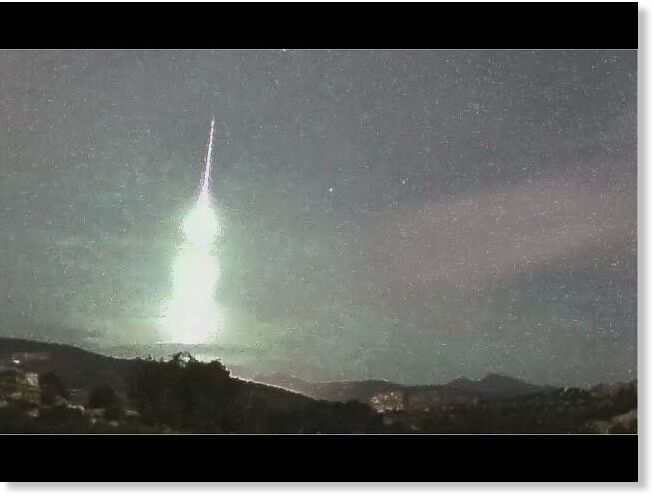
Stunning meteor fireball over northern Spain (Feb. 16)

nnnnnn
This stunning bolide was spotted from Spain on February 16, at 2:11 local time (equivalent to 1:11 universal time). It was brighter than the full Moon. The fireball was observed by some casual eyewitnesses, who reported it on social networks.

The event was generated by a rock (a meteoroid) from a comet that hit the atmosphere at about 135,000 km/h. The fireball overflew the province of Huesca (Spain). It began at an altitude of about 94 km over the locality of Loporzano (province of Huesca), moved northeast, and ended at a height of around 33 km over the locality of Sobás (province of Huesca).

This bright meteor was recorded in the framework of the SMART project, operated by the Southwestern Europe Meteor Network (SWEMN) from the meteor-observing stations located at La Hita (Toledo), Calar Alto, Sierra Nevada, La Sagra (Granada), Olocau (Valencia), Faro de Cullera (Valencia), Sant Celoni, and Breda. The event has been analyzed by the principal investigator of the SMART project: Dr. Jose M. Madiedo, from the Institute of Astrophysics of Andalusia (IAA-CSIC). Its code in the SWEMN database is: SWEMN20250216_011130.


Fireball 5

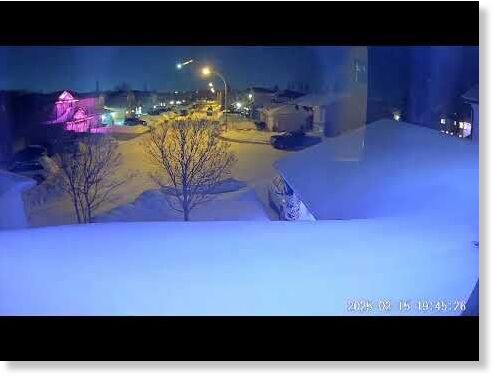
Meteor fireball over Alberta and Saskatchewan, Canada on February 16

bbbbbb
We received 44 reports about a fireball seen over Alberta and Saskatchewan on Sunday, February 16th 2025 around 02:43 UT.

For this event, we received 3 videos.


Fireball 2

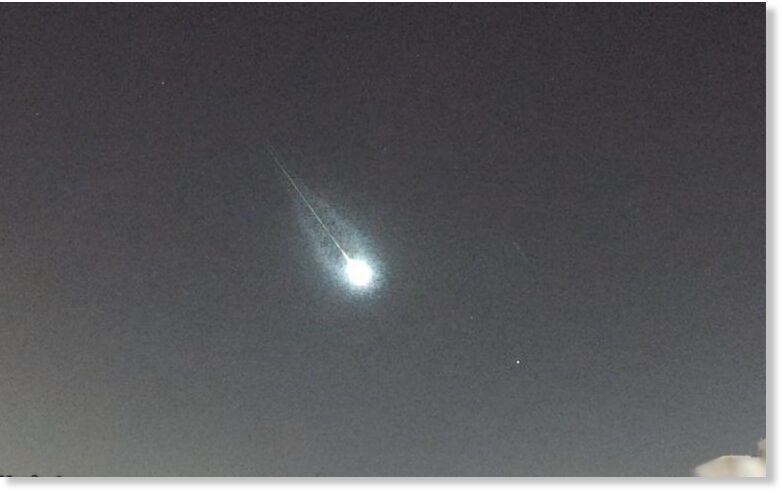
Spectacular meteor fireball lights up the night sky over Chile on February 10

mmmmmm
A camera captured what appears to be a meteor crossing the night sky over Viña del Mar, Valparaíso, in the early hours of Monday, February 10.


Fireball 2

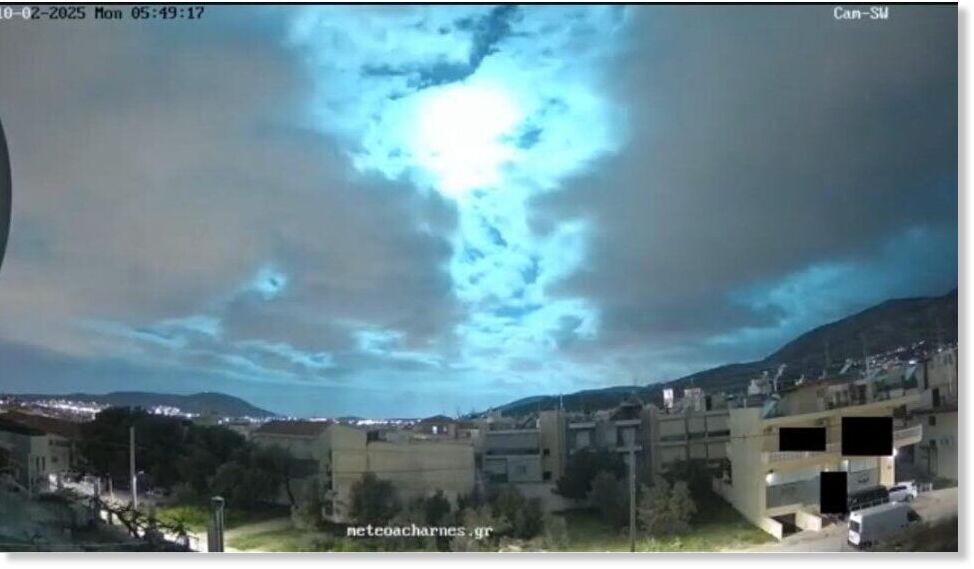
Mysterious morning flash over Attica, Greece caused by meteor fireball on February 10

nnnnnn
© Meteoacharnes
The director of the Hellenic National Meteorological Service (EMY), Theodoros Kolydas, explained that the mysterious morning glow observed by some in the Attic sky on early Monday was caused by a meteor entering Earth's atmosphere.

A video captured by a camera mounted on a meteorological station in Acharnes shows a sudden flash of light that does not appear to originate from cloud formations.

Kolydas confirmed that the phenomenon was indeed a meteor, with its glow visible across central Greece.

"For an observer on Earth, meteors that enter the atmosphere in the early morning hours travel at higher speeds and are more difficult to spot, whereas those appearing in the early evening move more slowly," he noted.


Cassiopaea

Astronomers investigate the evolution of a newly detected supernova

SN 2024jlf
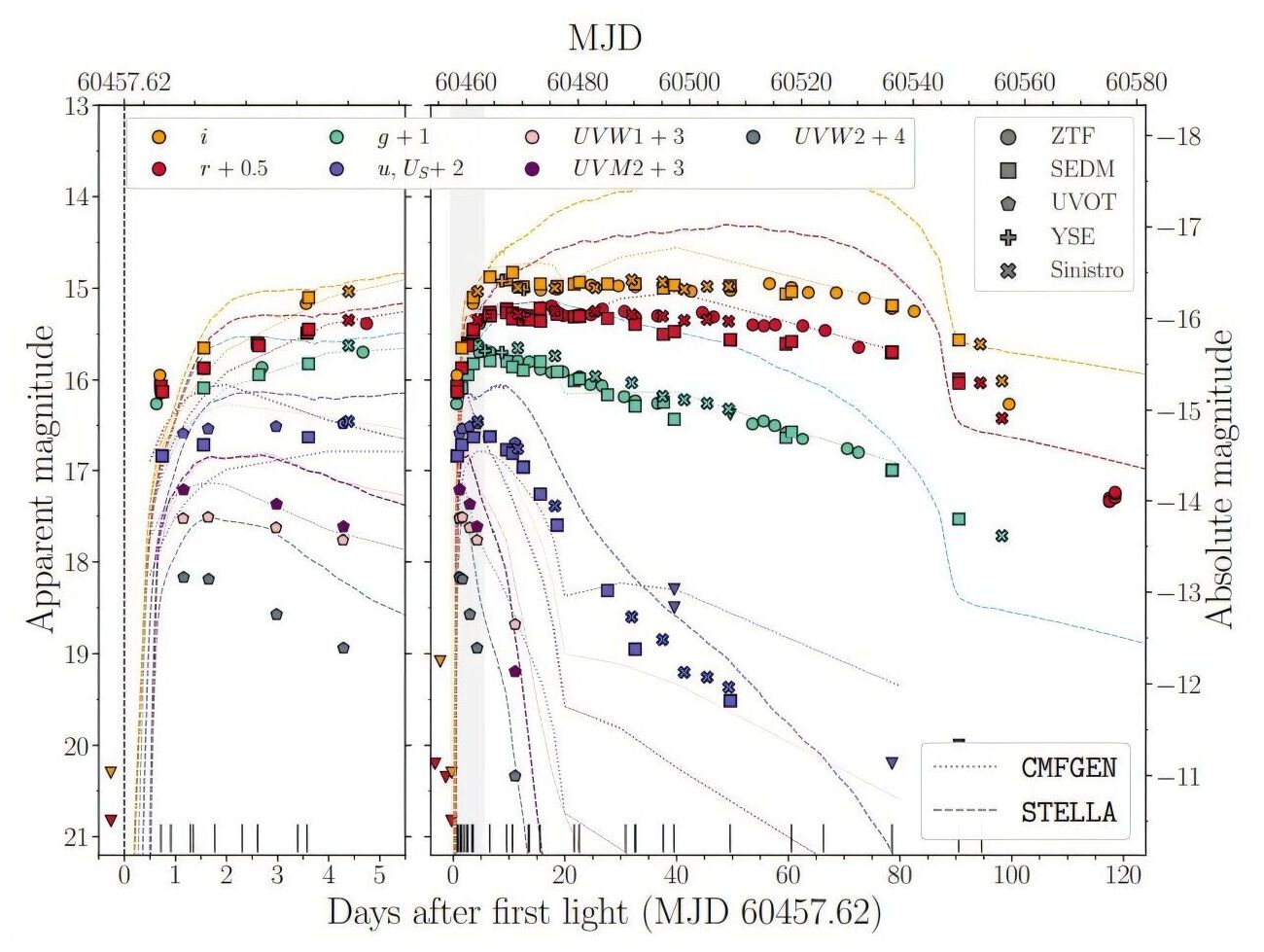
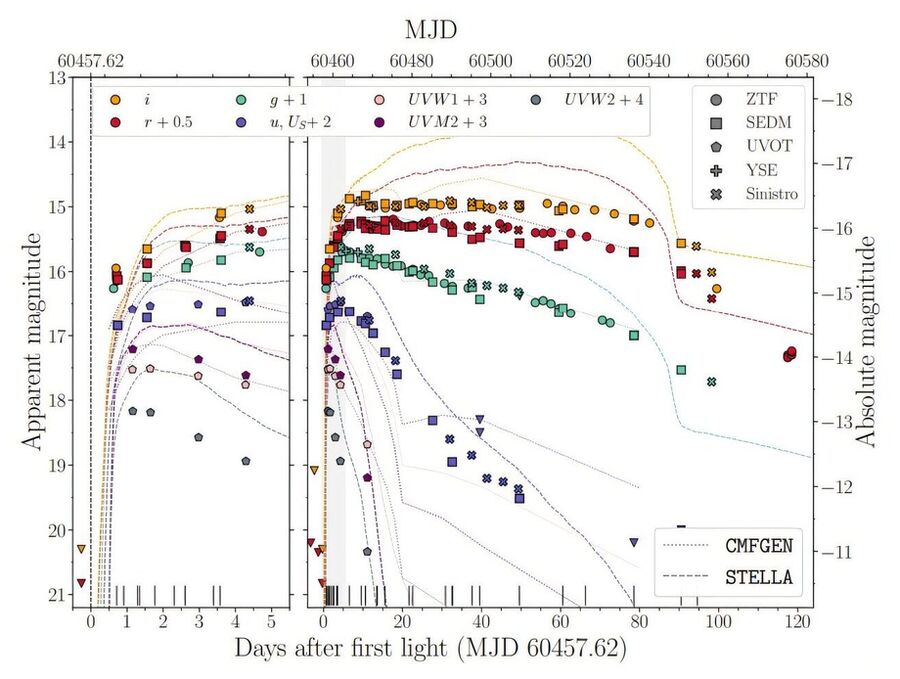
© arXiv (2025). DOI: 10.48550/arxiv.2501.18686Multi-band light curve of SN 2024jlf and best fit model light curves.
An international team of astronomers has investigated a newly detected Type II supernova designated SN 2024jlf. The new study, detailed in a paper published Jan. 30 on the arXiv pre-print server, yields important information regarding the evolution of this supernova and the nature of its progenitor.

Type II supernovae (SNe) are the results of rapid collapse and violent explosion of massive stars (with masses above 8.0 solar masses). They are distinguished from other SNe by the presence of hydrogen in their spectra.

Based on the shape of their light curves, they are usually divided into Type IIL and Type IIP. Type IIL SNe show a steady (linear) decline after the explosion, while Type IIP exhibit a period of slower decline (a plateau) that is followed by a normal decay.

SN 2024jlf was first spotted on May 28, 2024 using the Zwicky Transient Facility (ZTF), with a brightness of 15.88 mag. The supernova occurred in NGC 5690 — an edge-on spiral galaxy at a redshift of 0.0058.

Subsequent observations of SN 2024jlf after its discovery have revealed that its spectrum shows a blue continuum with weak flash features, indicating a young core-collapse supernova of Type II. A search for the progenitor of SN 2024jlf has also been conducted. However, no source has been identified in the location of this supernova.

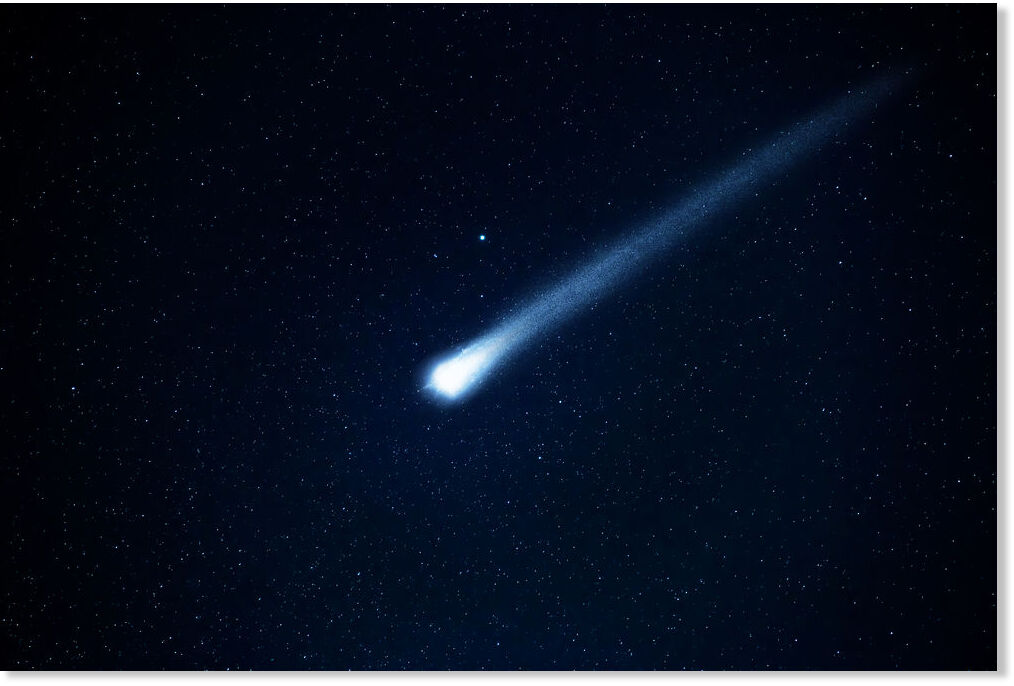
Fireball 4

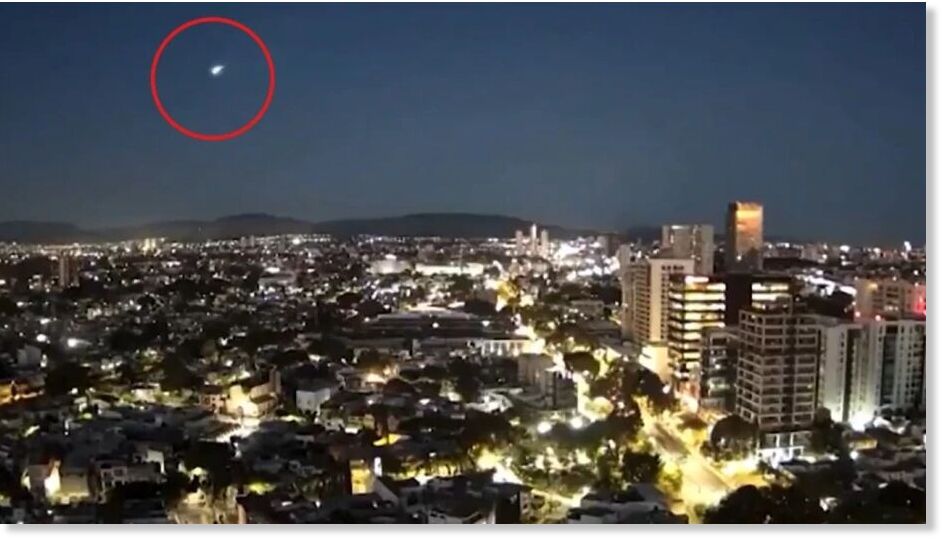
Meteor fireball streaks across Guadalajara, Mexico night sky on January 29

mmmmm
A fireball was spotted streaking across the sky above Guadalajara in Jalisco, Mexico, on the morning of Wednesday, January 29.

Footage from Webcams de Mexico shows the bright object shooting over Jalisco's state capital.

According to the American Meteor Society (AMS), meteors were expected to be visible from January 25 to January 31.