Storms
S


Cloud Lightning

Storm knocks out power, swamps U.S. Pacific Northwest - more rain in a day or two than typically falls in the entire month

Image
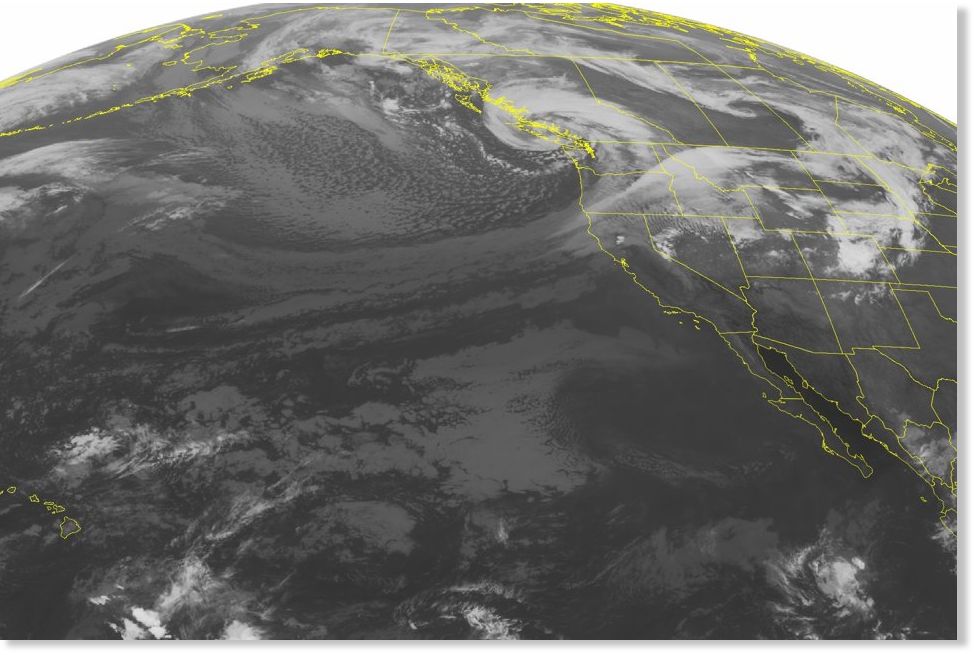
This NOAA satellite image taken Monday, Sept. 30, 2013, at 02:00 AM EDT shows an expansive area of cloudine
An early winter storm dumped a record amount of rain in the Pacific Northwest, knocked out power to thousands and likely churned up a rare tornado Monday that ripped a hole in the roof on an industrial plant near Seattle. The most dramatic damage was at an industrial park in Frederickson, south of Tacoma. As thunder and lightning flashed, the wind uprooted trees and tore a jagged hole in the roof of the Northwest Door manufacturing plant.

"It looked from the inside like a wave going along. You could actually see the roof flexing," Northwest Door President Jeff Hohman said. Witnesses reported seeing a tornado in the area at the time, and the Weather Service sent a team to Frederickson to investigate. Washington may get a tornado or two every year, but they are usually small. One of the largest was an F3 in 1972 in Vancouver that killed six people.

No one was injured in Monday. About 100 employees evacuated and the business closed while inspectors assess a 40-by-40-foot hole in the roof. The wind also caused damage at a nearby Boeing plant, mostly in the parking lot, spokesman Doug Alder said. The storm blew out the windows of about two dozen cars and knocked down fences, power lines and trees. Some tiles were blown off the Boeing roof. Nobody was injured and there wasn't any damage to airplane parts or equipment.

Cloud Lightning

Typhoon leaves 75 missing in China

Typhoon Wulip
© UnknownShips are seen moored in the Xiuying Port to take shelter from typhoon Wulip in Haikou, capital of south China’s Hainan Province, September 29, 2013.
A powerful typhoon has left 75 people missing after sinking three Chinese fishing boats in the South China Sea, media reports say. Citing maritime authorities, Xinhua news agency said on Monday that "three fishing boats have sunk since Sunday afternoon."

The incident took place after the vessels with 88 fishermen aboard encountered strong winds near the Paracel Islands, said a statement released by the Hainan government in south China. "Two of the vessels sank Sunday and contact with the third has been lost," it said. Typhoon Wutip also forced tens of thousands of people to flee high-risk areas in central Vietnam on Monday.

The powerful typhoon, with sustained winds of up to 93 miles per hour, was expected to rock the central coast later Monday. Disaster official Le Tri Cong said more than 43,000 people were evacuated from coastal areas to safe places in Quang Tri Province as of Sunday night.

Arrow Down

Oil spills add to the damage of flood disaster in Colorado

Image
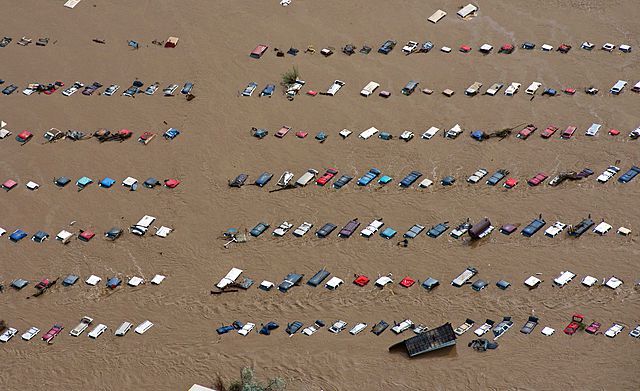
© Dana Romanoff/Getty ImageWorkers attempt to clear a drainage that was clogged from a flash flood September 12, 2013 in Boulder, Colorado. An estimated 6-10 inches of rain fell in 12-18 hours and more is expected throughout the day. Flash flood sirens warned people to stay away from Boulder Creek and seek higher ground.
5,250 gallons of crude oil has spilled from two tank batteries in to the South Platte River south of Milliken.

The spill from a damaged tank was reported to the Colorado Department of Natural Resources Wednesday afternoon by Anadarko Petroleum, the company responsible for the spill.

Nearly 1,900 oil and gas wells in flooded areas of Colorado are shut, and 600 workers are inspecting and repairing sites, according to the Colorado Oil and Gas Association.

Anadarko, the second-largest operator in the operator in the Denver-Julesburg Basin, has shut down 250 tank batteries and 670 wells.

Comment: See also: Is there a media blackout on the fracking flood disaster in Colorado?


Snowflake

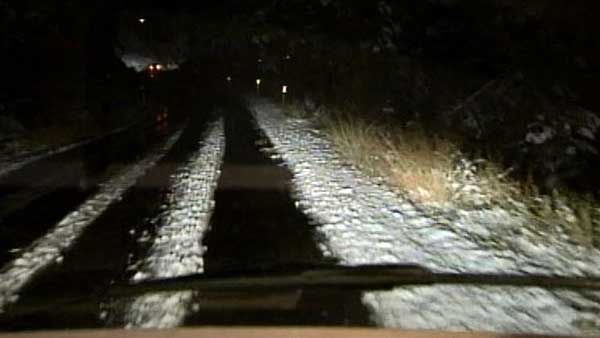
Snow covers parts of California

Image
© KCRA/NBCCalifornia's Sierra Nevada Mountains get the season's first dusting of snow on Saturday.
The first day of fall looked more like the first day of winter in parts of California!

The area around the Sierra Nevada Mountains hit with snow and heavy rains.

The wet weather even causing slick road conditions and caught residents by surprise - who said they were just in t-shirts a few days ago!

Bizarro Earth

Super-Typhoon Usagi: 'Most powerful storm on the planet since 1984' is tearing through Southern Pacific, headed for Hong Kong

Usagi
© The Independent, UK
A monster Super Typhoon has intensified explosively in the last 24 hours and remains on track to wreak havoc in Taiwan, the Philippines and potentially Hong Kong over the weekend.

Over the last day Super Typhoon Usagi, which is now the strongest storm to form on earth this year, has seen winds increase from 75mph on Tuesday to over 160 mph today. The cyclone is now classified now as a Super Typhoon and is considered the equivalent of a category 5 hurricane.

The storm, which is expected to maintain its current strength for at least the next 24 hours, is on course to dump 1000mm of rain (three times the annual London rainfall) on Taiwan over the next three days.

The storm is set to roar between the Philippines and Taiwan before hammering the southern Chinese coast, and possibly Hong Kong, later in the weekend.

Experts have said that due to the lack of 'hurricane hunter' aircraft in the Pacific they can't accurately measure how strong the storm is, and that it may be even stronger.

Cloud Precipitation

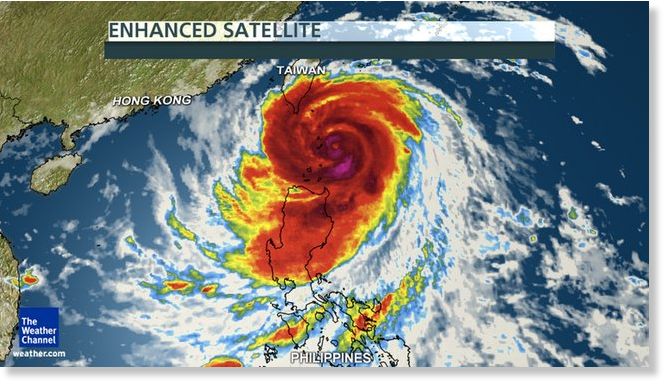
Super Typhoon Usagi threatens Taiwan, Northern Philippines, and Hong Kong

Super Typhoon Usagi,the equivalent of a Category 5 Atlantic hurricane, intensified rapidly Thursday in the western Pacific Ocean and will threaten parts of Taiwan, the far northern Philippines and southern China through the next several days.

Image
A tropical cyclone is dubbed a "super typhoon" when maximum sustained winds reach at least 150 mph. Usagi underwent a period of rapid intensification from early Wednesday through midday Thursday (U.S. Eastern time), going from a 55-knot tropical storm to a 140-knot super typhoon in just 33 hours, or just under a 100 mph intensification, based on satellite estimates of intensity.

Bizarro Earth

Best of the Web: Signs of change in September 2013

Image
A snapshot of the weather around the planet in the past week or so. Floods devastate parts of the U.S., Mexico and India; tornadoes wipe out Tokyo and Bangkok suburbs; mass fish deaths in the U.S. and China; a smokenado in the U.S. (?! yes, it's new to us too!); massive fireballs over Italy (for the second week running) and the U.S. (where they're now being reported daily); major hailstorms in the UK... what in the world is going on?


Cloud Lightning

Downpours, hailstorm leave 7 dead in north west China

china flood
© Unknown
Seven people died and another went missing after downpours and hailstorms lashed Northwest China's Gansu province late Monday, local authorities said Tuesday.

The heavy rain hit parts of Dingxi city, Gannan Tibetan autonomous prefecture and the provincial capital Lanzhou from 7 pm to 11 pm Monday, said the provincial government.

Twenty-six people were injured. Nearly 20,000 people were affected and 213 houses collapsed.

Nuke

Leaking Fukushima nuclear plant dumped more than 1,000 tons of polluted water into the sea after Typhoon Man-yi raked the facility

The operator of the leaking Fukushima nuclear plant said Tuesday that it dumped more than 1,000 tons of polluted water into the sea after a typhoon raked the facility. Typhoon Man-yi smashed into Japan on Monday, bringing with it heavy rain that caused flooding in some parts of the country, including the ancient city of Kyoto.

The rain also lashed near the broken plant run by Tokyo Electric Power (TEPCO), swamping enclosure walls around clusters of water tanks containing toxic water that was used to cool broken reactors. Some of the tanks were earlier found to be leaking contaminated water.
Image
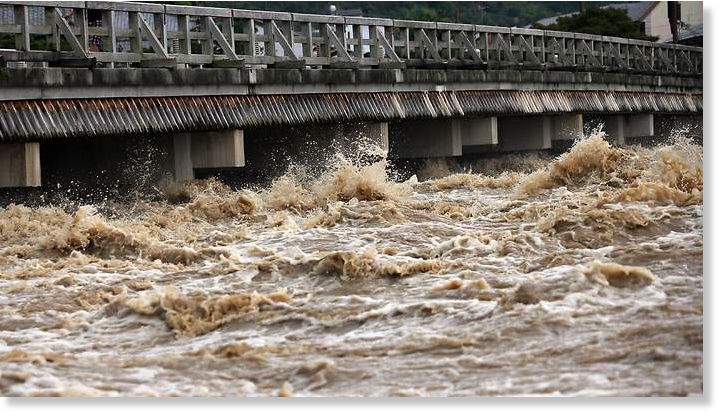
© AAPMuddy water of the Katsura river runs under a bridge in Kyoto as torrential rain hit western Japan. (AAP)
"Workers measured the radioactive levels of the water collected in the enclosure walls, pumping it back into tanks when the levels were high," said a TEPCO official. "Once finding it was mostly rain water they released it from the enclosure, because there is a limit on how much water we can store."

The utility said about 1,130 tons of water with low levels of radiation -- below the 30 becquerels of strontium per litre safety limit imposed by Japanese authorities -- were released into the ground. But the company also said at one site where water was found contaminated beyond the safety limit workers could not start the water pump quick enough in the torrential rain, and toxic water had leaked from the enclosure for several minutes.

Bizarro Earth

Rare twin storms batter Mexico, 40 dead

Mexican Storm
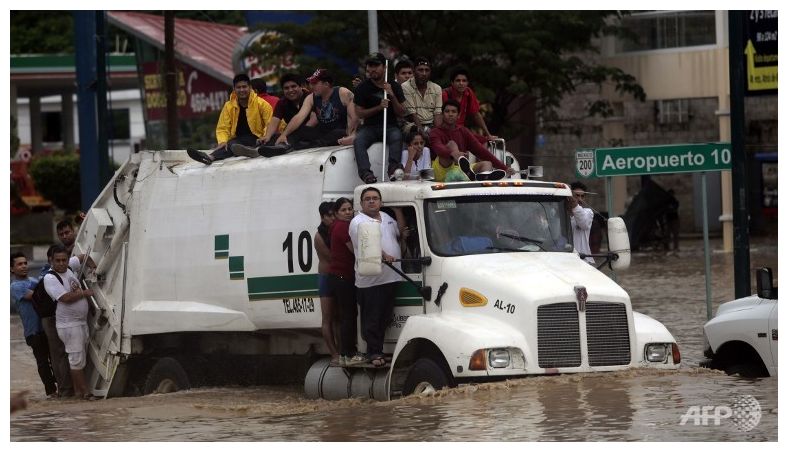
© AFP/Pedro PardoResidents attempt to leave the flooded area in Acapulco, Guerrero state, Mexico, after heavy rains hit the area.
Acapulco: Mexico reeled Monday from the rare one-two punch of major storms on opposite coasts that triggered floods and landslides, killing at least 40 people while stranding tourists in Acapulco.

The Pacific coast was still being battered by the remnants of tropical storm Manuel, which continued to dump rain after dissipating, while hurricane Ingrid hit the northeast with tropical storm force before being further downgraded.

Thousands of people were evacuated as the two storms set off landslides and floods that damaged bridges, roads and homes across the country.

Water rose to almost 10 feet (three meters) in parts of the Pacific resort of Acapulco, cutting off the main highway to the city and marooning tens of thousands of Mexican and foreign beach-goers.

The last time Mexico was hit by two tropical storms in the span of 24 hours was in 1958, officials said. Never had it been struck by a hurricane and another storm at the same time, forecasters said.