Floods
S


Igloo

UN issues new 15 year climate tipping point - but UN issued tipping points in 1982 and another 10-year tipping point in 1989!

Image
© Space.com
According to the Boston Globe, the United Nations has issued a new climate "tipping point" by which the world must act to avoid dangerous global warming.

The Boston Globe noted on April 16, 2014: "The world now has a rough deadline for action on climate change. Nations need to take aggressive action in the next 15 years to cut carbon emissions, in order to forestall the worst effects of global warming, says the Intergovernmental Panel on Climate Change."

Once again, the world is being warned of an ecological or climate "tipping point" by the UN.

As early as 1982, the UN was issuing a two decade tipping point. UN official Mostafa Tolba, executive director of the UN Environment Program (UNEP), warned on May 11, 1982, the "world faces an ecological disaster as final as nuclear war within a couple of decades unless governments act now." According to Tolba in 1982, lack of action would bring "by the turn of the century, an environmental catastrophe which will witness devastation as complete, as irreversible as any nuclear holocaust."

Cloud Grey

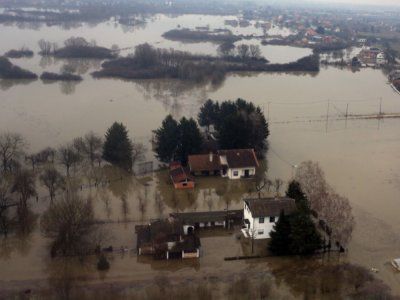
Floods in Serbia prompt evacuation of more than 400 families

Serbia flooding
© Unknown
Flood waves on several rivers and their tributaries in Serbia have prompted the evacuation of at least 440 families in the last two days, leaving thousands of people without water and power supply.

An emergency situation has been declared in five municipalities, but there have been no casualties. The damage caused by the floods that have hit parts of the western, central and eastern Serbia is not possible to estimate until the rivers recede.

Bizarro Earth

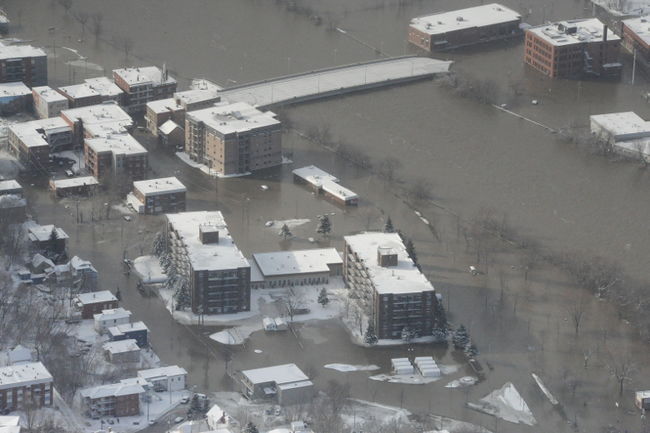
Spring flooding leads to landslides in Quebec, Tim Hortons closure in New Brunswick

Sherbrooke Flooding
© QMI AgencySherbrooke Flooding
The spring thaw and steady rain triggered floods that inundated Quebec towns, washing away homes, forcing evacuations and causing a landslide.

In Sherbrooke, Que., in the Eastern Townships, the Saint-Francois river reached a record 25 feet Wednesday and floodwaters cut the city in two.

Firefighters rang doorbells just after midnight on Wednesday and asked 480 people to leave their homes, bringing the total number of displaced people to 632.

Downtown streets flooded and quickly froze in Sherbrooke as morning temperatures neared -10 C.

The situation was also precarious in Saint-Raymond, Que., east of Quebec City. Torrential rains caused the Saint-Anne River to rise at breakneck speed on Tuesday evening, flooding the downtown core. Mayor Daniel Dion told QMI Agency that 300 people were told to leave their homes.

Umbrella

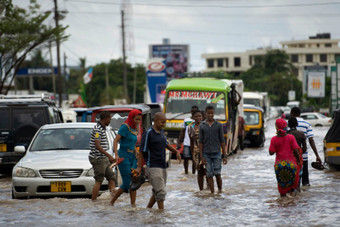
More than 40 feared dead after floods in Dar es Salaam, Tanzania

Tanzania flooding
© Daniel Hayduk / AFPPedestrians cross the flooded Old Bagamoyo Road in the Mikocheni area of Dar es Salaam on April 12th.
Some 41 people are feared dead as a result of floods caused by downpour that hit Dar es Salaam for about three days over the weekend, according to Dar es Salaam Regional Commissioner (RC) Saidi Meck Sadiki.

Mr Sadiki, who by virtue of his position is the Chairman of the Regional Defence and Security Committee, noted, however, that so far 25 people have been confirmed by police to have died as a result of the floods.

"In Ilala District, there are two people who have been reported missing while 11 have been confirmed dead while in Kinondoni, there are seven confirmed deaths and 14 were reportedly buried before corroboration by the police.

In Temeke, seven people perished. "I have directed the police to visit families of the 14 people reported dead to ensure that the said persons really died as a result of the floods as the search for other bodies continue," Mr Sadiki told this newspaper in a telephone interview.

Attention

Best of the Web: Signs of change: Extreme weather, seismic activity, and meteor fireballs in March and early April 2014

Image

Comment: More rain in California in one day than it got in the past year, a record cold winter in the U.S., a "1 in 100 years" flooding event in New Zealand, a meteor explosion that shook homes in New Mexico, giant hailstones in places that don't usually get any hail, record earthquakes in California, the Andaman Islands and all along the Ring of Fire, two meteor fireballs lighting up the East coast of Canada and northern U.S. states in the space of 24 hours, landslides and flash-flooding putting out wildfires in Western U.S. states, and the "worst flooding in living memory" on the Solomon Islands (at the same time as a strong earthquake)...

The following video compilation is a sample of just some of the planetary upheaval recorded in the last month.

Visit HawkkeyDavis's Youtube channel to check out the rest of his awesome work chronicling the 'signs of the times'.


The world has been overwhelmed with disasters in recent weeks. A series of fireballs and earthquakes has rocked and shaken this planet to its core. Meanwhile, the "one-in-100-year events" continue to strike...

Even though it looks like it sometimes, this series does not mean the world is ending! These are documentaries of series of extreme weather events that are leading to bigger earth changes. If you are following the series, then you are seeing the signs.

For those who can't view YT videos:


Cloud Lightning

Unlike anything seen before: Solomon Islands flash floods kill at least 19 people

solomon floods
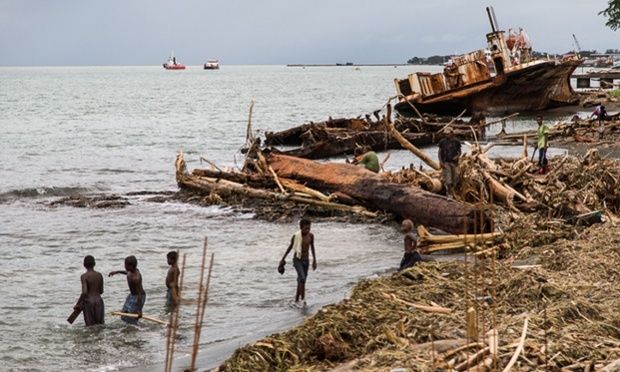
© Rachel Skeates/AFP/Getty ImagesPeople search through the debris on the beach near the Solomon Islands capital of Honiara
Forty people are missing and 49,000 homeless after entire communities washed away following heavy rains

Devastating flash floods in the Solomon Islands have killed at least 19 people, while 40 are still missing and an estimated 49,000 people are homeless.

Entire riverside communities and bridges were washed away when the Matanikau river in Honiara broke its banks on Thursday. The government declared a state of emergency.

Rivers in the north-west, central and north of the island also flooded, destroying homes and displacing communities.There are more than 5,500 people in three of the most populous of the 13 evacuation shelters in Honiara, where aid groups report dengue fever is threatening to spread.

Cloud Precipitation

IPCC: More hunger, floods, conflict and mass migration ahead due to climate change

Image
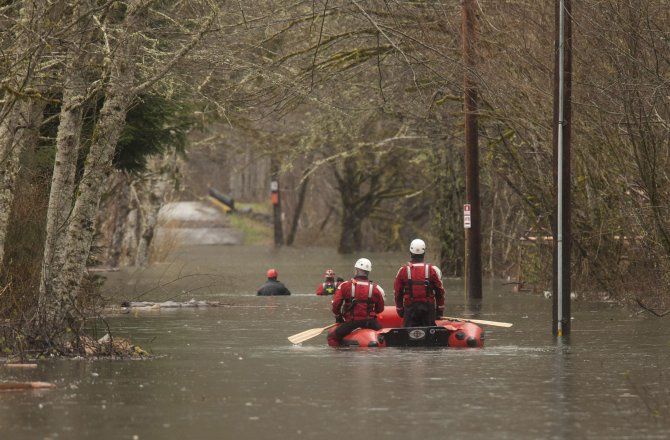
© David Ryder/Getty ImagesSearch-and-rescue crews work in and around flood waters caused by the Oso mudslide on March 29, 2014 in Oso, Wash. A new climate change report predicts flooding will become more common as the planet warms.
Soaring carbon emissions will amplify the risk of conflict, hunger, floods and mass migration this century, the UN's expert panel said Monday in a landmark report on the impact of climate change.

Left unchecked, greenhouse gas emissions may cost trillions of dollars in damage to property and ecosystems, and in bills for shoring up climate defences, it said, adding the impact would increase with every additional degree that temperatures rise.

"Increasing magnitudes of warming increase the likelihood of severe, pervasive and irreversible impacts," a summary said, in a stark message to policymakers.

The report is the second chapter of the fifth assessment by the Intergovernmental Panel on Climate Change (IPCC), set up in 1988 to provide neutral, science-based guidance to governments.

Comment:
Ice age cometh: No warming left to deny... Global cooling takes over... CET annual mean temperature plunges 1°C since 2000
SOTT Talk Radio: Climate Change, Food Shortages and the Future


Snowflake Cold

STILL not done - Massive March Nor'easter bigger than Hurricane Sandy expected to bring winds, snow, cold blast to Northeast

March came in like a lion, and it looks like the lion isn't leaving, but you can't blame the "polar vortex" this time.

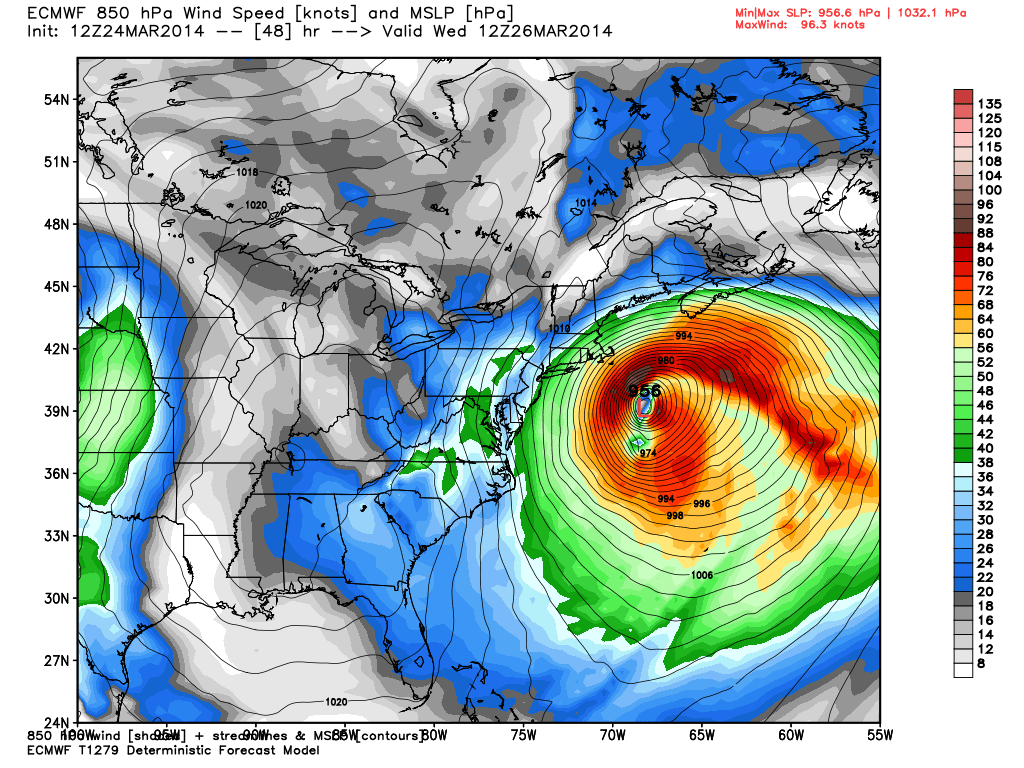
As a massive winter storm at sea known as a Nor'easter prepares to skirts the Northeast coast of the USA, bringing with it high seas and bitterly cold weather in its wake, Dr. Ryan Maue writes:
Massive Nor'easter will develop a warm-core thru a seclusion process.

Compare previous image w/Hurricane Sandy - same 850-mb Wind speed & MSLP. Nor'easter wind field much stronger/larger.

[It is] maybe 4 times more powerful than Sandy based on integrated KE of wind field.
The image of the storm is quite stunning for it's sheer size.
March Nor’easter
© ECMWF

Cloud Precipitation

Sheets of rain: Torrential rains kill 32 in South Africa

Rain in South Africa
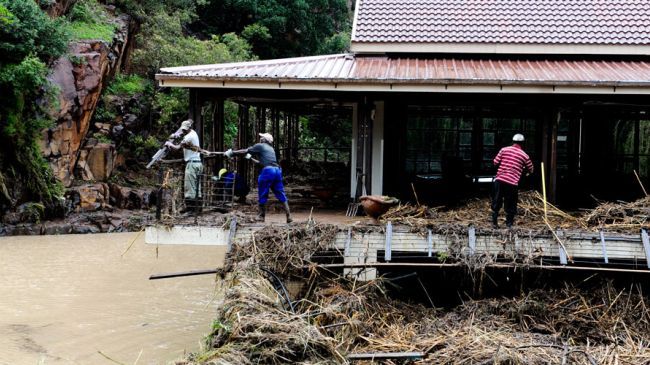
© UnknownThree men clean up a lodge after the building was gutted by flooding following a dam burst caused by heavy raining in Limpopo, South Africa.
Floods caused by torrential rains have killed at least 32 people and displaced thousands of others in South Africa.

Andries Nel, South African deputy minister of cooperative governance and traditional affairs, said on Monday that the heavy raining had displaced 3,000 people from their homes in the Lephalale Local Municipality in the northern part of the country.

"Regrettably, the present disaster events have resulted in 32 fatalities. These include 25 drownings. Six fatalities were also caused by lightning and one person died due to a collapsed wall," Nel stated.

The South African official also said rescue operations were underway as a number of people were still trapped in their homes due to flooding. In addition, search efforts have begun to find people reported missing.

Over the past two weeks, torrential and persistent rains have pounded most parts of South Africa. The most affected areas are in the north and eastern parts of the country.

Ice Cube

Frequent floods in the European Alps coincide with cooler periods of the past 2500 years

Image
Floods of the European Alps

Background

The authors write that "severe floods triggered by intense precipitation are among the most destructive natural hazards in Alpine environments, frequently causing large financial and social damage," and they say that "potential enhanced flood occurrence due to global climate change would thus increase threats to settlements, infrastructure, and human lives in the affected regions." However, they note that, currently, "projections of intense precipitation exhibit major uncertainties" and that "robust reconstructions of Alpine floods are limited to the instrumental and historical period," giving one reason to question whether global warming would lead to such a consequence.

What was done

In a study designed to reduce these uncertainties and extend reconstructions back in time beyond the instrumental period, Glur et al. developed "a multi-archive Alpine flood reconstruction based on ten lacustrine sediment records, covering the past 2500 years." More specifically, they studied ten lakes situated north of the Central Alpine arc along a montane-to-Alpine transect, spanning an elevation gradient from 447 to 2068 m asl," which allowed "the extraction of a synoptic, rather than a merely local rainfall signal revealed by a single-lake study." And to verify their approach to the subject, they compared the last 500 years of their Central Alpine flood reconstruction with an independently established flood record for that period that was based on historical documents, as developed and described by Schmocker-Fackel and Naef (2010).

What was learned

"Regarding the best-characterized climatic periods during the past 2500 years," the eight researchers report that "flood activity was generally enhanced during the Little Ice Age (1430-1850 C.E.; LIA) compared to the Medieval Climate Anomaly (950-1250 C.E.; MCA)." And they say that "this result is confirmed by other studies documenting an increased (decreased) flood activity during the LIA (MCA) in the Alps," citing the studies of Schmocker-Fackel and Naef (2010), Czymzik et al. (2010), Wilhelm et al. (2012) and Swierczynski et al. (2012).