Animals
S


Wolf

'Super pack' of 400 wolves terrorise remote Russian town after killing 30 horses in just four days

Image
© Caters News AgencyAttacks: A hunter holds up the body of a dead wolf after a massive pack of 400 of the animals has terrorised the town of Verkhoyansk in Russia
A 'super pack' of wolves has been terrifying a town after leaving more than 30 horses dead in just four days.

Four hundred bloodthirsty wolves have been spotted prowling around the edges of Verkhoyansk, in Russia, attacking livestock at will.

Twenty four teams of hunters have been put together to get rid of the wolves, with a bounty of £210 for every wolf skin brought to officials.

Stepan Rozhin, an administration official for the Verkhoyansk district in Russia, said: 'To protect the town we are creating 24 teams of armed hunters, who will patrol the neighbourhood on snowmobiles and set wolf traps.

'But we need more people. Once the daylight increases, the hunters will start shooting predators from helicopters.'

A pack of wolves this size is unheard of, with the animals usually preferring to hunt in smaller groups of just six or seven.

The massive group is believed to be made from hundreds of packs and has left animal experts baffled.

Dr Valerius Geist, a wildlife behaviour expert, said the harsh Siberian winter - where temperatures plummet to minus 49C - had killed off the animal's usual prey.

He said: 'It is unusual for wolves to gather in such numbers or hunt large animal like horses.

'However, the population of their usual prey, rabbits, has decreased this year due to lack of food, so wolves have had to change their habits.

'Wolves are very careful to choose the most nutritious food source easiest obtained without danger - which in this case happens to be horses.

Camera

US: Poisonous New Pseudoscorpion Found in Colorado Cave

Image
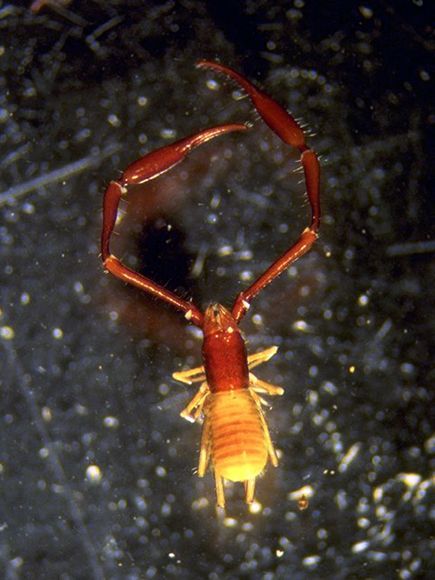
© Dave SteinmannThe new pseudoscorpion is top of the food chain in Glenwood Caverns.
Nearly blind animal has venom-tipped pincers.

Unless you've been living in a cave, you probably haven't run across this new species of poisonous, nearly blind pseudoscorpion.

The 0.5-inch-long (1.3-centimeter-long) species, Cryptogreagris steinmanni, was discovered recently in high-altitude caverns near Glenwood Springs, Colorado.

Pseudoscorpions are essentially scorpions that lack a stinging tail. However, the new species does have long, venom-tipped pincers that likely help it nab agile prey, such as springtails, in the gloom.

Most likely, the new pseudoscorpion lives only in Glenwood Caverns and Historic Fairy Caves, the study authors say.

"A lot of these caves are islands, almost like an isolated environment where invertebrates ... evolve into being adapted to underground life," said biospeleologist David Steinmann, a zoology department associate with the Denver Museum of Nature and Science. Steinmann collected the new species after it was discovered in 2000 by tour guide Micah Ball.

With its primitive eyes and pale color, the arachnid is perfectly suited to its dark, chilly existence and has probably been scurrying through the passages for millions of years, Steinmann said.

Bizarro Earth

New Zealand: New Bid to Free Re-Stranded Whales

Stranded Whales
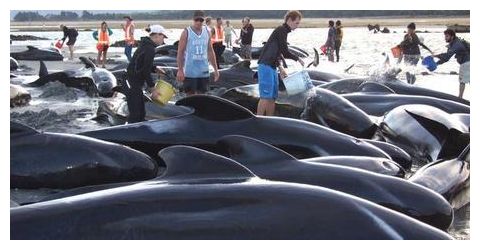
© Serge ZollingerVolunteers help keep the beached whales hydrated at Puponga Point on Friday.

Three pilot whales were found dead near Farewell Spit, at the top of the South Island, after they beached for the third time this morning.

Department of Conservation (DOC) spokeswoman Trish Grant told NZPA the two groups of whales which restranded on Farewell Spit yesterday afternoon moved with the high tide overnight, and have now formed three groups.

She said there were about 19 whales near Puponga, about 25 at the base of Farewell Spit on triangle flat, and about 25 whales 10km down the spit.

The groups were believed to include the 66 whales which refloated themselves on Saturday morning after becoming stranded at Puponga Point, north of Taupata Point, on Friday. Fourteen of the pod died in that stranding.

"Some of the dead are calves," Ms Grant said. "This is the third time they have stranded and to be stranded even once is a quite a stressful ordeal for a whale. They are doing surprisingly well considering what they have been through."

Question

New Zealand: Mystery as Dead Birds Pile up on City Street

Dead Bird
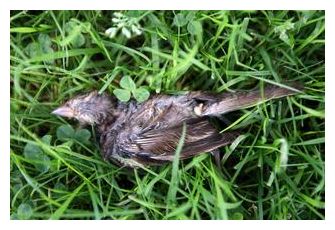
© Andrew Warner 020211aw2 Dead: One of the sparrows found on Amohau St over the long weekend.

What killed hundreds of dead birds found on a Rotorua central city street? Nobody seems to know.

Rotorua mother Glyssa Bosworth was walking down Amohau St this week when her 1-year-old daughter pointed out a bird on the ground.

Then she saw a few more.

"I could smell something absolutely horrific," Miss Bosworth told The Daily Post.

She turned around and saw "hundreds" of them on the ground around the base of a tall tree in the reserve near the entrance to the Central Mall.

She said she had never seen that many dead birds before.

"There was a humongous pile of them. It was gross."

Bizarro Earth

Dead fish wash up on Florida shore

dead fish
© CNN
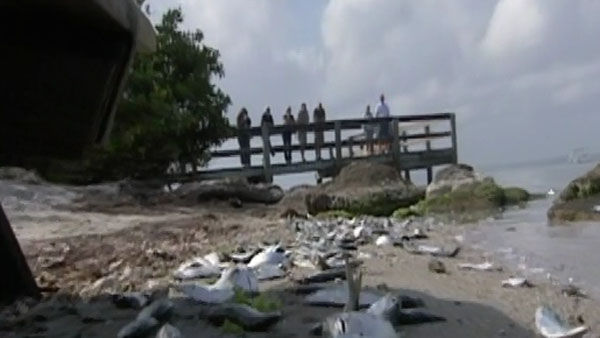
Sebastian - Biologists from the Florida Fish and Wildlife Conservation Commission said they believe a lack of oxygen is what caused thousands of fish to die at Sebastian Inlet State Park.

WPBF 25 News alerted the FWC after u local user jhazel uploaded photos of the dead fish that had washed ashore Friday morning.

"I saw the fish jumping out there and I thought it was going to be a really good day for fishing, and then I noticed over here in the surf that they're all dead," fisherman Jeff Johnson told WPBF 25 News.

FWC biologists arrived to assess the situation and take water samples as people watched.

"It's a little shocking, yes," Johnson said. "I don't know if there's chemicals in the water or the temperatures that caused this."

Biologists said it's neither.

Bizarro Earth

Brazil - Thousands of dead fish in the Pantanal

dead fish
© Rhobson T. Lima/O Pantaneiro
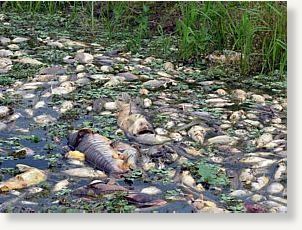
Mato Grosso Do Sul, Amazon Region - At Aquidauana, pantanal region of the Mato Grosso do Sul state, shoals of painteds, pacus, golden fishes, cacharas - and even stingrays, are floating dead in Rio Negro, one of the largest in the Amazon River basin.

The estimated Environmental Policy is of that several tons of fishes died, adding that the authorities and experts, they still do not have the scale of the ecological disaster.

Biologist of the State Institute of the Environment, Robert Gill Machado, noted the phenomenon, considered of great proportion, after flying over the region of sub-basin of Rio Negro. At this place fishing is banned. The area is considered one of the nurseries of fish breeding of the Pantanal.

According to the technicians of the Institute the symptoms that occur in this case are the same symptoms of other instances of the genre. The fish are dying putting their heads out of water trying to obtain air, due to lack of oxygen in the water. This deficiency is due to the large volume of ash produced by burned, which is carried by runoff along riverbeds of the wetland.

Bizarro Earth

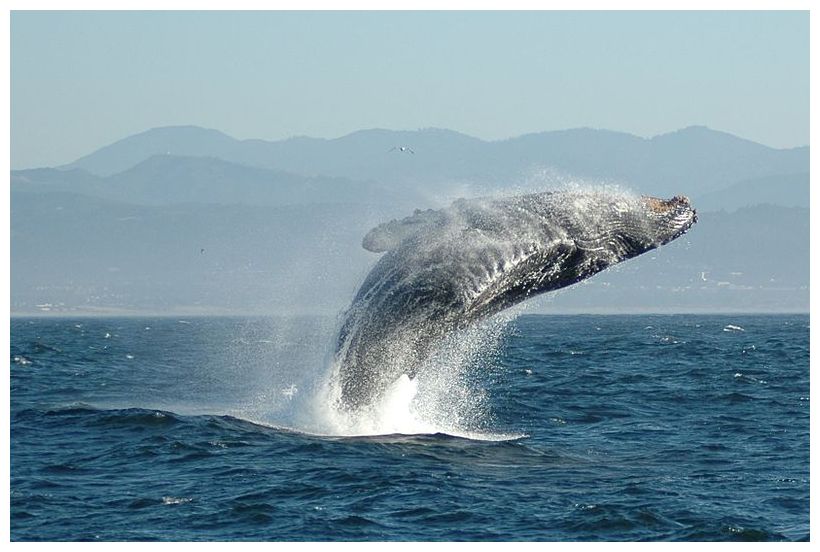
Whales Appearing in New York Harbor in Greater Numbers

Humpback Whale
© Zorankovacevic / Wikipedia Commons
Just minutes outside of the New York Harbor, whales, dolphins and seals have been arriving in increasing numbers.

Prof. Christopher Clark, neurobiology and behavior and zoology, has monitored the animals since 1972 by placing acoustic recorders on Long Island and the mouth of New York Harbor and analyzing the data collected from them.

Although their presence has surprised many people, whales and other aquatic mammals have inhabited the area for many years, Clark said. He explained that scientists had not studied them consistently until recently.

"The whales are quite mobile and might go out from the continental shelf into the Gulf Stream, but there are enough of them moving around that there are always whales in New York," Clark said. "This is part of their home turf."

Clark estimates that as many as 30 to 50 fin whales are now living in the ocean offshore of New York City.

Fish

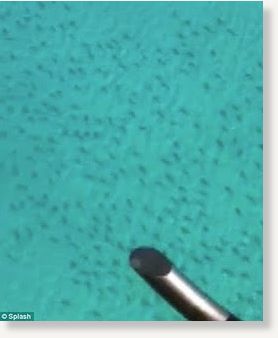
More strange animal behavior: More than 100,000 Sharks off Florida beach!

Image

Pilot Steve Irwin was astonished after spotting a mass of more than 100,000 sharks swimming just 100 yards off Florida's sandy beaches.

The long-time fisherman and marine technology expert was cruising 300ft above the clear waters in his helicopter on Sunday when he came across the astonishing scene.

Experts say this is the time of year when sharks migrate and head for warmer waters, typically swimming close to the shore while chasing after bait-fish.

But Mr Irwin, who runs Island Marine Services in Fort Pierce, was baffled as to the staggering number of sharks gathered in the shallow waters.

Bizarro Earth

New Zealand: 82 Whales Stranded in Golden Bay

Stranded Whales
© Newstalk ZB

Ten of the whales which stranded at Golden Bay have died.

The Department of Conservation received a call from a member of the public about 82 pilot whales stranding at Puponga Point at around 1pm this afternoon.

Around 100 volunteers are at Puponga Point trying to keep the remaining 72 wet, however they will knock off at around half past eight as it's too dangerous in the dark.

DOC spokeswoman Trish Grant says the next high tide isn't until 11:30pm tonight so another attempt at re-floating the whales won't be able to take place until the morning.

"Initially there were about 30 stranded and about 50 DOC staff with volunteer help tried to get those that were still floating back out to sea but unfortunately they weren't able to do that with the tide," she told Newstalk ZB.

Arrow Down

Oysters Disappearing Worldwide: Study

oysters
© AFP/Getty Images/File/Chris GraythenA survey of oyster habitats around the world has found that the succulent mollusks are disappearing fast and 85% of their reefs have been lost due to disease and over-harvesting. Most of the remaining wild oysters in the world, or about 75 percent, can be found in five locations in North America, said the study published in BioScience, the journal of the American Institute of Biological Sciences.
A survey of oyster habitats around the world has found that the succulent mollusks are disappearing fast and 85 percent of their reefs have been lost due to disease and over-harvesting.

Most of the remaining wild oysters in the world, or about 75 percent, can be found in five locations in North America, said the study published in BioScience, the journal of the American Institute of Biological Sciences.

An international team of researchers led by Michael Beck of the Nature Conservancy and the University of California, Santa Cruz, examined the condition of native oyster reefs in 40 ecoregions, including 144 bays.

"Oyster reefs are at less than 10 percent of their prior abundance in most bays (70 percent) and ecoregions (63 percent)," said the study.

"They are functionally extinct -- in that they lack any significant ecosystem role and remain at less than one percent of prior abundances in many bays (37 percent) and ecoregions (28 percent) -- particularly in North America, Australia and Europe."

By averaging the loss among all regions, the researchers came up with an estimate that 85 percent of oyster reef ecosystems have been lost, but said that figure was likely low because some areas lacked historical records for comparison.

The study also did not include oyster reefs in parts of South Africa, China, Japan, and North and South Korea.