Animals
S


Attention

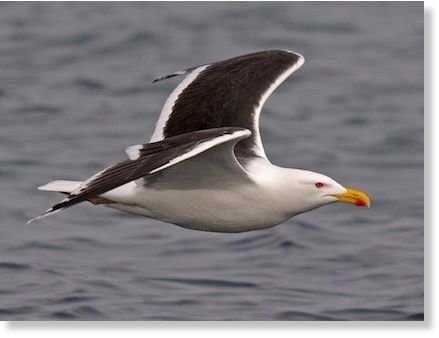
Swimmer attacked by great black-backed gull in County Kerry, Ireland

Image
Great Black-backed Gull
A swimmer reportedly needed tetanus shots after being attacked by a seagull in the sea at Fenit in Co Kerry last week.

The attack took place last Tuesday afternoon, around 70m off the shoreline.

Medical attention was needed, senior county council officers have confirmed.

The gull swooped on the man, believed to be a visitor to the area, and returned a second time, even though the swimmer was trying to resist the bird.

The man beat the gull away, but it drew blood from his hand.


Lifeguards directed him to the emergency department at Kerry General Hospital, where he is understood to have received tetanus shots.

Wolf

Child seriously injured by family dog in Plant City, Florida

Image
© Marcus Grayson, WTSPThe Hillsborough County Sheriff's Office says it was a 50-pound female boxer that attacked the child. Investigators are seen impounding the dog and her puppies.
A child was taken to Tampa General Hospital with serious injuries after being attacked by the family dog Tuesday.

Teresa Budd, a Good Samaritan and witness, says that though she was shocked by what she saw, and glad to be at the right place at the right time.

"He was tossing around like a dog does when they get into things (demonstrating a growl). He would go back and forth and attack again," says Budd.


Attention

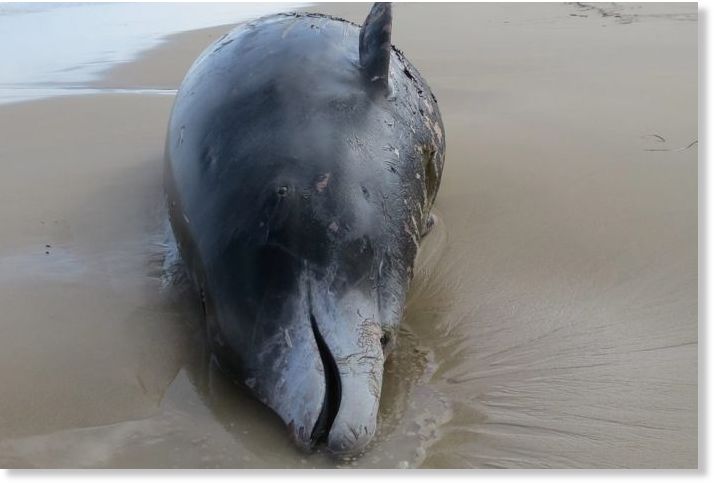
Carcass of deep-diving Cuvier's beaked whale found on beach at Discovery Bay, Australia

Image
© Scott Baker Scott Baker stumbled across a dead Cuvier's beaked whale on a remote stretch of beach west of Portland.
The carcass of an elusive Cuvier's beaked whale has been found stranded on a beach at Discovery Bay in Portland, in south-western Victoria.

The deep-diving mammal was discovered on a remote stretch of beach west of Warrnambool on Sunday.

The whale species is known to dive to depths of up to 3,000 metres and can spend more than two hours underwater.

Scott Baker, who came across the carcass while hiking, knew the find was significant.

"It was very exciting, they're not very commonly found," he said.

After photographing the animal, Mr Baker contacted researchers for a second opinion.

Attention

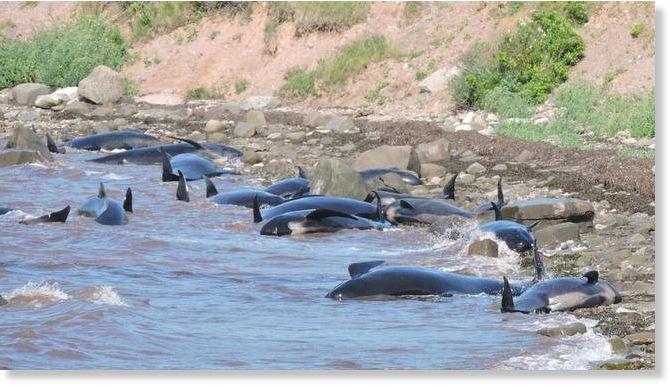
6 pilot whales die after beaching in Cape Breton, Canada

Image
© Elaine LegaultBeached whales are shown on the shores of St. Georges Bay in Judique
Sixteen pilot whales beached on a shore near Judique, Cape Breton, Tuesday morning, sparking a rescue effort involving about 20 people.

Andrew Reid with the Marine Animal Response Society said 10 of the whales were pushed into deeper water and survived. Six others died.

Local resident Maggie MacIntyre said people gathered at the beach early in the morning for the rescue effort.

"There were between one and four people surrounding each whale," she said.

"For as many whales as we could, people were just trying to keep them upright and trying to nudge them out to deeper water."

MacIntyre said the whales ranged in size, including a baby that was less than a metre long and adults that were up to 3½ metres in length.


Attention

Dozens of dead seabirds found on beaches around Homer, Alaska

Image
© KBBI Bishops Beach
The Alaska Maritime National Wildlife Refuge is receiving multiple reports indicating a significant increase in dead and dying birds found on beaches in the Homer area over the last two weeks. The reports are coming from beach walkers and local citizen scientists dedicated to surveying sea bird populations. Leslie Slater is the Gulf of Alaska Unit Biologist for the Alaska Maritime National Wildlife Refuge. She says the number of birds reported is in the dozens.

"So it's hard to give a real exact number of the normal number. I would say on a given stretch of beach we normally don't find more than one within a couple of miles stretch."

Slater says there are a lot of potential reasons for the increase in fatalities but the prevailing cause is likely tied to the birds' food sources.

"What we're seeing more precisely is that birds seem to be starving. That's sort of the ultimate cause of their deaths but something might be happening before that. We might be having a PSP (Paralytic Shellfish Poisoning) outbreak or another situation called domoic acid where these biotoxins can build up through the food chain and ultimately cause the deaths of these birds."

Binoculars

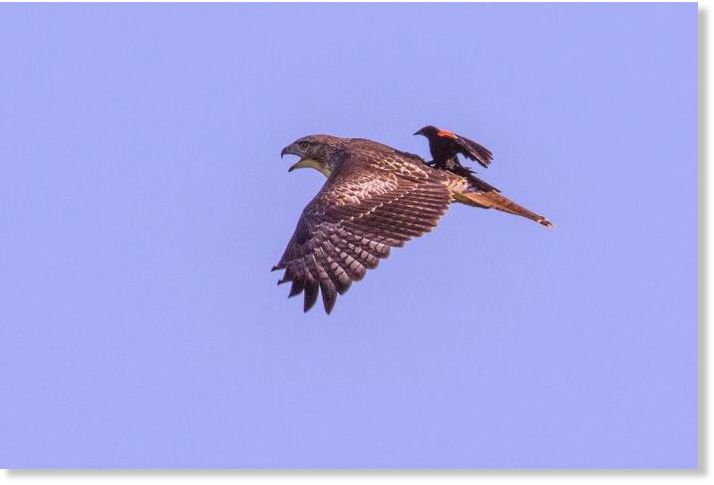
Red-winged blackbird rides on red-tailed hawk's back

Image
© Mike White"Hitching a Ride."
The U.S. Department of the Interior shared a photo from a wildlife refuge showing a red-winged blackbird hitching a ride on the back of a red-tailed hawk.

The photo, which was shared by the department on Facebook and Instagram, was snapped by eagle-eyed photographer Mike White at the DeSoto and Boyer Chute National Wildlife Refuges in Nebraska and Iowa.

"We occasionally see territorial blackbirds (among others) dive-bombing raptors, but this is definitely something you don't see every day," the department said.

White's photo was titled "Hitching a Ride."

Attention

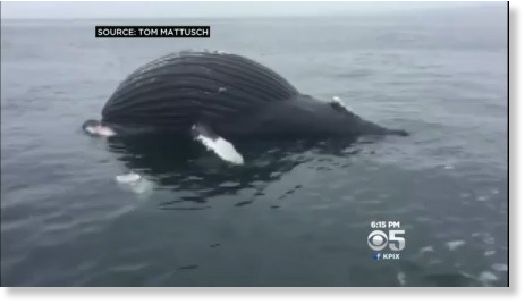
Another dead whale found near Pacifica, California: 4th since mid-April

Image
© Tom MattuschTom Mattusch provided this picture of a dead Humpback Whale floating off the Pacifica Coast.
Boaters were being warned to watch out for a large dead whale found floating off the Pacifica Coast near shipping channels.

"We found this Humpback Whale, floating, rather bloated," boater Tom Mattusch said.

The whale was found just a few miles off the coast, swollen to the size of a small house.

The fishing vessel Hulli Cat was returning from a Farallon bird watching trip when Mattusch spotted it.

"I've been coming out on the ocean since 1967, and this is the first bloated, floating whale that large I've ever seen," Mattusch said.

An increased number of dead whales have been washing onto Bay Area shores. Another dead whale washed onto the beach in Pacifica Sunday.

Comment: See also:Dead whale found on beach in Pacifica, California: 3rd since mid-April


Sheeple

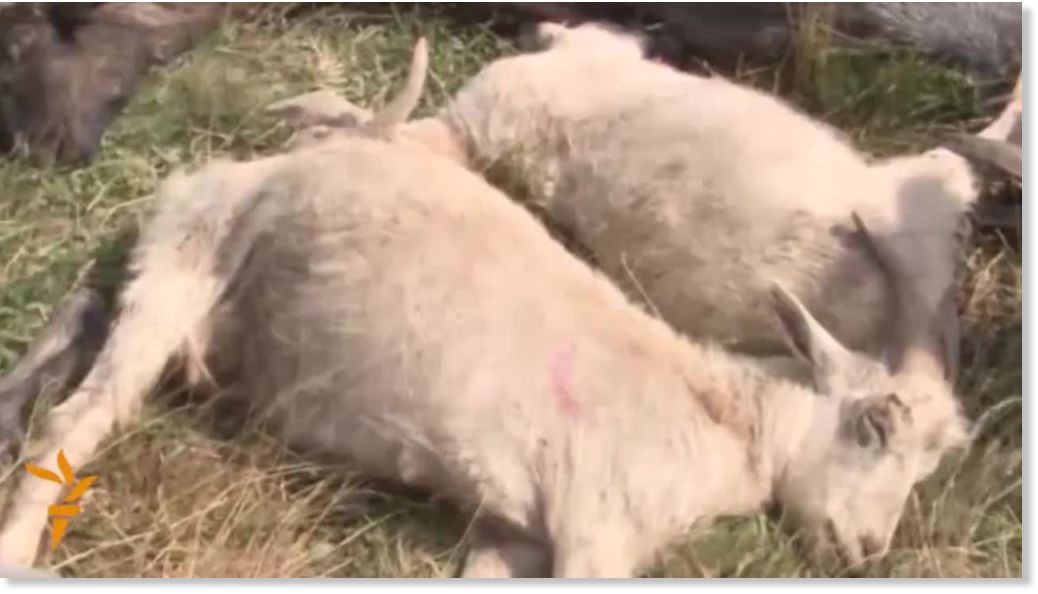
1,000 sheep die mysteriously in Kazakhstan

Image
Dead sheep in Kazakhstan
Kazakh authorities are unable to explain the sudden death of around 1,000 sheep in a single district.


Comment: See also these other recent reports of mysterious mass animal deaths in Kazakhstan: Death toll of rare saiga antelope reaches 85,000 in Kazakhstan

More mass animal deaths in Kazakhstan: 70 rare dalmatian pelicans found dead in country's west

Over 1 thousand dead seagulls discovered in Kazakhstan sector of Caspian Sea

If these deaths are being caused by viruses, then perhaps the following extract from the book Earth Changes and the Human-Cosmic Connection (The Secret History of the World) by Pierre Lescaudron, may be of some relevance here:
Space-bound bio-hazard

Fred Hoyle and Chandra Wickramasinghe have shown how viruses can be spread in the Earth's atmosphere by dust in the debris stream of comets. [313] When Earth passes through this stream, the dust and viruses enter the upper parts of our atmosphere, [314] where they can remain suspended for years until gravity finally pulls them down. [315]

Microbes can also be brought by meteorites directly to Earth's surface. That's the conclusion of the same Professor Chandra Wickramasinghe, who published a paper showing the presence of fused fossilized microorganisms in a meteorite that recently hit the ground. [316] Wickramasinghe conducted extensive tests that ruled out any possibility of terrestrial contamination. A cosmic origin for some microbes may explain why so many new viruses emerge in Asia. The Earth's atmosphere is thinnest at the Himalayas and its surrounding region, [317] therefore 'drop-downs' should take less time there. It might also explain why new strains of viruses usually affect birds first, as we see with the numerous avian flus. [318] During their drop-down, microbes are first present in the sky, where they can contaminate birds before eventually reaching the ground.[321]
In addition, there's this report to take into possible consideration - Why the U.S. Is Building a High-Tech Bubonic Plague Lab in Kazakhstan?


Binoculars

Lost Tropical Kingbird turns up far north of normal range, near Savage, Minnesota

Image
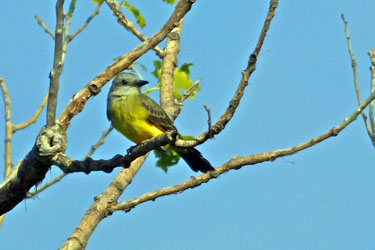
© Ron TaubeTropical kingbird photographed in Murphy-Hanrehan Park in Savage. Likely the first seen in Minnesota.
Recently on the Minnesota Ornithological Union's rare bird alert a tropical kingbird was reported. To my knowledge, this was the first reporting of this bird in Minnesota's history.

It was spotted by a keen observer down in the Murphy-Hanrehan Park, part of the Three Rivers Park district in Savage, Minnesota. The tropical kingbird is most often seen in Texas, Arizona and in Central and South America. No one really knows what it is doing so far out of its area, but nevertheless, it is here.

After going down to Murphy-Hanrehan once and failing to find the bird my wife, Carolyn, and I went down again a few days later to try again. I read several reports of its sightings, and it seemed that you had your best chance early in the morning or from 6 p.m. on, so we timed our visit to arrive in the evening.

The tropical kingbird is between 8 1/2 and 9 inches long. It has a pale gray head with a darkened mask-like area around its eyes and a gray bill. The back is gray-green and it has a forked tail. The throat is grayish and then beneath that is an olive yellow that turns into yellow on the belly and on down.

Wolf

Dog attacks on the rise in New Zealand

Image
© AFP
The Association of Plastic surgeons looked at ACC claims from 2004 to 2014 and said the number of attacks increased each year.

The study found almost 6000 of those bitten by dogs were admitted to hospital - a rate of almost two a day. More than a third of them are children, with mostly facial injuries.

Plastic surgeon Dr Zachary Moaveni said about 70 percent of attacks occured on private properties.

He said children under 10, Maori and Pacific Islanders and people who lived in low socio-economic areas were more likely to be attacked.