Animals
S


Clock

Colorado: Bugs killing off Aspen's namesake tree

EAGLE COUNTY - With each new day, city officials in Aspen find more dead or dying aspen trees. They say the culprit is a tiny insect known as the Willow Scale.

Clock

Tiny but Hungry, Moth Threatens California Crops

SAN FRANCISCO - Full grown, the light brown apple moth is roughly the size of a nickel: a little dirt-colored insect with an adult life span shorter than the average summer vacation.

Wine

Giant Frogs Raid Toilets, Power Lines

It sounds like the plot of a B movie.

People scream after finding huge frogs in their toilet bowls. Electrified amphibians cause multiple blackouts. Frogs hitch rides in cars, later surprising unsuspecting drivers.

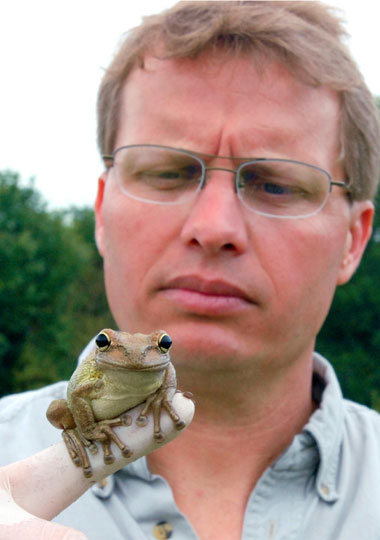
It's all real, and, according to the University of Florida, the invasive Cuban tree frog is responsible for the chaos. The species has colonized over half of Florida and is now moving in on the rest of the state. The 6-inch-long frogs, which dwarf native tiny tree frogs, have also been found in Georgia, South Carolina, California, Hawaii and Canada.

©AP photo/University of Florida/IFAS/Josh Wickham
In this photo, Steve Johnson holds a Cuban tree frog at the Gulf Coast Research and Education Center in Plant City. The invasive frog, which can be more than six inches long, has colonized the southern half of the state and is moving north.

Question

"Stinky Whale" Mystery Stymies Scientists, Aboriginal Hunters

A rancid stench in the meat of some gray whales has made them inedible to Russian aboriginal hunters, according to a new report.

Chemical contamination or disease may be causing the increasing phenomenon of so-called stinky whales, experts say.

A similar stink is also being noticed in the meat of ringed and bearded seals, walruses, and cod, the report by the International Whaling Commission (IWC) adds.

Something Fishy

Aboriginal whalers in Russia's northeastern province of Chukotka first began sensing there was something wrong with the whales in the 1990s.

Since then, many of the mammals they tow ashore from a hunt end up having a foul medicinal odor.

People who eat the meat have reported temporary problems such as numbness in the mouth, skin rashes, and stomach aches. Such whales are of no other use to locals.

"Even dogs will not eat the meat," said Gennady Inankeuyas, a whaling captain and chairman of the Association of Traditional Marine Mammal Hunters of Chukotka. The organization looks after the interests of whale hunters and their families.

USA

Gypsy Moths Attack Mid-Atlantic Forests

Picnickers in East Coast woods may get some hungry visitors this summer. But at least they won't ask for sandwiches.

Leaf-eating gypsy moth caterpillars are out in force in parts of the mid-Atlantic following a warm, dry spring - just the kind of weather that can make the insects thrive.

Experts are predicting an especially bad year for trees, primarily oaks, which are the caterpillars' favorite snack. The moths will also munch on 475 types of foliage.

Attention

Australia: Warning from Asian bees

Four swarms of Asian bees found in Cairns have been cleared of carrying the dreaded Varroa destructor mite but the intruders themselves could pose the beginning of a serious threat to Australian honey bee populations.

Asian bees are known to have found their way into Australian ports at least half a dozen times in the last decade.

This time it's a Javanese strain of the bee and because the latest incursion had lain undiscovered for at least three months, it is unknown how many more swarms might exist and how far afield they may have flown.

Within a one kilometre radius from the first colony, disturbed in the mast of a yacht undergoing repairs after two years docked at a wharf in Cairns, three more swarms were found and the search widened.

Already operating under marginal circumstances, many of Australia's beekeepers can only afford a momentary sigh of relief.

Attention

US: With development, common birds are losing ground

The loss of millions of acres of grasslands and shrubs nationwide to suburban sprawl and agriculture -- along with a warming planet -- has dramatically reduced the numbers of common birds seen across the United States over the past 40 years, according to a National Audubon Society study released yesterday.

In Massachusetts, several birds seen regularly three or four decades ago, including the Northern bobwhite and the Eastern meadowlark, have all but disappeared, according to the study.

Human encroachment on their habitats has so vastly diminished their populations that specialists now consider it rare to see those birds, as well as several others, according to annual counts.

"It shows how suburban development really affects bird habitats," said Greg Butcher , national director of bird conservation for Audubon. "In many cases the development destroys the habitat outright or causes fragmented spaces for them."

The nationwide analysis looked at data collected by volunteer bird-watchers in the Audubon's annual Christmas Bird Count , which started 107 years ago and is held over a 20-day period before and after Christmas, and the annual North American Breeding Bird Survey organized by the US Geological Survey every June. Combining the data from both surveys produced a snapshot of 550 bird species from roughly 5,000 sites in 48 states, Butcher said. Alaska and Hawaii have had fewer sites and were not included.

Question

Mysterious illness affects otters in Calif.

Perhaps no marine mammal is more adored than California's sleek, swift, shellfish-crunching sea otters. They dart and slither to the delight of visitors at one of Monterey Bay Aquarium's most popular exhibits.

But sea otters, an endangered species, are becoming mysteriously sick, and research biologist Tim Tinker of the University of California, Santa Cruz and others aren't sure why. They see symptoms in the disfigured faces of females and unusually aggressive mating habits in males.

USA

Snakes alive! Unusual climate conditions bring out rattlers galore - California

It's been a banner season for snake snatching, and the season has only just begun, Slyapich said. "After 20 years catching these guys, I've never seen a season like this."

Record rains over the last couple of years produced record plant growth, allowing the rodent population to flourish. More rodents means more food for snakes.

USA

Grizzly Bear Attack in Grand Teton National Park

A visitor to Grand Teton National Park was attacked by a grizzly bear Wednesday morning and was taken to a hospital in Jackson Wyoming for treatment.

54-year-old Dennis Vandenbos of Lander, Wyoming was walking near the Jackson Lake Lodge when he surprised a female grizzly and her three cubs feeding on a freshly killed elk carcass.