Strange Skies
S


Cloud Grey

Widespread outbreak of noctilucent clouds over Europe

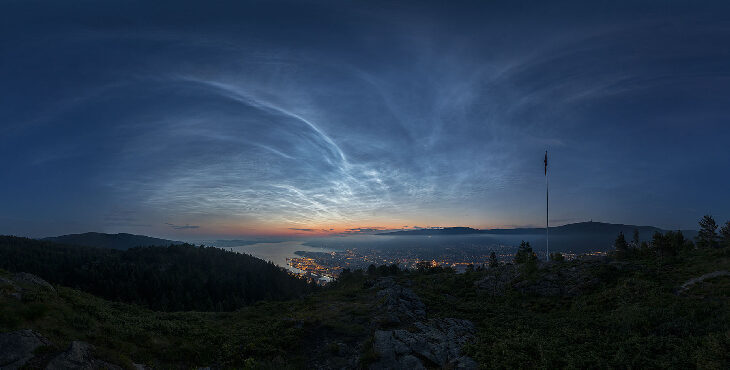
Noctilucent clouds over Bergen, Norway on June 17, 2020
© Arnim BerhorstNoctilucent clouds over Bergen, Norway on June 17, 2020
Night is supposed to be dark. But not last night. Across northern and central Europe on June 16-17, the sky lit up with electric-blue ripples from noctilucent (night-shining) clouds. "It was a very bright display," reports Arnim Berhorst, who sends this picture from Bergen, Norway.

"The noctilucent clouds (NLCs) were so widespread, I had to assemble 12 images to capture the complete panorama," says Berhorst. Similar displays were recorded as far south as Germany, Poland, and Switzerland.

NLCs are Earth's highest clouds. Seeded by meteoroids, they float at the edge of space 83 km above the ground. The clouds form when summertime wisps of water vapor rise up to the mesosphere, allowing water to crystallize around specks of meteor smoke.

Last summer, NLCs spread as far south as Los Angeles and Las Vegas, setting records for low-latitude sightings. 2020 is shaping up to be just as good. Record-cold temperatures in the mesosphere are boosting the production of NLCs, pushing them farther south with each passing night. Stay tuned!

Comment: Are noctilucent clouds increasing because of the cooling climate, and the rise of fireball and volcanic activity?


Info

Huge circular arc discovered near the Big Dipper

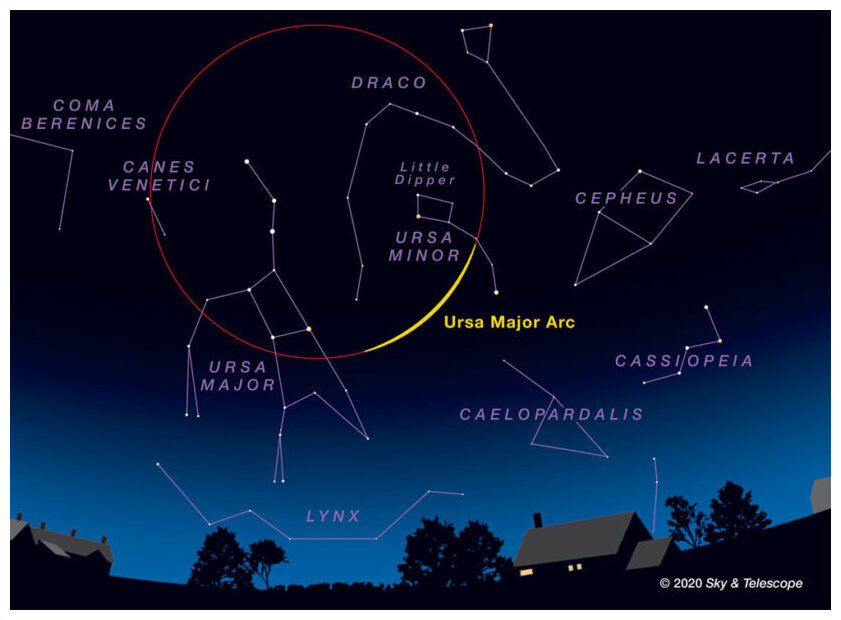
The 30-degree arc is likely a shock front expanding from a star that exploded some 100,000 years ago.

Circular Arc near Big Dipper
© Sky & Telescope
An oddly perfect puddle of hydrogen gas lies splashed just outside the bowl of the Big Dipper. Yet even though it spans a third of the northern sky, you'd never see it visually through your telescope.

Ultraviolet and narrowband photography have captured the thin and extremely faint trace of hydrogen gas arcing across 30°. The arc, presented at the recent virtual meeting of the American Astronomical Society, is probably the pristine shockwave expanding from a supernova that occurred some 100,000 years ago, and it's a record-holder for its sheer size on the sky.

Andrea Bracco (University of Paris) and colleagues came upon the Ursa Major Arc serendipitously when looking through the ultraviolet images archived by NASA's Galaxy Evolution Explorer (GALEX). They were looking for signs of a straight, 2° filament that had been observed two decades ago — but they found out that that length of gas was less straight than they thought, forming instead a small piece of a much larger whole. The researchers report the arc in the April issue of Astronomy & Astrophysics.

Cassiopaea

Bright light of novae come from shockwaves and not from thermo-nuclear explosions says new study

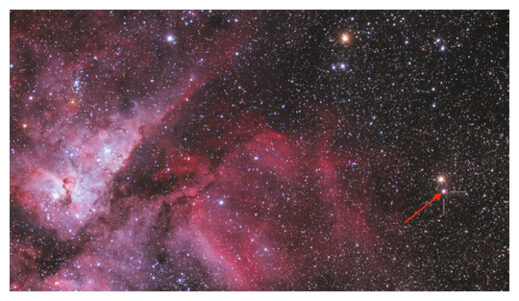
V906 Carinae
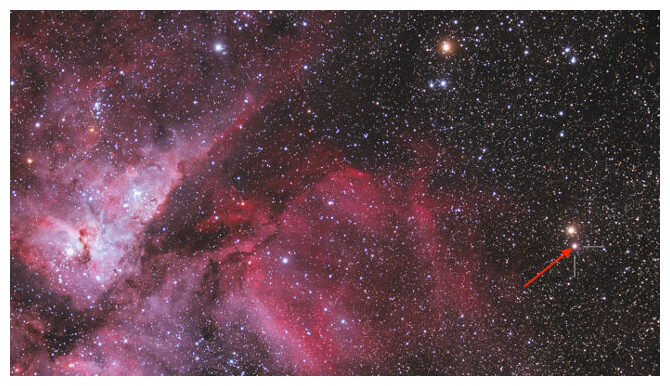
© Copyright 2018 by W. Paech + F. Hofmann, Team Chamaeleon, Chamaeleon and Onjala Observatory, NamibiaImage of V906 Carinae about 18 days after its discovery.
Astronomers have long believed that the bright light of novae comes from thermo-nuclear explosions. Now, an international team, including researchers from the University of Copenhagen, has for the first time demonstrated that most of their brightness comes from shockwaves created in a unique and a previously unknown process. The finding ends a decades-old understanding of novae — and may help solve one of the greatest riddles in astrophysics.

Classical novae have been among the most extensively studied astrophysical phenomena since humans first began wondering about twinkling points in the night sky. Yet we continue to learn new things, as evidenced by new research conducted by the University of Copenhagen, among others.

Novae are explosions that occur when a white dwarf star and its companion star in a binary system orbit closer and closer around one another. As the two stars approach, gas from the companion star is stripped away and onto the white dwarf's surface, where it builds up like a gas shell. Eventually, after thousands of years, the piled up gas shell explodes in a nuclear fusion reaction.

For decades, astronomers believed that this thermo-nuclear explosive event is what caused white dwarves to suddenly shine up to a million times brighter — making them appear to be entirely new stars. Hence the name 'nova', meaning 'new' in Latin. But now, for the first time, an international team of researchers has demonstrated that it is the "shock", not the explosion itself, which mainly causes a nova to blaze brightly in the night sky.

"It's a whole new understanding of how a nova works. Indeed, it changes the more than 45-year-old perception that novae only get their light from the nuclear reaction," states Luca Izzo, co-author of the study — now published in Nature Astronomy. Izzo is an astrophysicist and post-doctoral fellow at the University of Copenhagen's Niels Bohr Institute.

The new evidence comes from observations of 'V906 Carina', a nova discovered in 2018 roughly 13,000 light-years from Earth.

Nuke

2017 Radioactive cloud over Europe likely from civilian source

Air Filters
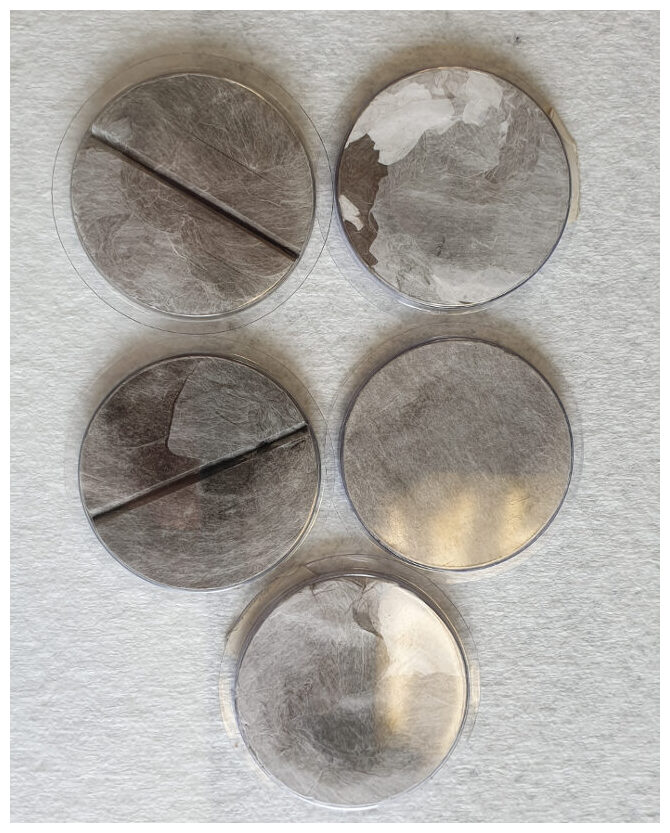
© Dorian Zok/LUHThe scientists carried out the isotope measurements using such air filters.
A mysterious cloud containing radioactive ruthenium-106, which moved across Europe in autumn 2017, is still bothering Europe's radiation protection entities. Although the activity concentrations were innocuous, they reached up to 100 times the levels of what had been detected over Europe in the aftermath of the Fukushima accident. Since no government has assumed responsibility so far, a military background could not be ruled out.

Researchers at the Leibniz University Hannover and the University of Münster now found out that the cloud did not originate from military sources - but rather from civilian nuclear activities. Hence, the release of ruthenium from a reprocessing plant for nuclear fuels is the most conclusive scenario for explaining the incident in autumn 2017. The study has been published in the journal Nature Communications.

Rainbow

Rare fire rainbow appears in northeast Taiwan

Circumhorizontal arc in Taiwan
© Chen Bi-ling
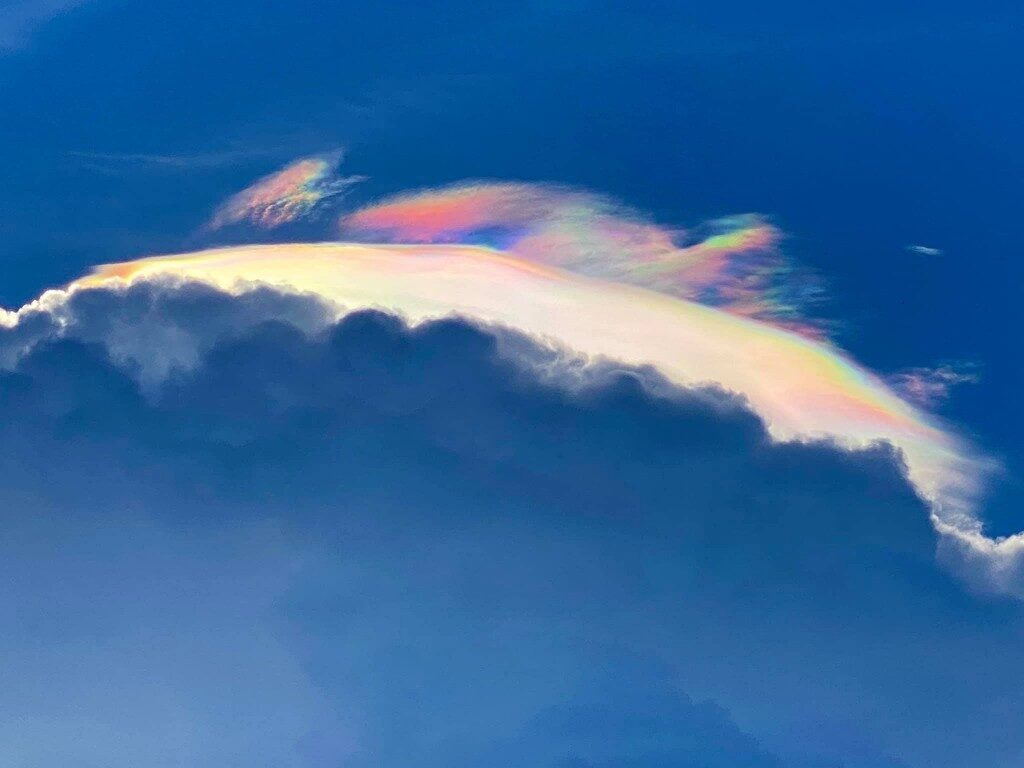
A circumhorizontal arc, also known as a fire rainbow, appeared in the sky over Yilan County on Sunday (June 14).

The curator of the Lanyang Museum, Chen Bi-ling (陳碧琳), captured the natural phenomenon at 5 p.m. near Yilan Interchange and Toucheng Interchange, reported CNA.

According to Chen's Facebook page, three of the fire rainbow pictures were taken by her mobile phone and a drone. The rainbow can be seen clearly in the photos, which quickly drew the public's attention.


Some netizens connected the optical phenomenon with the earthquake that rocked northeastern Taiwan early Sunday morning. However, the director of the Central Weather Bureau in Hsinchu, Tang Shuen-Ran (湯舜然), said the forming of fire rainbows have nothing to do with earthquakes.

Tang told CNA a fire rainbow is the refraction of sunlight or moonlight and only can be formed in the sky up to 6000 meters high, which makes it a very rare occurrence — mostly happening during summer.

Cloud Lightning

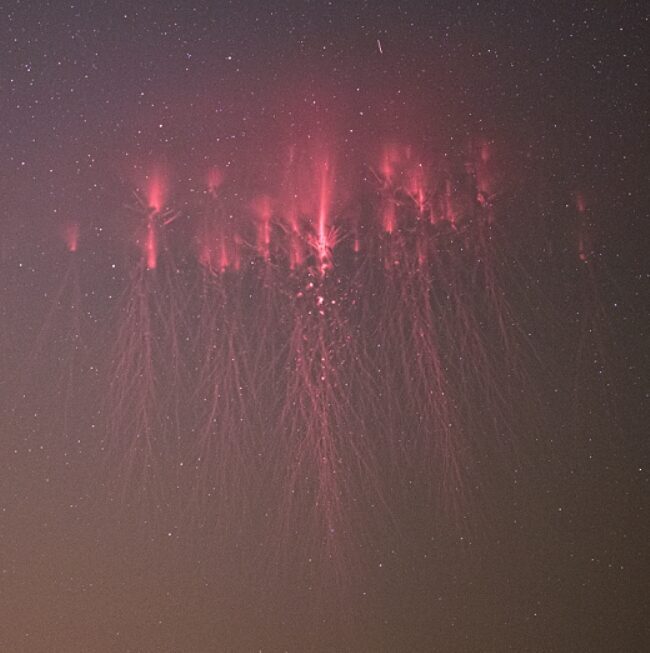
Giant jellyfish sprites recorded over Europe

Red Sprites from MCS storm over Slovakia
© Daniel ŠčerbaRed Sprites from MCS storm over Slovakia.
Sprite season is underway in Europe. On June 13th, Czech photographer Daniel Ščerba-Elza recorded these giant jellyfish over a mesoscale convective thunderstorm.

"My camera was set up in the Jeseniky mountains," says Ščerba-Elza. "The sprites were more than 200 km away, across over border with Slovakia." Considering the distances involved, the jellyfish must have been nearly 50 km tall, measured from heads to tentacle-tips.

"The storm was very active," continues Ščerba-Elza. "During my observing session, I observed more than 30 clusters like this."

This kind of hyperactivity may be boosted by Solar Minimum, happening now. During this low phase of the solar cycle. cosmic rays from deep space flood into the inner solar system, allowed in by the sun's weakening magnetic field. Some models hold that cosmic rays help sprites get started by creating conductive paths in the atmosphere. That would make the summer of 2020 a good time to look for jellyfish in the sky.

Comment: Extremely bright 'jellyfish' sprites easily visible with naked-eye over Colorado


Cloud Lightning

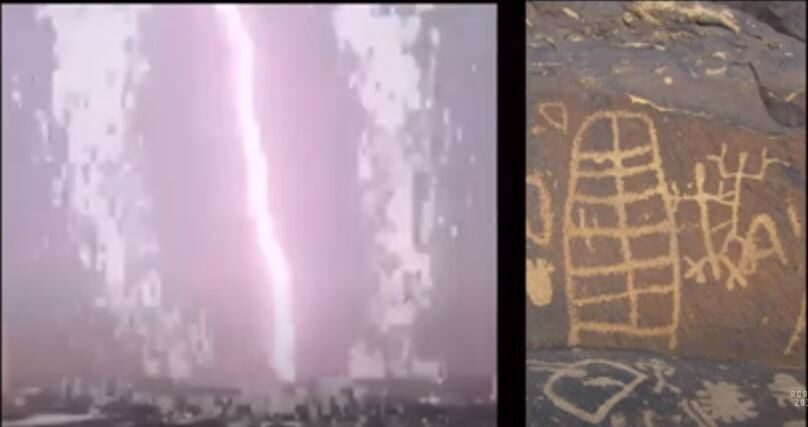
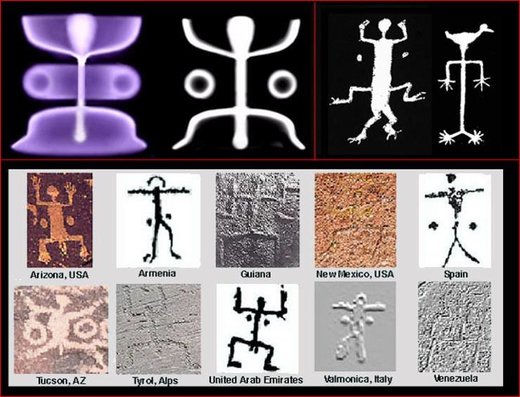
Adapt 2030 Ice Age Report: Plasma petroglyphs over Washington DC and summer snow

Plasma petroglyphs
© YouTube/Adapt 2030 (screen capture)
Massive plasma discharge over Washington D.C leaving an air glow for a fraction of a second. If the glowing air lasted for seconds or minutes ancient peoples would have left petroglyphs of the event, I found several. Also these same sets of carvings show a micronova from our Sun with Squatter Man, so are we witnessing another repeat of ancient events over the USA Capital?


Comment: See also: It looks like we are beginning to observe what the ancients recorded at times of global upheaval/climate shift. See: Symbols of Transition: Shifting sands unveil 'stick man' petroglyphs on Hawaii beach

petroglyphs plasma


Info

Terrestrial gamma-ray flash and ionospheric ultraviolet emissions powered by lightning

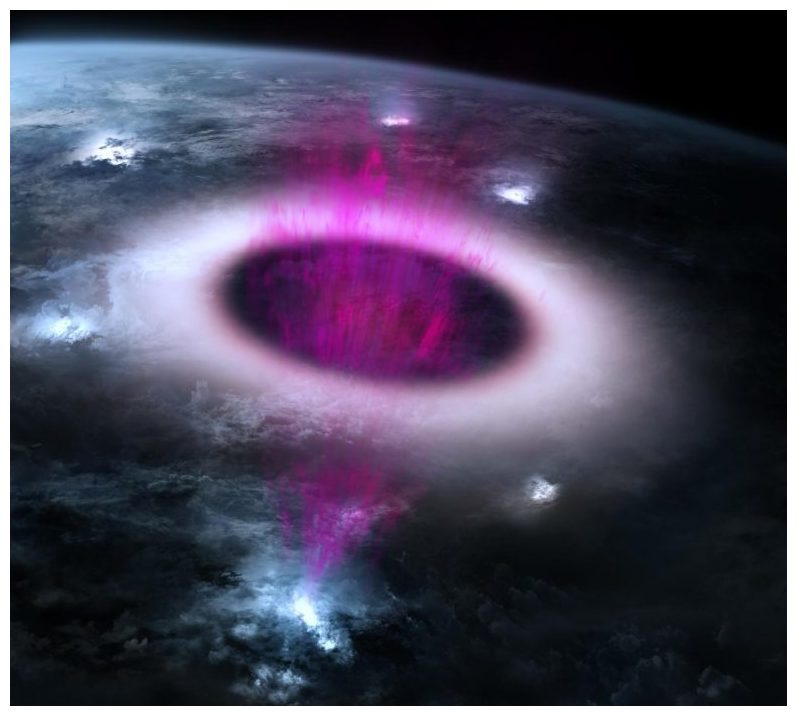
Lightning Above Clouds
© Birkeland Centre for Space Science, Daniel Schmelling/Mount VisualArtist’s impression of multi-wavelength emission above a thunderstorm based on data from ASIM. The high electric field associated with lightning (light blue) generates a terrestrial gamma-ray flash (magenta). The resulting electromagnetic pulse causes an elve, or expanding ring of ultraviolet emission (red and white).
You have likely seen lightning flash from a storm cloud to strike the ground. Such bolts represent only a small part of the overall phenomenon of lightning, though. The most powerful activity occurs high above the surface, in Earth's upper atmosphere.

Up there, lightning creates brief bursts of gamma rays that are the most high-energy naturally produced phenomena on the planet. Researchers recently measured these high-energy terrestrial gamma-ray flashes, or TGFs, using instruments on the International Space Station. The work helps reveal the mechanism behind the creation of the bright flashes we call lightning.

The instruments are part of the Atmosphere-Space Interactions Monitor (ASIM), an Earth observation facility on the outside of the space station used to study severe thunderstorms and their role in Earth's atmosphere and climate. ASIM recorded other types of upper-atmospheric lightning known as transient luminous events (TLEs) in addition to TGFs. ASIM's high-speed instruments helped researchers to determine the sequence of events that produces TGFs, as reported in a paper recently published in the journal Science.

"With ASIM, we see how the atmosphere and clouds bubble like a pot of stew on the stove," says Torsten Neubert of the National Space Institute, Technical University of Denmark and lead author on the paper. "Convection brings humidity, dust and other particles into the upper atmosphere where they affect Earth's radiation balance. Lightning is a measure of convection and can be relatively simple to put into weather and climate models."

Cloud Lightning

Adapt 2030 Ice Age Report: New atmospheric phenomenon 'Green Ghosts' overlaps with an evaporating economy

Green Ghosts
© YouTube/Adapt 2030 (screen capture)
New electrical phenomenon termed "Green Ghost" appears in Earths atmosphere with plasma ropes, record south latitude noctilucent clouds and naked eye Jellyfish Sprites. The economy is collapsing at the same time so it appears we are in a cycle witnessed before as planets are lining up as 79 A.D in 2024. Global events match heavenly body timelines.....


Comment: See also: Electric universe theory provides rational, intelligible explanations for such atmospheric phenomena as ball lightning, plasma discharges, noctilucent clouds, lightning, hurricanes and tornadoes. For more information on this and much more read, Earth Changes and the Human-Cosmic Connection by Pierre Lescaudron and Laura Knight-Jadczyk.


Info

Conventional theory of cosmic-ray origin and propagation challenged by new data

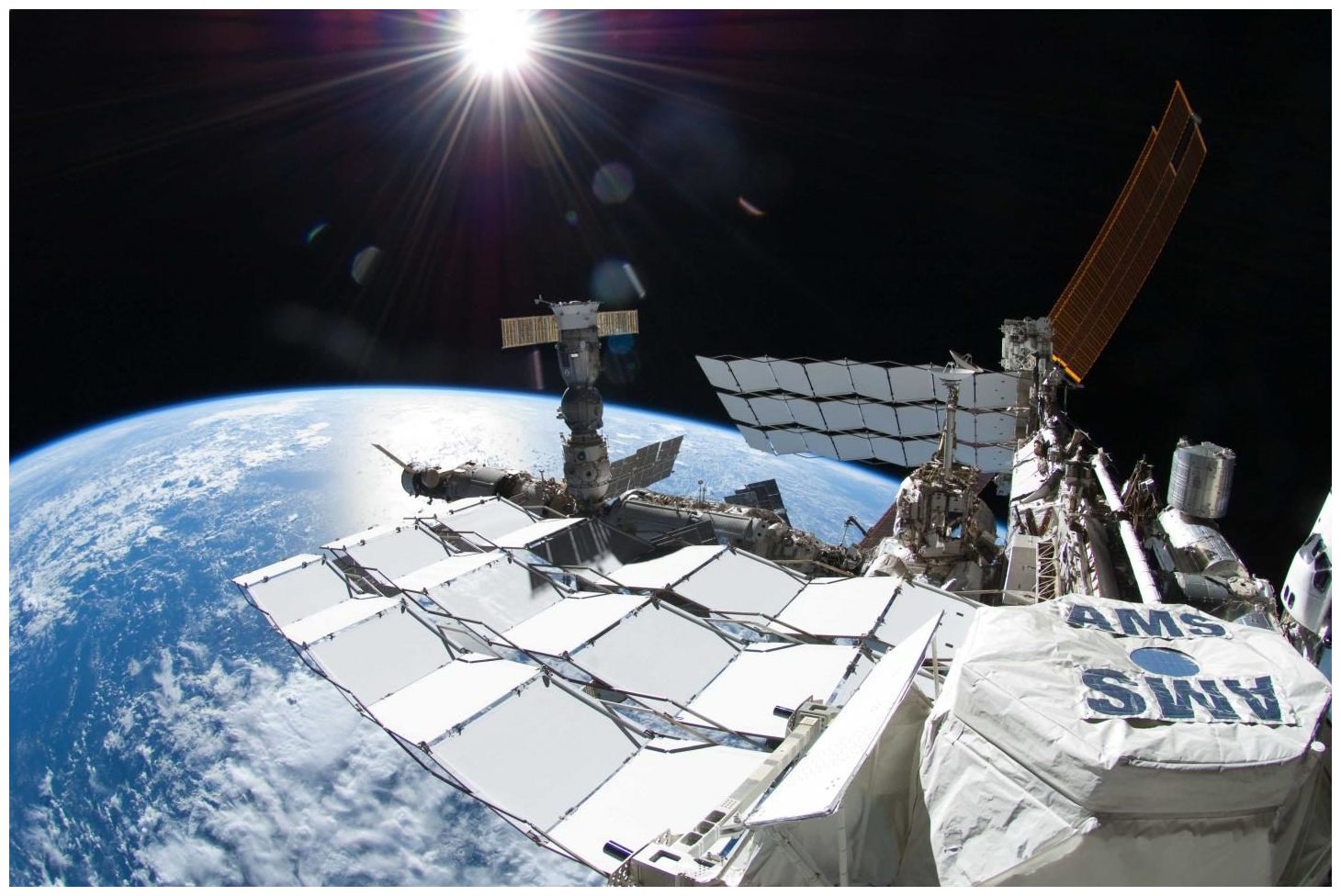
AMS Detector on ISS
© NASAThe AMS detector on the International Space Station.
Ever since astronauts attached the 7.5 tonne AMS detector to the International Space Station in May 2011, the space-based magnetic spectrometer, which was assembled at CERN, has collected data on more than 150 billion cosmic rays - charged particles that travel through space with energies up to trillions of electron volts. It's an impressive amount of data, which has provided a wealth of information about these cosmic particles, but remarkably, as the spokesperson of the AMS team Sam Ting has previously noted, none of the AMS results were predicted. In a paper just published in Physical Review Letters, the AMS team reports measurements of heavy primary cosmic rays that, again, are unexpected.

Primary cosmic rays are produced in supernovae explosions in our galaxy, the Milky Way, and beyond. The most common are nuclei of hydrogen, that is, protons, but they can also take other forms, such as heavier nuclei and electrons or their antimatter counterparts. AMS and other experiments have previously measured the number, or more precisely the so-called flux, of several of these types of cosmic rays and how the flux varies with particle energy and rigidity - a measure of a charged particle's momentum in a magnetic field. But until now there have been no measurements of how the fluxes of the heavy nuclei of neon, magnesium and silicon change with rigidity. Such measurements would help shed new light on the exact nature of primary cosmic rays and how they journey through space.

In its latest paper, the AMS team describes flux measurements of these three cosmic nuclei in the rigidity range from 2.15 GV to 3.0 TV. These measurements are based on 1.8 million neon nuclei, 2.2 million magnesium nuclei and 1.6 million silicon nuclei, collected by AMS during its first 7 years of operation (19 May 2011 to 26 May 2018). The neon, magnesium and silicon fluxes display unexpectedly identical rigidity dependence above 86.5 GV, including an also unexpected deviation above 200 GV from the single-power-law dependence predicted by the conventional theory of cosmic-ray origin and propagation. What's more, the observed rigidity dependence is surprisingly different from that of the lighter primary helium, carbon and oxygen cosmic rays, which has been previously measured by AMS.