Earthquakes
Measuring devices this morning have picked up a large earthquake swarm, usually a tell-tale sign of a potential volcanic eruption.
The Icelandic Government last month announced it was increasing monitoring Katla, which is one of Europe's most feared volcanoes, following a consistent and strengthening spike of tremors and quakes.
And last week, officials at the Iceland Meteorological Office confirmed a series of smaller eruptions had occurred in July strengthening fears of an imminent, much larger, eruption.
Evidence gathered by geophysicists showed the magma had risen to the height of the glacier ice above the volcano causing it to melt.
They said the high seismic tremors recorded on July 8 and 9 confirmed Katla had become active and started small eruptions.
The earthquakes, both measuring 4.5 magnitude on the Richter Scale, struck at 10:18 PM and 10:36 PM local time on Monday.
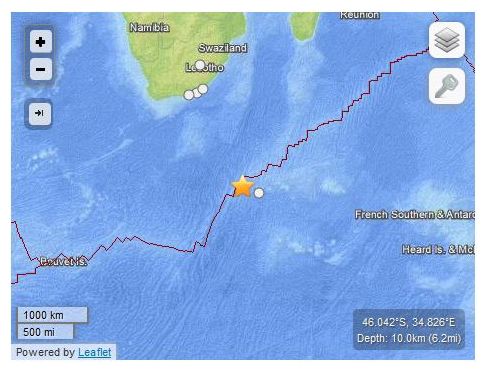
The subsea quakes, the strongest to be recorded in the region in more than 20 years, were centred about 80 miles (130 km) south of Hamilton, the capital of the British overseas territory.
According to the United States Geological Survey (USGS), the quakes (1st, 2nd) occurred at depths ranging between 10 and 14 kilometres.
Sunday, October 02, 2011 at 09:19:25 UTC
Sunday, October 02, 2011 at 05:19:25 PM at epicenter
Time of Earthquake in other Time Zones
Location:
8.385°N, 126.723°E
Depth:
46.9 km (29.1 miles)
Region:
MINDANAO, PHILIPPINES
Distances:
43 km (26 miles) E of Hinatuan, Mindanao, Philippines
143 km (88 miles) ESE of Butuan, Mindanao, Philippines
864 km (536 miles) W of KOROR, Palau
929 km (577 miles) SE of MANILA, Philippines
They targeted the Afar region in the Horn of Africa after a recent surge in volcanic activity and earthquakes plus the appearance of giant cracks in the rocky surface. Tectonic plates in the area are pulling apart and gradually creating a new ocean.
Now, the scientists have mapped the colossal underground lake of magma that lies up to 20 miles (32km) below the earth's surface.
"We estimate that there is 3,000 cubic kilometers of molten rock under Afar -- enough to cover all of London ... with around a kilometer of rock," said Kathy Whaler, professor of geophysics at Edinburgh University.
The reservoir is under such pressure that it has forced tongues of molten rock up towards the surface, producing eruptions and earthquakes.
The quake wasn't strong enough to create any damage, but it likely felt a lot stronger than a regular magnitude-2.5 rumble, said Michael Hansen, senior geologist at the Ohio Department of Natural Resources.
That's because rocks underneath the ground of river valley areas are mostly made up of unconsolidated sediments that amplify ground movement.
"That makes it feel higher intensity," Hansen said. That could explain the booming and crashing noises heard by some throughout the Valley. And although the initial magnitude registered a 2.5, Hansen said follow-up data could revise that number slightly higher.
"It may be 2.6 or a little bigger than 2.6, but not by much," he said.
Geologists have recorded earthquakes with epicenters in Mahoning County just six times - and all happened in the past 61/2 months.
All have occurred west of the Mahoning River, in close proximity to Salt Springs Road. The six earthquakes registered magnitudes ranging from 2.2 to 2.6. According to the Mercalli Intensity Scale, earthquakes between magnitudes 2.0 and 3.0 are felt by a few people, especially those on upper floors.
But why, after a lifetime with no earthquakes centered in Mahoning County, is the area averaging a quake per month?
Experts say there are a few reasons.
B.C.'s energy regulator is investigating a cluster of earthquakes in a busy gas drilling area of the province, CBC News has learned.
Since 2009, more than 30 earthquakes have been registered in the Horn River area, a region that has also seen extensive drilling and a process called hydraulic fracturing used by companies extracting natural gas.
Hydraulic fracturing, also known as fracking, involves injecting a pressurized mix of water and other substances into the rock to release trapped natural gas. The B.C. Oil and Gas Commission said it has not identified a direct link between hydraulic fracturing and the seismic activity, but is examining recent data collected from Horn River.
The coincidence of earthquakes and gas exploration warrants further investigation, said University of Calgary seismologist David Eaton.
"This would fall within the descriptor of a seismic swarm," Eaton told CBC News. "I think, you know, any links to hydrocarbon extraction of fluid injection would be really interesting."
Wednesday, September 28, 2011 at 22:40:13 UTC
Wednesday, September 28, 2011 at 06:40:13 PM at epicenter
Time of Earthquake in other Time Zones
Location:
37.963°S, 73.903°W
Depth:
12.9 km (8.0 miles)
Region:
OFFSHORE BIO-BIO, CHILE
Distances:
43 km (26 miles) SSW of Lebu, Bio-Bio, Chile
42 km (88 miles) NW of Temuco, Araucania, Chile
145 km (90 miles) SSW of Concepcion, Bio-Bio, Chile
580 km (360 miles) SSW of SANTIAGO, Region Metropolitana, Chile
Interestingly, if you look at the distribution of the earthquakes (see below), the earthquakes over the last few days are deeper than those 4 days ago or older. Many are centered 14-16 km below the surface of the volcano, putting them into the upper mantle, the likely source of the magma in the Canary Hotspot plume. The increasing seismicity and intensity might suggest that an eruption is in the cards, but you would really expect the earthquakes should be getting shallower as magma nears the surface and right now, it doesn't appear to be the case. Maria Jose Blanco, director of the National Geographic Institute on the Canaries puts the chances of an eruption in the near future at ~10%, although carbon dioxide emissions are steadily rising (spanish), another clue on new magma degassing under the volcano.
Tuesday, September 27, 2011 at 12:08:21 UTC
Tuesday, September 27, 2011 at 03:08:21 PM at epicenter
Time of Earthquake in other Time Zones
Location:
34.413°N, 23.677°E
Depth:
19.1 km (11.9 miles)
Region:
CRETE, GREECE
Distances:
126 km (78 miles) SSW of Chania, Crete, Greece
167 km (103 miles) SW of Iraklion, Crete, Greece
259 km (160 miles) N of Tobruk (Tubruq), Libya
396 km (246 miles) S of ATHENS, Greece
Spanish seismologists, accompanied by the President of the Cabildo de El Hierro and the Minister of Security and Emergency Area, held a press conference on Sunday to reassure the 10,000 residents of the smallest of the Canary Islands that the raising of the alert level does not indicate that an eruption is imminent. They indicated, however, that the number of volcanic earthquakes detected beneath El Hierro continues to increase.
Hierro, a shield volcano, has had a single historic eruption from the Volcan de Lomo Negro vent in 1793. The eruption lasted approximately one month and produced lava flows.
The Canary Islands Government commenced an in-depth geological survey of El Hierro earlier this month in an effort to determine the source of an earthquake swarm.


Comment: For additional data see Canary Islands Government Raises El Hierro Volcanic Risk Level.