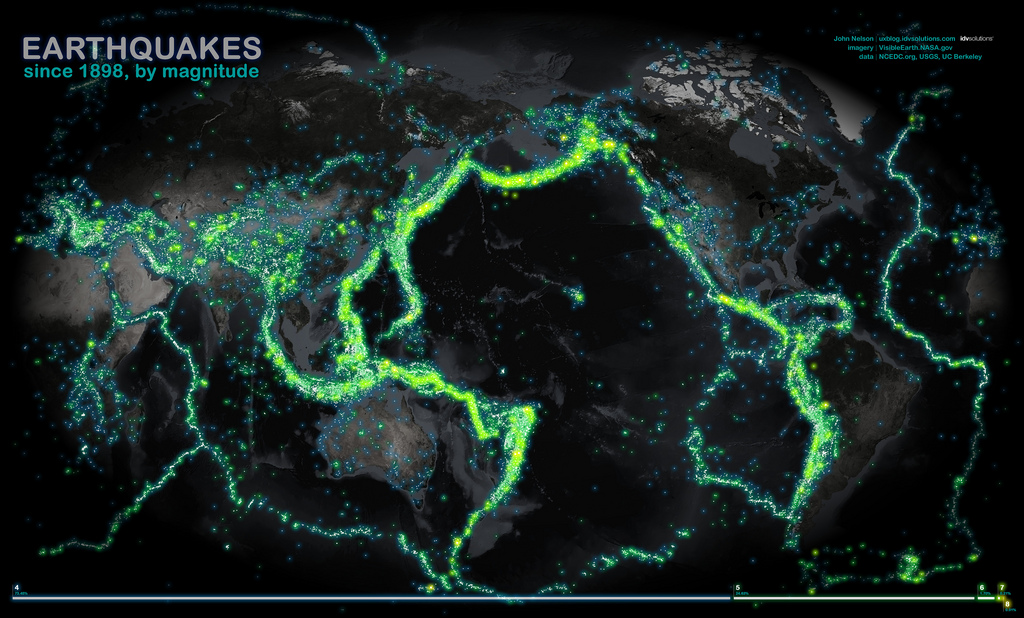
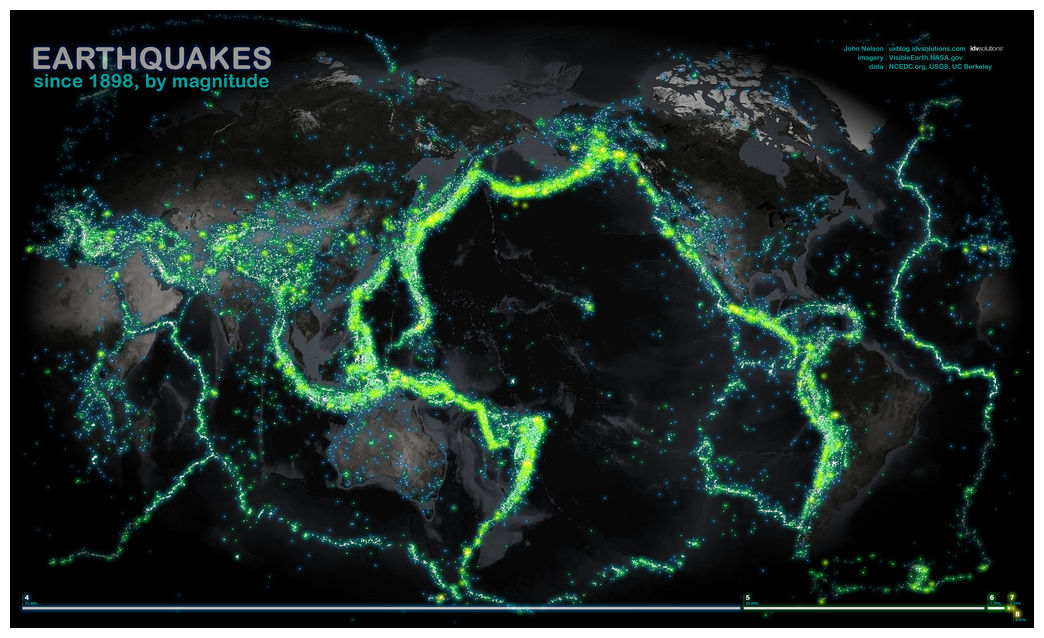
© John Nelson, IDV SolutionsMore than 100 years of earthquakes glow on a world map.
San Francisco - The number of great earthquakes experienced in the past may be higher than previously thought, one researcher said here today (Dec. 11) at the annual meeting of the American Geophysical Union.
As a result, the global community may be underestimating the risk of
the next big one, said Susan Hough, of the U.S. Geological Survey.
"There's very compelling evidence that we have underestimated the magnitude of earthquakes in the 19th century and possibly in the first half of 20th century," Hough said.
Prior to about 1900, scientists didn't have an easy way to measure the strength of an earthquake. When seismologists try to recreate historical temblors, they typically look to see whether a
tsunami is generated or how far away people felt the quake to get an idea of how strong it was.
But those are imprecise measures. Hough wondered whether many of the past big earthquakes - such as those now classified between about a magnitude-8.0 and a magnitude-8.5 - were underestimated. In the 19th century, for instance, most records say there were just three big earthquakes larger than magnitude-8.5, but 12 in the 20th century. At first glance, that seemed suspicious, Hough said.










Comment: But people were surprised; nobody remembers what happened last month, much less in the 9th and 18th Centuries!
That's because since then and now, things were much calmer. In addition, there's the problem of misinterpreting earthquakes for meteor events, both then and now.
This research is trying to suggest that there is a gradual increase or constant uniformity to the rate of environmental disasters, but the evidence for cyclical catastrophism is writ large in the geological, palaeontological and archaeological records.