Health & WellnessS


Pirates

The criminality of the global pesticide industry

ecocide
The agrichemicals industry wallows like an overblown hog in a cesspool of corruption. With its snout firmly embedded in the trough of corporate profit to the detriment of all else, it is most likely responsible for more death and disease than the combined efforts of the tobacco companies ever were. It indulges in criminality that hides behind corporate public relations, media misrepresentations and the subversion of respectable-sounding agencies which masquerade as public institutions.

Dominated by a handful of powerful parasitical corporations with a global reach, the message from this sector is that its synthetic biocides are necessary to feed billions who would otherwise go hungry. Often accompanying this public relations-inspired tale is the notion that organic agriculture is not productive enough, or is a kitchen-table niche, and that agroecology is impractical.

Of course, as any genuinely informed person would know that, as numerous high-level reports have suggested, organic farming and agroecology could form the mainstay of agriculture if they were accorded sufficient attention and investment. Unfortunately, big agribusiness players, armed with their chemicals or GMOs seek to marginalise effective solutions which threaten their markets and interests.

Armed with a compulsion to dominate and to regard themselves as conqueror and owner of nature, they require more of the same: allegiance to neoliberal fundamentalism and an unsustainable model of farming that is so damaging to soil that we could have at most just 60 years of farming left if we don't abandon it.


Headphones

The ignored pollutant: Noise

Rollright Stones
© Cyrus MowerThe Rollright Stones in North Oxfordshire, not far from Paul's home town of Banbury.
The sonic backdrop to our lives is increasingly one of unwanted technospheric noise, writes Paul Mobbs. And as it eclipses the sounds of nature, it's taking its toll on our health, wellbeing and quality of life. So as well as campaigning for more trees, and quieter cars, trucks and aircraft, what's to be done? Let us seek out calm moments of quiet tranquillity - and listen to the birds.

A few days ago I went for a walk, well before the dawn, in order to listen to the 'dawn chorus'. It's something I like to do a few times a year, especially in the early Spring when the birdsong is at its loudest.

I've been doing these walks since before my teens. Over that period there's been one inescapable change in the countryside around my home town of Banbury - noise.

In many ways the modern urban-dweller has become immured to noise; we exclude it, and bar it from our thoughts - a process even more challenging since the advent of the personal stereo and the mobile phone. But we never truly escape it.

For those who like to enjoy the natural environment, noise is something to be escaped from within the relative sanctuary of the landscape. These days that's getting harder and harder to accomplish.

That's not only because of noise from all around - in particular from urban areas, roads and the increasing mechanisation of agriculture - but also due to the increasing level of air traffic overhead.

Comment: Silence: Why it is so good for your brain
In silence, we can tap into the brain's default mode network.

The default mode network of the brain is activated when we engage in what scientists refer to as "self-generated cognition," such as daydreaming, meditating, fantasizing about the future or just letting our minds wander.

When the brain is idle and disengaged from external stimuli, we can finally tap into our inner stream of thoughts, emotions, memories and ideas. Engaging this network helps us to make meaning out of our experiences, empathize with others, be more creative and reflect on our own mental and emotional states.

In order to do this, it's necessary to break away from the distractions that keep us lingering on the shallow surfaces of the mind. Silence is one way of getting there.

Default mode activity helps us think deeply and creatively. As Herman Melville once wrote, "All profound things and emotions of things are preceded and attended by silence."


Info

How gentle touch can shape babies' brain development

baby touch
For newborns, skin-to-skin contact with parents and caregivers may help shape how their brains respond to touch, a sense necessary for social and emotional connections, a new study suggests.

Plenty of previous research has linked skin-to-skin touch with developmental benefits for both premature and full-term babies, ranging from improved growth and sleep to better motor development.

Research has also tied breastfeeding and other forms of supportive touch to less discomfort during needle sticks and other painful medical procedures.

In the current study, researchers tested how 125 premature and full-term infants responded to gentle touch. Overall, the preemies were more likely than the full-term babies to have a reduced response to this contact, the study found.

But preemies who had more gentle contact with parents and caregivers had a stronger response to touch than the preterm infants who didn't get this type of support. The preterm babies who had more exposure to painful medical procedures also had a reduced response to touch.

Comment: Kangaroo care and premature infants: Keeping baby closer is better for everyone


Health

Fillers lurking in some supplements may compromise your health

magnesium stearate, fillers supplements
Supplements all use some form of filler. However, which fillers are used and the quantity of fillers used can make a huge difference in the final product. You can find a complete list here, but we want to focus on Dimethicone and Magnesium Stearate/Stearic Acid.

Dimethicone is a silicone emollient which coats the skin, not allowing toxins out. It may promote tumors and accumulate in the liver and lymph nodes. It is commonly found in lotions and creams.

Magnesium Stearate/Stearic Acid may contain phosphatidyl choline, which collapses cell membranes and selectively kills T-cells, which breaks down the immune system. It is an execeptant that is used to bind medicinal tablets and make them smooth; it is also used in pharmaceuticals, foods, talcum powder, ammunition, and as a drying agent in paints.

Comment:


Attention

Vaccine Impacts: Aluminum, Autoimmunity, Autism & Alzheimer's

Vaccine Cover Up
© Vaccine Cover Up
Rebutting Big Pharma's Talking Points About the Safety of Aluminum (and Mercury) in Vaccines

I predict that Gardasil will become the greatest medical scandal of all times because at some point in time, the evidence will add up to prove that this vaccine...has absolutely no effect on cervical cancer and that all the very many adverse effects which destroy lives and even kill, serve no other purpose than to generate profit for the manufacturers. - Dr. Bernard Dalbergue a former pharmaceutical industry physician with Gardasil manufacturer Merck, emphasis added.

"No vaccine manufacturer shall be liable...for damages arising from a vaccine-related injury or death." - President Ronald Reagan, as he signed The National Childhood Vaccine Injury Act (NCVIA) of 1986, absolving drug companies from all medico-legal liability when vaccines kill or disable children

"The 271 vaccines in development span a wide array of diseases, and employ exciting new scientific strategies and technologies. These potential vaccines - all in human clinical trials or under review by the Food and Drug Administration (FDA) - include 137 for infectious diseases, 99 for cancer, 15 for allergies and 10 for neurological disorders." - "Statement from the Pharmaceutical Research and Manufacturers of America (PhRMA) - the pharmaceutical industry's trade association and lobbying group.

The #1 talking point of Big Pharma, Big Vaccine, the CDC, the AMA and the American Academy of Pediatrics when they try to justify the use of the neurotoxin aluminum (and mercury) in their vaccines is this one:
"humans shouldn't be afraid of the small amount of either aluminum or mercury that is or has been in many human and animal vaccines."

Whistle

Two bills quietly slipping through Congress give Big Pharma unlimited power & zero accountability

big pharma
If you're hurt by a pharmaceutical, you can sue the company that made the drug, and be compensated for your losses, right? Most people assume that is the way the justice system works, but the reality is that it's difficult, and in many cases impossible, for victims of pharmaceutical companies (and other big corporations/industries) to gain compensation or justice.

There are many aspects of the current U.S. legal system that make getting compensation and justice for injuries caused by pharmaceutical drugs difficult, and there are two bills that are currently going through the U.S. House of Representatives (H.R. 985, the 2017 Fairness in Class Action Litigation Act and H.R. 1215, the Protecting Access to Care Act of 2017) that will make justice for victims of pharmaceuticals nearly impossible.

Info

What if we underestimate the economic cost of vaccinating?

vaccines
“Imagine, for the sake of argument, if it was discovered that vaccines were a factor in the onset of autism, asthma, allergies, ADD, ADHD, learning disabilities, Alzheimer’s disease, schizophrenia, multiple sclerosis, SIDS and other diseases, disorders, illnesses, and causes of death.”
In a study conducted by researchers at the University of North Carolina at Chapel Hill and published in the journal Health Affairs on Oct. 12, 2016, it was estimated that the cost to the U.S. economy of people deciding not to get government recommended vaccines to prevent 10 infectious diseases was $7.1 billion in 2015.1

The research team, led by Sachiko Ozawa, PhD, associate professor at the UNC Eshelman School of Pharmacy, studied 10 vaccines recommended by the Centers for Disease Control and Prevention (CDC), including the vaccines for hepatitis A and B; herpes zoster virus (chickenpox); human papillomavirus (HPV); influenza; measles, mumps, and rubella (MMR); meningococcal disease; pneumococcal disease; tetanus, diphtheria, pertussis (Tdap); and chickenpox.1 2

In their Annual Gates Letter highlighting the work of the Bill & Melinda Gates Foundation released on Feb. 14, 2017, Bill and Melinda Gates appear to have taken the $7.1 billion figure from the Ozawa study and calculated that, "for every dollar spent on childhood immunizations, you get $44 in economic benefits." According to Mr. and Mrs. Gates, the calculation "includes saving the money that families lose when a child is sick and a parent can't work."3 4

Health

Electroacupuncture results in stem cell release to promote healing and relieve pain

electroacupuncture
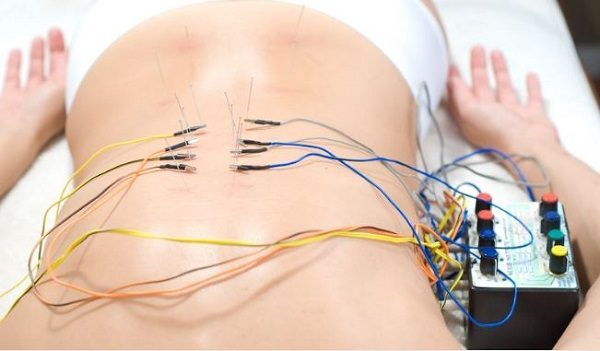
A study led by Indiana University School of Medicine researchers demonstrates how electroacupuncture triggers a neurological mechanism that can help promote tissue repair and relieve injury-induced pain.

Their findings, published online March 16 in the journal Stem Cells, provide the most comprehensive picture yet of how electroacupuncture stimulates the brain to facilitate the release of stem cells and adds new insight relating to the cells' healing properties.

Electroacupuncture is a form of acupuncture that uses a small electrical current to augment the ancient Chinese medical practice of inserting fine needles into the skin at pre-determined points throughout the body.

For the study, a team of more than 40 scientists at institutions in the United States and South Korea was led by four senior authors including IU School of Medicine's Maria B. Grant, MD, Marilyn Glick Professor of Ophthalmology and co-corresponding author; Mervin C. Yoder, MD, IU Distinguished Professor, Richard and Pauline Klingler Professor of Pediatrics, associate dean for entrepreneurial research at IU School of Medicine, director of the Herman B Wells Center for Pediatric Research and co-corresponding author; and Fletcher A. White, PhD, Vergil K. Stoelting Chair of Anesthesia, professor of anesthesia, pharmacology and toxicology.

"This work is a classic example of the power of team science, where investigators in different institutions with specific expertise worked together to unravel the complexity of how electroacupuncture works to help the body respond to stressors," said Dr. Yoder.

Comment: More on this practice: Acupuncture hits same biologic pathways in rats that pain drugs target in humans


Health

Topical curcumin gel works wonders for skin burns

burned face
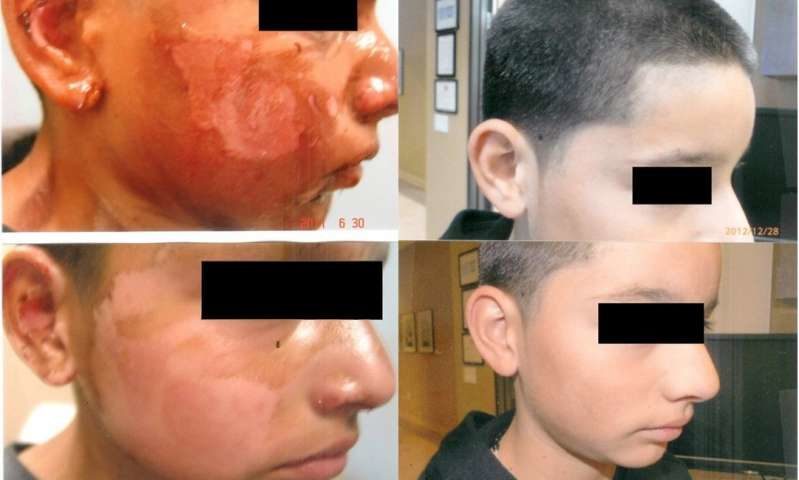
© Dr. Madalene HengResults from 5 days upon application of curcumin gel to burns, and results after 6 weeks.
What is the effect of Topical Curcumin Gel for treating burns and scalds? In a recent research paper, published in the open access journal BioDiscovery, Dr. Madalene Heng, Clinical Professor of Dermatology at the David Geffen School of Medicine, stresses that use of topical curcumin gel for treating skin problems, like burns and scalds, is very different, and appears to work more effectively, when compared to taking curcumin tablets by mouth for other conditions.

"Curcumin gel appears to work much better when used on the skin because the gel preparation allows curcumin to penetrate the skin, inhibit phosphorylase kinase and reduce inflammation," explains Dr Heng.

In this report, use of curcumin after burns and scalds were found to reduce the severity of the injury, lessen pain and inflammation, and improve healing with less than expected scarring, or even no scarring, of the affected skin. Dr. Heng reports her experience using curcumin gel on such injuries using three examples of patients treated after burns and scalds, and provides a detailed explanation why topical curcumin may work on such injuries.

Curcumin is an ingredient found in the common spice turmeric. Turmeric has been used as a spice for centuries in many Eastern countries and gives well known dishes, such as curry, their typical yellow-gold color. The spice has also been used for cosmetic and medical purposes for just as long in these countries.

Life Preserver

During fasting fat cells step in to help the liver

fat cells
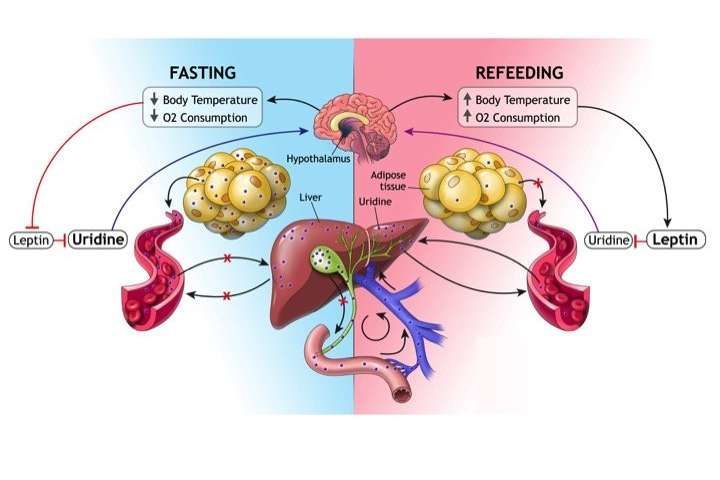
© UT Southwestern Medical CenterA UT Southwestern study determined that the metabolite uridine helps the body regulate glucose. This graphic depicts how the body’s fat cell-liver-uridine axis works to maintain energy balance.
How do mammals keep two biologically crucial metabolites in balance during times when they are feeding, sleeping, and fasting? The answer may require rewriting some textbooks.

In a study published today in Science, UT Southwestern Medical Center researchers report that fat cells "have the liver's back," so to speak, to maintain tight regulation of glucose (blood sugar) and uridine, a metabolite the body uses in a range of fundamental processes such as building RNA molecules, properly making proteins, and storing glucose as energy reserves. Their study may have implications for several diseases, including diabetes, cancer, and neurological disorders.

Metabolites are substances produced by a metabolic process, such as glucose generated in the metabolism of complex sugars and starches, or amino acids used in the biosynthesis of proteins.