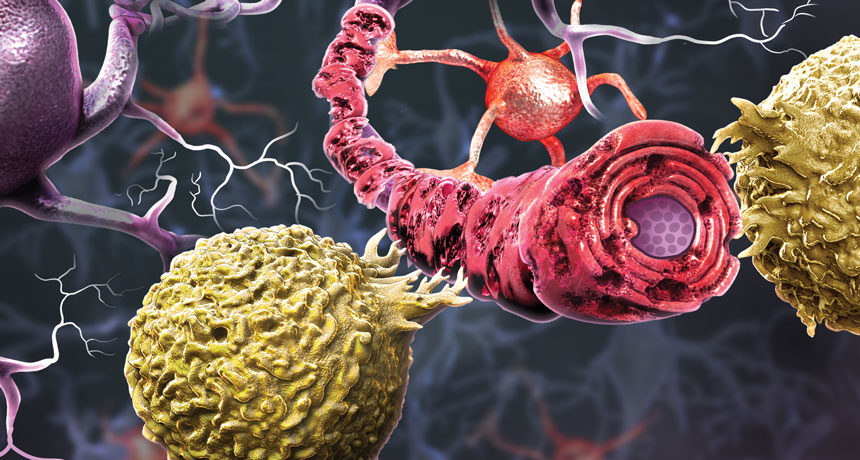
© NICOLLE RAGER FULLERTaking narrow aim at the immune system isn’t enough, so researchers are looking for new treatment targets within nerve cells and even in the gut.
James Davis used to be an avid outdoorsman. He surfed, hiked, skateboarded and rock climbed. Today, the 48-year-old from Albuquerque barely gets out of bed. He has the most severe form of multiple sclerosis, known as primary progressive MS, a worsening disease that destroys the central nervous system. Diagnosed in May 2011, Davis relied on a wheelchair within six months. He can no longer get up to go to the bathroom or grab a snack from the fridge.
Davis hoped life might improve when he was chosen in 2012 to participate in a clinical trial of a drug called ocrelizumab. The drug offered a first sliver of hope for patients waiting for a cure, or at least something to slow down the disease's staggering march. Early research suggested the drug could help some of the roughly 60,000 people in the United States, like Davis, suffering from primary progressive MS. The drug also held promise for patients with the other major form of the disease, relapsing-remitting MS, which afflicts about 340,000 people nationwide.
For some people, ocrelizumab seemed to work. Brain scans of patients with primary progressive MS
showed fewer signs of damage and the patients' ability to walk deteriorated more slowly than in individuals who received a placebo, researchers reported in January in the
New England Journal of Medicine. The drug also helped people with relapsing-remitting MS, which, as the name implies, includes shifts between disability and wellness. Over a year's time, these patients experienced about
half as many flare-ups as those taking another commonly prescribed drug, a different research group reported in the same issue of the journal.

















Comment: Alarming results of Big Pharma & the CDC in America: 1 in 6 children now has a developmental disability