|
| ©Georgia Institute of Technology
|
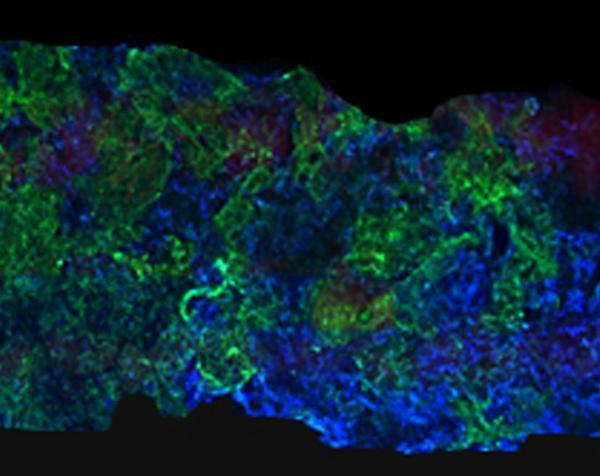
| A microscopic image of a 10 mm collagen scaffold containing a uniform distribution of skin cells (blue) seeded on top of a 3-D polylysine gradient (green).
|
Engineers at Georgia Tech have used skin cells to create artificial bones that mimic the ability of natural bone to blend into other tissues such as tendons or ligaments. The artificial bones display a gradual change from bone to softer tissue rather than the sudden shift of previously developed artificial tissue, providing better integration with the body and allowing them to handle weight more successfully.
|
| ©Associated Press
|
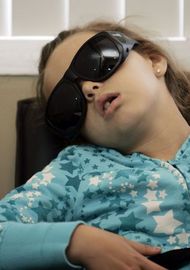
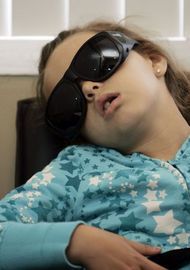
| Megan Garvin wears oversize dark glasses and is still groggy after intraocular lens implant surgery.
|
Dr. Paul Dougherty delicately slipped a tiny lens inside the right eye of 7-year-old Megan Garvin - a last-ditch shot at saving her sight in that eye.
The California girl became one of a small number of U.S. children to try an experimental surgery to prevent virtual blindness from lazy eye diagnosed too late, or too severe, for standard treatment.
Charleston, West Virgina - It's no coincidence Charleston anesthesiologist Tim Deer was the first physician to implant the world's smallest rechargeable spinal cord stimulator in patients who suffer from chronic pain.
Dr. Deer, a pain medicine specialist with St. Francis Hospital, helped to develop and test the silver-dollar-size medical device over the past five years.
"It's like a pacemaker for the spine," Deer explained. "I have the ideas, the engineers make it work."
New research strongly suggests that a mix of preventative agents, such as those found in concentrated black raspberries, may more effectively inhibit cancer development than single agents aimed at shutting down a particular gene.
Researchers at the Ohio State University Comprehensive Cancer Center examined the effect of freeze-dried black raspberries on genes altered by a chemical carcinogen in an animal model of esophageal cancer.
The carcinogen affected the activity of some 2,200 genes in the animals' esophagus in only one week, but 460 of those genes were restored to normal activity in animals that consumed freeze-dried black raspberry powder as part of their diet during the exposure.
Can a damaged brain change its own structure and learn to replace lost functions? Conventional neuroscience once said no, but pioneers in the field have achieved miraculous transformations. From his investigation of their work, Norman Doidge tells the story of the perpetually falling woman.

|
| ©Unknown
|
Households located in poor neighborhoods pay more for the same items than people living in wealthy ones, according to a new study in the Journal of Consumer Research.
Author Debabrata Talukdar (Columbia University) examines the impact of what has been dubbed the "ghetto tax" on low-income individuals. His study found that the critical factor in how much a household spends on groceries is whether it has access to a car. "Arguably, as the bigger, more cost-efficient stores move out, the poor increasingly are likely to find themselves choosing between traveling farther to purchase nutritious, competitively priced groceries or paying inflated prices for low-quality, processed foods at corner stores," Talukdar writes.
Brain scientists have moved a step closer to understanding why some people may be more prone to depression than others.
Dr Roland Zahn, a clinical neuroscientist in The University of Manchester's School of Psychological Sciences, and his colleagues have identified how the brain links knowledge about social behaviour with moral sentiments, such as pride and guilt.
The study, carried out at the National Institutes of Neurological Disorders and Stroke in the US with Dr Jordan Grafman, chief of the Cognitive Neuroscience Section, and Dr Jorge Moll, now at the LABS-D'Or Center for Neuroscience in Rio de Janeiro, Brazil, used functional magnetic resonance imaging (fMRI) to scan the brains of 29 healthy individuals while they considered certain social behaviours.
Leading child advocates have called for a new approach to tackling child abuse and neglect amid rising rates of abuse notifications and children being brought into State care.
The arguments for a new approach are set out in the latest edition of the Australian and New Zealand Journal of Public Health.
Report co-authors Melissa O'Donnell, Professor Dorothy Scott and Professor Fiona Stanley say a greater focus is needed on preventing abuse and neglect occurring in the first place.
"If there is a real commitment to protect all children, then supporting families and children before they reach the point of being abused and neglected should be a priority," said Professor Fiona Stanley, Director of the Telethon Institute for Child Health Research.
A typical characteristics of children's linguistic development are early signs of the risk of developing reading and writing disabilities, or dyslexia. New research points to preventive exercises as an effective means to tackle the challenges children face when learning to read. The results achieved at the Centre of Excellence in Learning and Motivation Research were presented at the Academy of Finland's science breakfast on 21 August.
A group of Ontario farmers is claiming victory after Monsanto Co. agreed to sell its Posilac brand of synthetic cow hormones to drug maker Eli Lilly and Co. for $300 million.
Dave Mackay, president of the Renfrew County chapter of the National Farmers Union (NFU) and a former dairy farmer in Beachburg, Ont., told CBC News Friday that the sale is good news. Mackay, now a sheep farmer with a flock of 300, speaks for 150 farmers in Renfrew County.
"We think it's a bit of a victory," he said from his 200-acre farm near Pembroke, Ont. "We are pleased. I think we have won. Obviously, these guys are moving on."
Monsanto, an agricultural chemical company, announced the sale on Wednesday. It said the Posilac brand will become part of Lilly's Elanco animal health unit.