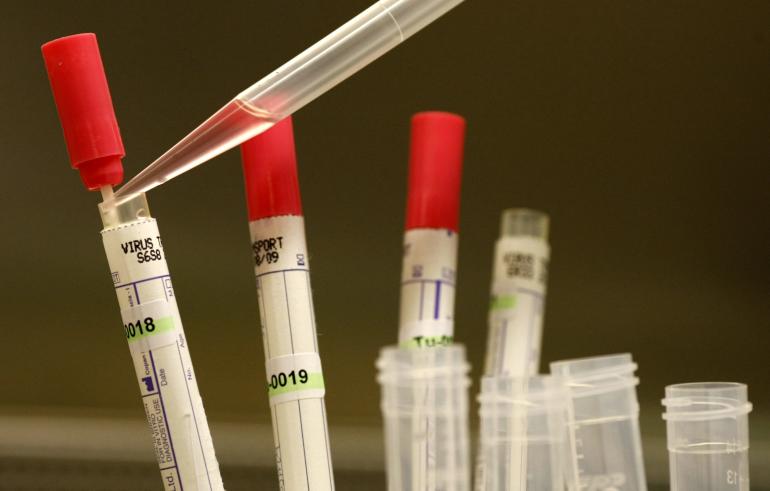
© www.ibtimes.comEbola drug option receives preliminary go-ahead.
While Ebola, the deadly disease spreading through parts of West Africa, has no cure, specific treatment or vaccine, there are several experimental drugs being tested in US labs. Now the FDA has lifted its hold on one of those drugs.
The US Food and Drug Administration gave
Tekmira Pharmaceuticals verbal confirmation
that they modified the full clinical hold the regulatory agency had placed on the company's experimental
TKM-Ebola drug, enabling the potential use on Ebola patients, Tekmira said in a
statement.
"We are pleased that the FDA has considered the risk-reward of TKM-Ebola for infected patients. We have been closely watching the Ebola virus outbreak and its consequences, and we are willing to assist with any responsible use of TKM-Ebola. The foresight shown by the FDA removes one potential roadblock to doing so," said Dr. Mark Murray, CEO and president of Tekmira.
"This current outbreak underscores the critical need for effective therapeutic agents to treat the Ebola virus. We recognize the heightened urgency of this situation, and are carefully evaluating options for use of our investigational drug within accepted clinical and regulatory protocols."
The company, in collaboration with infectious disease researchers from
Boston University and the
United States Army Medical Research Institute for Infectious Diseases, showed the drug's ability to protect non-human primates from Ebola in preclinical trials in May 2010, Tekmira said.
A Phase I clinical trial ‒ the first step towards FDA approval ‒ began on humans in January. The agency then approved a fast-track designation for the drug in March, around the same time the Ebola outbreak began in Guinea, Liberia and Sierra Leone. It has since spread to Nigeria. According to World Health Organization figures published on Wednesday, there are over 1,700 suspected and confirmed cases of Ebola in the four countries, and 932 of those patients have died from the disease.
A different drug,
ZMapp by Mapp Biopharmaceutical Inc., was
used to treat two American aid workers who had contracted Ebola in Liberia. ZMapp, previously only known as
"a secret serum," has not been given the go-ahead to begin human trials yet, Forbes reported. It works by
boosting the immune system to battle against Ebola. The treatment consists of antibodies from lab animals exposed to the virus.
Comment: Timing? Phase1 clinical trials of TKM-Ebola began simultaneously with the outbreak of the virus in Sierra Leone, Liberia and Guinea in March. Depending on the "specific population" a FDA assessment is created for an acceptable "risk-benefit balance" in order to "fast-track the development and expedite the review of drugs to fill an unmet medical need." Purportedly, TKM-Ebola is considered the best-positioned drug that could be stockpiled by the U.S. Department of Defense. Securing this stockpiling contract, Tekmira could receive annual cash flows of $75M for both TKM-Ebola and TKM-HBV. Tekmira Pharmaceuticals increased their stock shares worth over 75% since July 22...well before the fast-track announcement on August 3, 2014, supposedly spurred on by the serum given to Brantley and Writebol. The experimental serum given to U.S. healthcare workers was
ZMapp,
not TKM-Ebola. Hmmm...
Looking more closely..."Tekmira has long been a partner for the biotech companies receiving royalties for products relying on its delivery technology. However, that changed with the announcement
Monsanto (MON) would be licensing Tekmira's intellectual property
to develop weed and pest control and virus suppression products. In return for a near term payment of $16.5 million and ongoing future payments as milestones are met, Tekmira is providing lipid formulations to Monsanto along with the option to purchase the worldwide rights to its technology. In all, the contract could potentially be worth $86.2 million over the four year option period."
Tekmira Signs Development Agreement on Delivery Technology for Agricultural ApplicationsItty bitty questions anyone?

















Comment: Read more about Glyphosate: A trajectory of human misery: