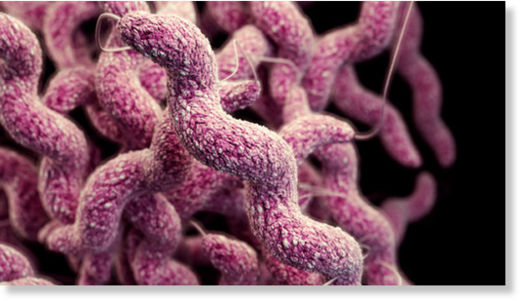
Campylobacter coli
The specific composition of bacterial species in a person's gut may protect against or increase susceptibility to
Campylobacter, the most common cause of human bacterial intestinal inflammation, according research published this week in mBio®, the online open-access journal of the American Society for Microbiology. The study also found that
Campylobacter infection can yield lasting changes to one's gut bacteria composition.
"It has been known for a long time that the microbiota, or microorganisms in the gut, can protect a person from colonization by organisms that cause intestinal tract disease. However, very little is known about how human gut microbiota influences susceptibility to these organisms, and to
Campylobacter in particular," said senior study author Hilpi Rautelin, MD, PhD, professor of clinical bacteriology at Uppsala University and Uppsala University Hospital in Sweden. "We wanted to see if the composition of the human gut microbiota plays a role in susceptibility to
Campylobacter infection."
Rautelin and colleagues followed 24 workers at three poultry slaughterhouses in Sweden. In 2010, they collected fecal samples from the workers once a month from June to September, during the summer peak of
Campylobacter-positive chicken flocks, and again the following February. Fecal samples were cultured for
Campylobacter and analyzed by sequencing for all bacteria. While all participants tested negative for
Campylobacter at the beginning of the study, seven participants became culture positive for the organism during the study. Only one of the
Campylobacter-positive participants experienced symptoms of illness.














Comment: Pfizer was found guilty in the largest healthcare fraud settlement in the U.S. Justice Department's history in 2009.
Readers might be interested in checking out these articles: