Earth ChangesS


Cloud Lightning

Taiwan Deploys 50,000 Troops as Typhoon Hits

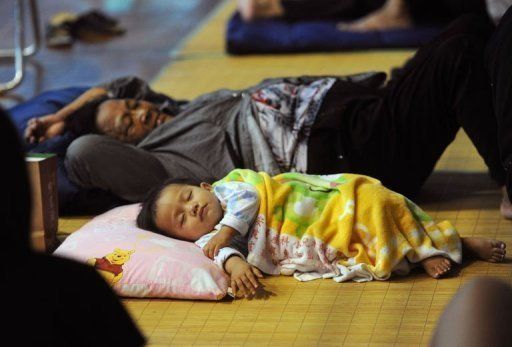
baby @ shelter / Taiwan typhoon
© AFP
Taiwan deployed more than 50,000 troops on Monday and evacuated thousands of people as Typhoon Nanmadol pummelled some of the island's most densely populated areas.

Soldiers moved in to help flood-threatened residents, a motorcyclist was reported killed, and in one remote area more than 300 villagers were trapped by landslides.

The typhoon, which left at least 16 dead in the Philippines at the weekend, made landfall near the city of Taitung on the east coast of Taiwan in the early hours of Monday, according to the Central Weather Bureau.

"This is the worst typhoon to hit Taiwan since Morakot," which left more than 700 people dead or missing in 2009, a bureau official said.

Bizarro Earth

Beyond Irene: Future Hurricanes Will Get Worse

Irene
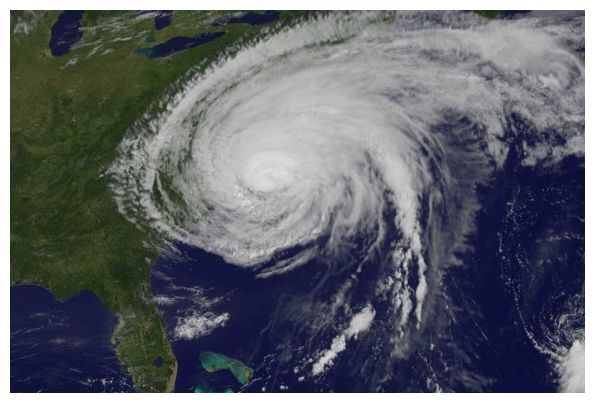
© NASAThe GOES-13 satellite saw Hurricane Irene on the morning of August 27, 2011.
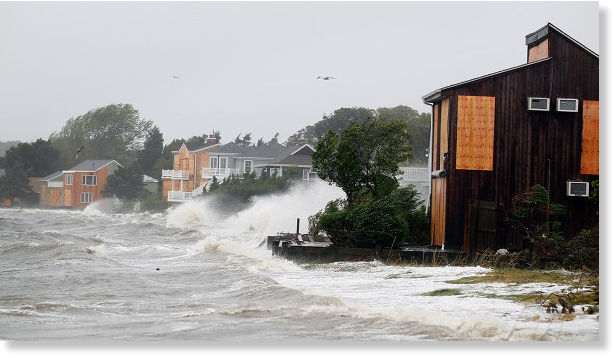
New York - Hurricane Irene battered the East Coast this weekend, blasting buildings and trees that hadn't felt such strong winds in decades, and flooding subways, tunnels and entire coastal neighborhoods.

Thankfully, Irene diminished in strength before making landfall on the Mid-Atlantic Coast and New England; though she is estimated to have caused $7 billion in damages, things could have been a lot worse. And atmospheric scientists say they will be.

They warn that hurricanes will get more destructive in the future. And as oceans warm, more and more of the strongest storms will creep north.

Warm seas

About 90 tropical cyclones form worldwide each year; that pace hasn't changed recently. Rather than causing more hurricanes and typhoons to develop, the 0.5-degree Celsius rise in tropical sea surface temperatures that has occurred over the past 30 years seems to have another effect. As Colorado State atmospheric scientist James Elsner ominously put it: "The strongest storms are getting stronger."

Bizarro Earth

It Ain't Over Yet: New Storm Brews in Atlantic

Katia
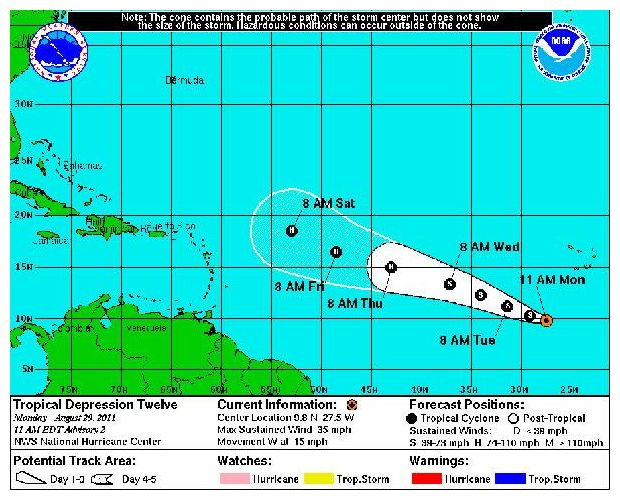
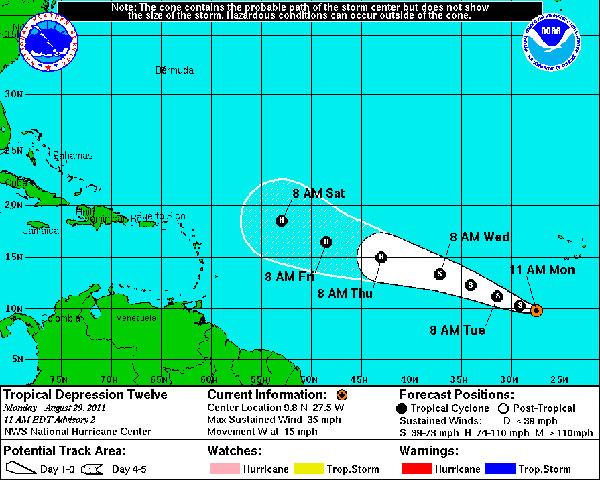
© NHC / NOAAThe projected path and intensification of Tropical Depression 12, the future Tropical Storm, or Hurricane, Katia.
Irene may be nothing more than a remnant low-pressure system over Arctic waters, but hurricane season is far from over. Tropical Depression 12 has formed in the eastern Atlantic and is poised to become Hurricane Katia, with a track taking it toward the Caribbean.

Communities along the Eastern Seaboard are cleaning up from Irene's fierce winds and relentless rains, which caused major flooding in many areas. Meanwhile, out over the Atlantic Ocean, the atmosphere is continuing to churn up more storms.

The remnants of Tropical Storm Jose, which formed over the weekend, are dissipating south of Nova Scotia, and now Tropical Depression 12 has formed off the west coast of Africa.

This new tropical system is about 405 miles (650 kilometers) south-southwest of the southernmost Cape Verde Islands and has winds of 35 mph (55 kph), according to the most recent advisory from the National Hurricane Center.

The budding storm is expected to blossom into a tropical storm, possibly as early as tonight, and eventually into a hurricane. When it becomes a tropical storm, it will be given the name Katia, the name that replaced Katrina after it was retired for the massive devastation it wrought on New Orleans and the Gulf Coast.

Nuke

Why the Fukushima Disaster is Worse Than Chernobyl

Fukushima
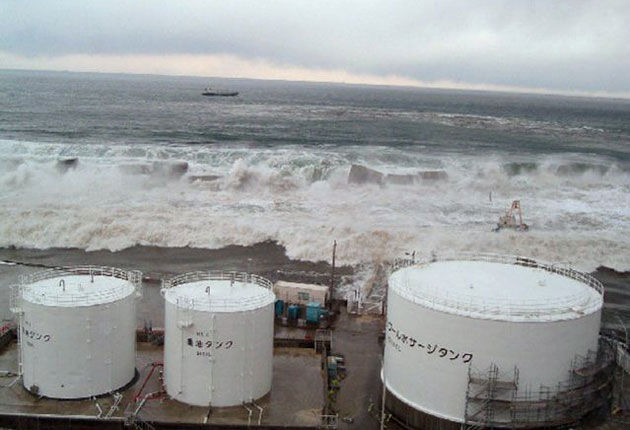
© APSome scientists say Fukushima is worse than the 1986 Chernobyl accident, with which it shares a maximum level-7 rating on the sliding scale of nuclear disasters.
Yoshio Ichida is recalling the worst day of his 53 years: 11 March, when the sea swallowed up his home and killed his friends. The Fukushima fisherman was in the bath when the huge quake hit and barely made it to the open sea in his boat in the 40 minutes before the 15-metre tsunami that followed. When he got back to port, his neighbourhood and nearly everything else was gone. "Nobody can remember anything like this," he says.

Now living in a refugee centre in the ruined coastal city of Soma, Mr Ichida has mourned the 100 local fishermen killed in the disaster and is trying to rebuild his life with his colleagues. Every morning, they arrive at the ruined fisheries co-operative building in Soma port and prepare for work. Then they stare out at the irradiated sea, and wait. "Some day we know we'll be allowed to fish again. We all want to believe that."

This nation has recovered from worse natural - and manmade - catastrophes. But it is the triple meltdown and its aftermath at the Fukushima nuclear power plant 40km down the coast from Soma that has elevated Japan into unknown, and unknowable, terrain. Across the northeast, millions of people are living with its consequences and searching for a consensus on a safe radiation level that does not exist. Experts give bewilderingly different assessments of its dangers.

Bizarro Earth

Hurricane Irene: Wet, Deadly and Expensive, But No Monster

Image
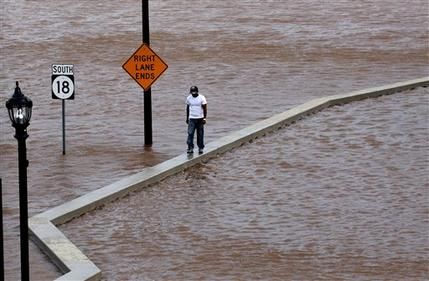
© AP Photo/Mel EvansA man walks on top of a wall next to a flooded highway in New Brunswick, N.J., Aug. 28, 2011, as heavy rains left by Hurricane Irene are causing inland flooding of rivers and streams.
The storm that had been Hurricane Irene crossed into Canada overnight but wasn't yet through with the U.S., where flood waters threatened Vermont towns and New Yorkers feared a commuting nightmare as their transit system, shut down ahead of the storm, was slowly restored.

The storm left millions without power across much of the Eastern Seaboard, left more than 20 dead and forced airlines to cancel about 9,000 flights. It never became the big-city nightmare forecasters and public officials had warned about, but it still had the ability to surprise.

Many of the worst effects arose from rains that fell inland, not the highly anticipated storm surge along the coasts. Residents of Pennsylvania and New Jersey nervously watched waters rise as hours' worth of rain funneled into rivers and creeks. Normally narrow ribbons of water turned into raging torrents in Vermont and upstate New York late Sunday, tumbling with tree limbs, cars and parts of bridges.

"This is not over," President Barack Obama said from the Rose Garden.

Cloud Lightning

Tropical storm Irene weakens as it moves towards Canada

Image
© AFP/ JOE RAEDLEThe tropical storm Irene
The U.S.-born tropical storm Irene, that has killed at least 12 in the United States, is moving towards Canada after raging through the East Coast, the U.S. forecasters said on Sunday.

Irene that was downgraded from the hurricane to a tropical storm, has killed at least 12 people on the East Coast.

The states of Virginia, Maryland, District of Colombia and the New York City area have been badly affected by the storm, which made landfall on Saturday morning in North Carolina.

Bizarro Earth

Ireland: Big Fish-Kill on Bandon

A significant fish-kill was discovered in the River Bandon in Cork after a member of the public alerted staff of Inland Fisheries Ireland.

More than 350 salmon and trout were found dead over a one-mile stretch of the river. The fish kill included salmon of up to 2.7kg (6lb). Many of the fish were decomposing.

An extensive search revealed no source of pollution and it was concluded that the event that caused the kill had passed by the time investigations began.

Head of fishery operations Dr Greg Forde, said: "During the summer, rivers are particularly vulnerable and factories and farmers must be particularly careful. There have already been three fish kills in the Cork and Kerry area."

Inland Fisheries is calling on the public to be alert to the threat to waters by pollution and to report any instances immediately to local IFI offices or the 24-hour hotline 1890-347424.

Cloud Lightning

Short of the Doomsday Predictions: Little Damage Seen in Many Places After Irene

Irene road flooding
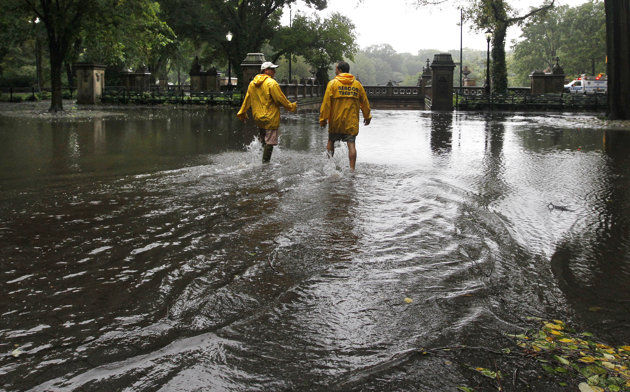
© AP Photo/Elise AmendolaElise Amendola - David Korostoff, left, and Jimmy Kaplow, both of New York, step through standing water on a walkway in New York's Central Park as Tropical Storm Irene passes through the city, Sunday, Aug. 28, 2011.
From North Carolina to New Jersey, Hurricane Irene appeared to have fallen short of the doomsday predictions. But with rivers still rising, and roads impassable because of high water and fallen trees, it could be days before the full extent of the damage is known.

More than 4.5 million homes and businesses along the East Coast lost power, and at least 11 deaths were blamed on the storm. But as day broke Sunday, surprisingly light damage was reported in many places, with little more than downed trees and power lines.

"I think it's a little strong to say we dodged a bullet. However, it certainly could have turned out worse for the Hampton Roads area" in Virginia, said National Weather Service meteorologist Mike Montefusco.

At the same time, officials warned of the possibility of severe flooding over the next few days as runoff from the storm makes its way into creeks and rivers. In some parts of the Northeast, the ground was soggy even before the storm because of an extremely rainy August.

Phoenix

US, California: Wildfire near Yosemite grows

Yosemite Wildfire
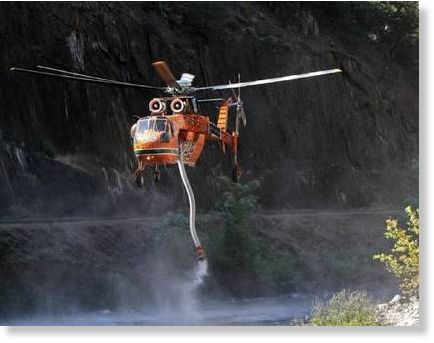
© ERIC PAUL ZAMORA/THE FRESNO BEEA helicopter finishes drawing water from the Merced River near the confluence of its south fork before dropping the water on an adjacent hillside as efforts continued to fight the Motor fire on Friday.
A rapidly moving wildfire grew on Saturday to about 3,600 acres west of one of the main entrances to Yosemite National Park, prompting voluntary evacuations of the Cedar Lodge hotel, campgrounds and a handful of homes in the Merced River canyon.

Highway 140 - a main entrance into Yosemite - remained closed west of the Foresta Bridge and east of Mariposa because of the fire. Fire officials said they do not know when it will be reopened. Highways 41 and 120 leading into the park were still open.

All park visitor services were unaffected by the fire, officials said.

The blaze, dubbed the Motor fire, was moving rapidly in Dry Gulch Canyon into the upper reaches of Moss Canyon, the U.S. Forest Service said. With containment at 15 percent, fire officials say it will take days to extinguish the blaze.

A motor home that caught fire on Highway 140 on Thursday afternoon sparked the blaze that raced up both sides of the canyon.

Bug

Mysterious Disappearance of Malaria Infected Mosquitoes in Africa

Malaria Mosquito
© Unknown
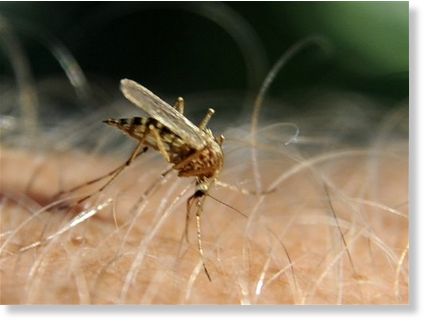
Malaria infected mosquitoes are mysteriously disappearing in some parts of Africa, and scientists are trying to explain why. In some sub-Saharan countries, numbers indicate that preventative measures, including anti-mosquito bed nets, are having a significant impact on reducing the malaria infection rates.

Researchers found that mosquitoes are disappearing from regions with few preventative measures available. The researchers are uncertain if mosquitoes are being eradicated or if the mosquito has dipped and later return with renewed vigor.

Tanzania, Eritrea, Rwanda, Kenya and Zambia reported reduced incidences of malaria cases. Researchers believe this observation could be due to effective implementation of control programs, such as the deployment of bed nets treated with insecticide.

But Danish and Tanzanian scientists predict there is more to the story that effective control programs. These scientists have collected and counted mosquitoes over the past 10 years in Tanzania. In 2004, they caught over 5,000 insects, and in 2009, that had dropped to 14 mosquitoes.