Earth ChangesS


Bizarro Earth

Northern Italy Rattled by Second Earthquake Swarm in 2 Months

At least ten earthquakes were recorded in northwestern Italy on Thursday, according to the European-Mediterranean Seismological Centre (EMSC).

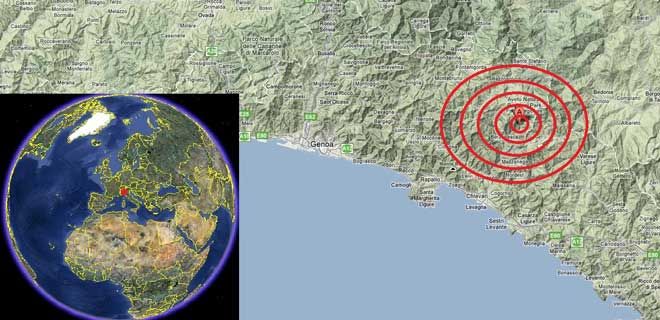
Epicentre of Thursday's earthquake
© Google/IWOEpicentre of Thursday's earthquake.
The largest of the earthquakes measured 4.2 magnitude (mb) on the Richter Scale and occurred at 08:11 AM local time (00:11 AM EDT) at a shallow depth of 10 km. The epicentre was located in the Aveto Natural Regional Park, about 5 km northeast of Borzonasca (pop 2,046), 16 km northeast of Chiavari (pop 27,865), and 39 km east of Genoa (pop 601,951).

It was the strongest earthquake to hit northern Italy since a 4.3 magnitude earthquake struck on 25 July last.

The other nine tremors recorded on Thursday ranged between 2.2 and 3.4 magnitude.

The most significant earthquake to hit the region in recent years occurred on 23 December 2008 when a 5.4 magnitude quake was recorded WNW of Genoa and SW of Parma. Previous to that a 5.4 mb earthquake struck northeast of Verona on 24 November 2004.

Bizarro Earth

Deepest and Most Explosive Underwater Eruption Ever Seen Happening Near Samoa Hotspot

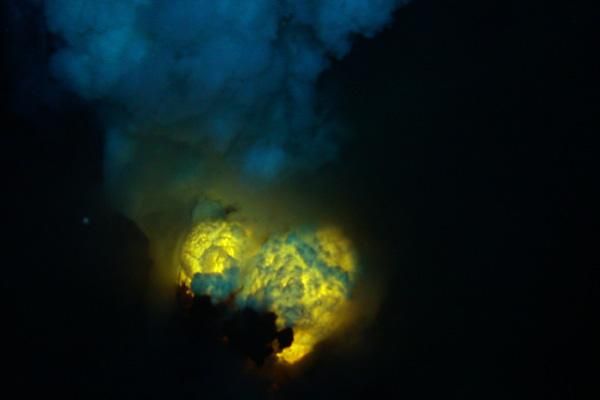
Double magma bubble
© Joseph ResingDouble magma bubble forms at Hades Vent at West Mata submarine volcano.
An underwater volcano bursting with glowing lava bubbles - the deepest active submarine eruption seen to date - is shedding light on how volcanism can impact deep-sea life and reshape the face of the planet.

Submarine eruptions account for about three-quarters of all of Earth's volcanism, but the overlying ocean and the sheer vastness of the seafloor makes detecting and observing them difficult. The only active submarine eruptions that scientists had seen and analyzed until now were at the volcano NW Rota-1, near the island of Guam in the western Pacific.

Now researchers have witnessed the deepest active submarine eruption yet. The volcano in question, West Mata, lies near the islands of Fiji in the southwestern Pacific in the Lau Basin. Here, the rate of subduction - the process in which one massive tectonic plate dives under another, typically forming chains of volcanoes - is the highest on Earth, and the region hosts ample signs of recent submarine volcanism.

Radar

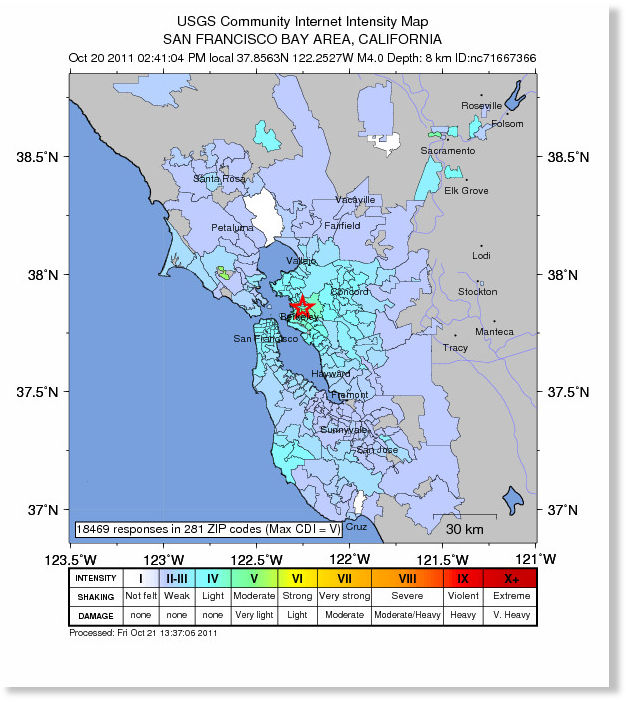
US, California: 3.8 Magnitude Earthquake Jolts San Francisco Area

Image
© USGS
A small earthquake hit the San Francisco area on Thursday afternoon, causing a sharp jolt but no immediate signs of damages or injuries.

The quake, with a preliminary 3.9 magnitude, was centered near Berkeley. San Francisco police and officials at University of California, Berkeley, said they had no reports of injuries or damages.

The U.S. Geological Survey said the earthquake hit two miles (3.2 kilometers) southeast of Berkeley at 2:31 p.m.

The quake was felt as a sharp jolt in the East Bay area, and across the bay in San Francisco.

The quake came almost 22 years to the day after the Loma Prieta earthquake struck the Bay Area during the 1989 World Series.

It came on the same day Californians took part in an annual earthquake preparedness drill at 10:20 a.m. Thursday. More than 8½ million people signed up to participate in the 2011 Great California ShakeOut.

Bizarro Earth

Unusually Chilly Stratosphere Behind 2011′s Record Arctic Ozone Hole

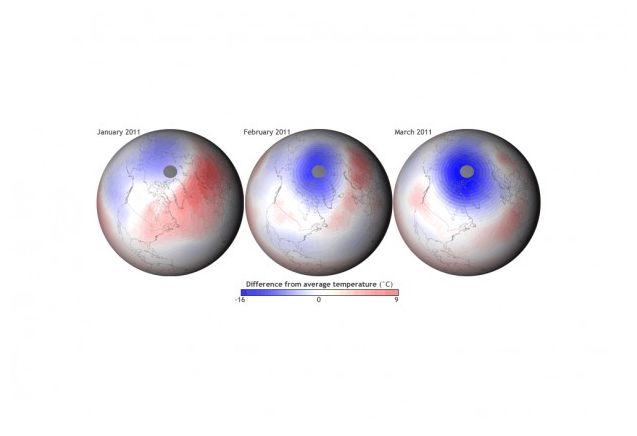
Arctic Ozone Hole
© redOrbit

Check the fine print on many cans of hairspray or shaving cream these days, and you'll probably find a reassurance that the product you are holding contains "No CFCs or chemicals known to harm the ozone layer." Located in the stratosphere, the ozone layer protects life on Earth from the harmful effects of ultraviolet radiation. To stop ozone destruction, chemical manufacturers phased out the production of CFCs (short for chlorofluorocarbons) over the past two decades.

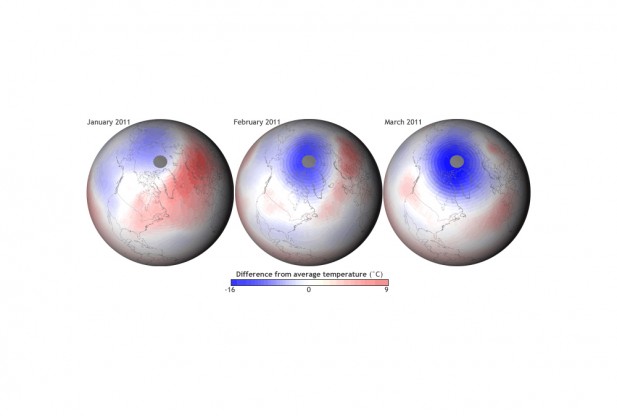
So why is it that this past spring, scientists observed the largest, most severe ozone destruction ever witnessed in the Arctic since records began in 1978? In part, it's because CFCs stick around in the atmosphere for a very long time. But the maps above reveal the main reason this winter's Arctic ozone loss was so much worse than it normally is: unusually persistent cold temperatures.

From January through March 2011, monthly average temperatures in the Arctic stratosphere were colder than usual. Places where temperatures were up to 9 degrees Celsius warmer than the long-term average (1979-2009) are red, while places where temperatures were up to 16 degrees cooler than average are blue. Colder-than-usual temperatures dominated the stratosphere all three months, especially in March.

What does the cold have to do with the ozone hole? Extreme cold allows clouds to form in the stratosphere, even though the air there is extremely dry. The clouds make rare chemical reactions possible. Normally, when CFCs break down, the chlorine they release gets incorporated into very stable molecules that don't react with ozone. But on the surface of particles in these unusual ice clouds, the stable molecules are converted into forms of chlorine that are much more reactive.

Question

Myrtle Beach, South Carolina, US: Mysterious bird deaths baffle hotel workers


The apparent death of 30-40 birds has workers at one Myrtle Beach hotel wondering what's to blame.

Ocean Forest Resort Hotel Security Guard Brandon Nelson said between 30 and 40 birds of various breeds fell from the sky around 2 Sunday morning while he was patrolling the building.

"The birds were just landing with a plop, some of them chirped and squirmed for a few minutes before they died. I've never seen anything like it," Nelson said.

Nelson's mother, Sarah Allen, stopped at the hotel to visit her son during his shift when she says one of the birds hit her in the shoulder as it fell from the sky.

Bizarro Earth

Underwater Volcanic Eruption

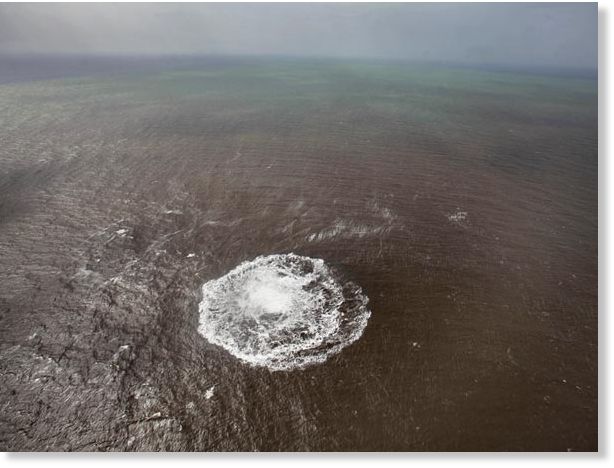
Whitecaps churn in the Atlantic off West Africa as an underwater volcano erupts off Spain's Canary Islands on Monday.

Image
© Desiree Martin, AFP/Getty ImagesWhitecaps churn in the Atlantic off West Africa as an underwater volcano erupts off Spain's Canary Islands on Monday.
Since last week, the volcano has been spewing gas and fragments of smoking lava, staining the ocean surface green and brown, as seen above.

Spanish authorities have closed a port on Hierro island (map), ordered ships away from the island's village of La Restinga, and banned aircraft from flying over the island's southern tip, according to the AFP news service.

Six hundred residents living at the port were evacuated Tuesday.

Bizarro Earth

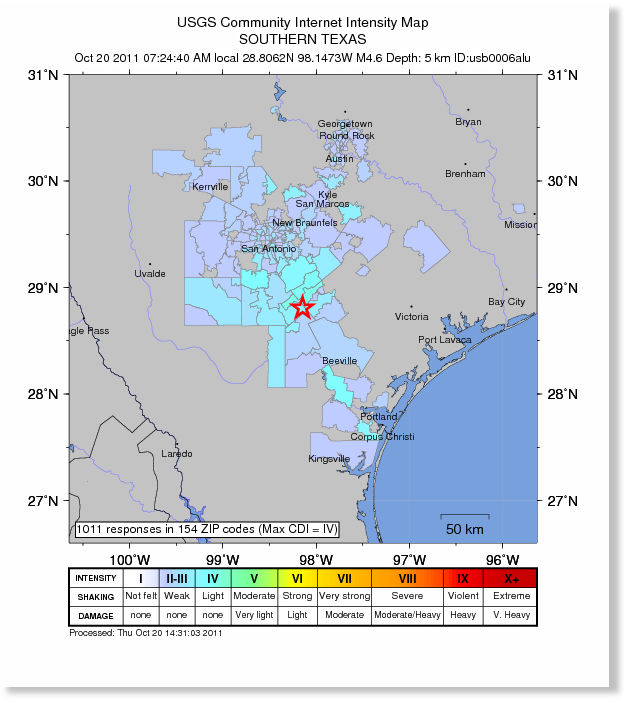
US: Earthquake Magnitude 4.8 - South Texas

Image
© USGS
Date-Time:
Thursday, October 20, 2011 at 12:24:40 UTC

Thursday, October 20, 2011 at 07:24:40 AM at epicenter

Time of Earthquake in other Time Zones

Location:
28.806°N, 98.147°W

Depth:
5 km (3.1 miles)

Region:
SOUTHERN TEXAS

Distances:
60 km (37 miles) NW of Beeville, Texas

76 km (47 miles) SSE of San Antonio, Texas

92 km (57 miles) E of Pearsall, Texas

166 km (103 miles) SSW of AUSTIN, Texas

Bizarro Earth

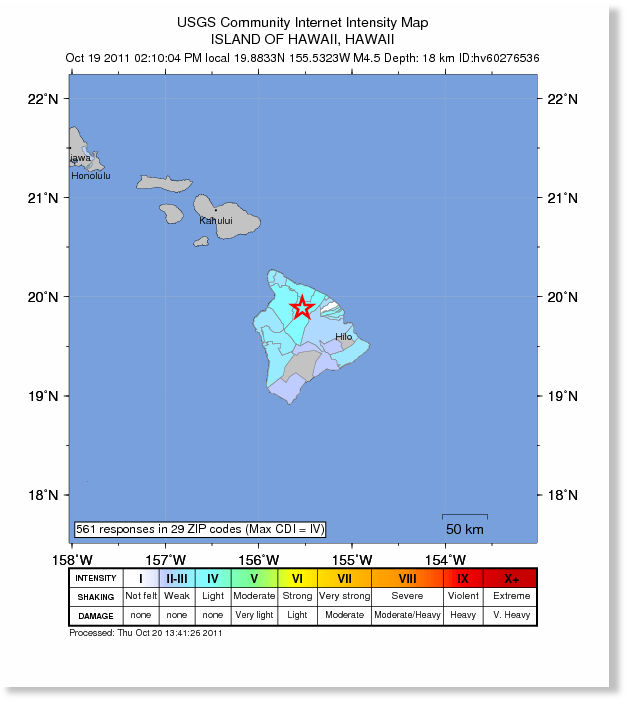
US: Earthquake Magnitude 4.5 - Island of Hawaii, numerous aftershocks

Image
© USGS
Date-Time:
Thursday, October 20, 2011 at 00:10:04 UTC

Wednesday, October 19, 2011 at 02:10:04 PM at epicenter

Time of Earthquake in other Time Zones

Location:
19.883°N, 155.532°W

Depth:
18.8 km (11.7 miles)

Region:
ISLAND OF HAWAII, HAWAII

Distances:
21 km (13 miles) SE (137°) from Waimea, HI

23 km (14 miles) SSW (198°) from Honokaa, HI

25 km (15 miles) SW (224°) from Paauilo, HI

51 km (32 miles) WNW (293°) from Hilo, HI

287 km (178 miles) ESE (123°) from Honolulu, HI

Bizarro Earth

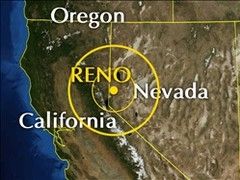
US: Magma Stirring Under Sierraville, Ca. in Ongoing Quake Swarm

reno US map
© n/a
Swarm of 700-plus quakes in Sierra 30 miles west of Reno, but no one's feeling them

A swarm of more than 700 earthquakes have struck near the small Sierra County, Calif., community of Sierraville since August, although there's a good chance few if any of the quakes have been felt.

There have been more than 30 quakes of a magnitude 1 or more in the last week, the largest being about 1.8, said Ken Smith, seismic network manager for the Nevada Seismological Lab.

But the quakes are so deep - most are 18 miles below the surface or more - and so minor Smith thinks they have little chance of being felt at the surface. They are centered about 2 miles west of Sierraville and 31 miles west of Reno.

Seismologists can't say with certainty yet what is happening, but appears the quakes are being caused by moving magma. The earth is basically divided into layers of the crust, the mantle and the core with the temperature getting hotter the deeper the depth. Smith said the ground in this area is constantly in motion, moving about 14 millimeters a year. Because of that motion, it appears magma found a way to flow from the mantle, the middle area, to the crust, the upper area.

Bizarro Earth

Experts Concerned with Abnormal Seismic Activity - Azores

Azores
© n/a
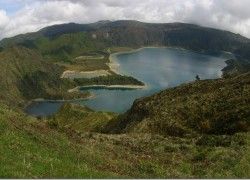
Experts in the Azores have alerted the population of São Miguel Island for seismic activity which they considered to be above normal. The seismic events where located in the system of Fogo and Congro lakes, the central region of the island.

"The situation is ongoing and the number of microseisms is slightly above reference values" said Wednesday João Luís Gaspar from the Center of Volcanology and Geological Risk Assessment (CVARG) of the University of the Azores.

He also said that the seismic activity was the result of "very low magnitude earthquakes" adding that "none of which have been felt by the population."

Declining to comment on what the evolution of the crisis could be João Luís Gaspar recalled that "seismological activity is difficult to predict," but that the possibility could not be eliminated of an earthquake occurrence which may be felt by the population. He said, "It does not mean it will happen; only that one cannot eliminate that possibility."