Earth ChangesS


Bizarro Earth

US Alaska: Cleveland Volcano sends ash up to 15,000 feet

A volcano in Alaska's Aleutian Islands sent up an ash cloud today that prompted scientists to increase the alert level for commercial aircraft traffic.

The Alaska Volcano Observatory said satellite images at 4:02 a.m. Alaska time showed Cleveland Volcano had spewed ash 15,000 feet into the air in a cloud that moved east-southeast. U.S. Geological Survey scientist-in-charge John Power called it a small explosion.
Image
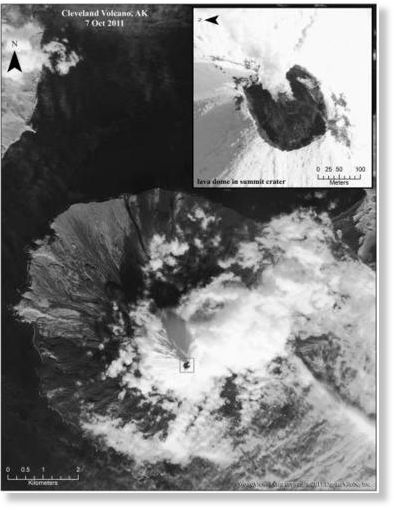
© Alaska Volcano ObservatoryA satellite image of Cleveland Volcano on Oct. 7. The summit of the volcano is mostly snow-covered, and the growing lava dome is seen as the dark feature in the center of the volcano (inset area outlined by black square).
"It's not expected to cause a disruption to big international air carriers," he said.

However, it was significant enough to raise the alert level from yellow, representing elevated unrest, to orange, representing an increased potential of eruption, or an eruption under way with minor ash emissions or no emissions.

Stop

UK: Mystery foam engulfs northern seaside town

Image
© MEN SyndicationThere's no place like foam … Cleveleys, near Blackpool gets in a lather with foam blown in from the ocean.
Foam blown from sea covering streets and houses of Cleveleys, near Blackpool, is thought to be non-polluted algal matter.

A thick white blanket settled gently on the seaside town of Cleveleys near Blackpool on Wednesday, but this was no seasonal dusting of snow from above.

The Environment Agency dispatched officers to Princess Promenade to gather evidence as gobs of foam blew in from the sea and smothered streets, cars and houses.

The foam is whipped up by strong winds once or twice a year along the town's seafront and vanishes soon after, a spokeswoman for the agency told the Guardian.

Bizarro Earth

US: Drought Leaves Texas Lake a Ghost of Its Former Self

Buchanan Lake_1
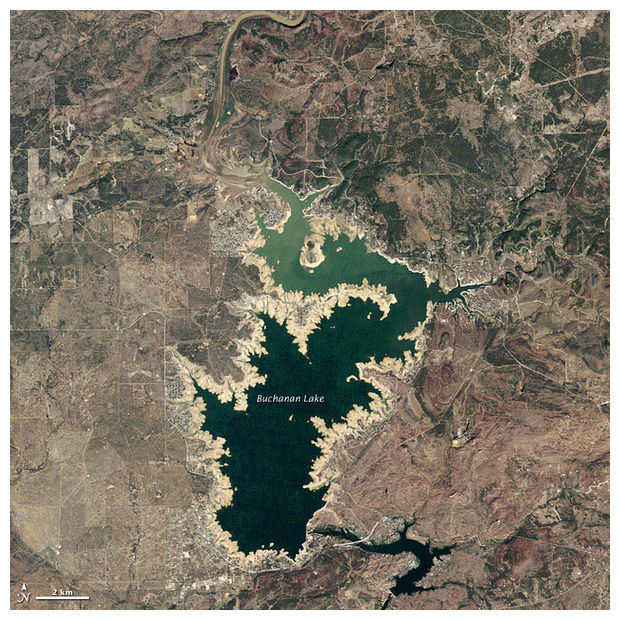
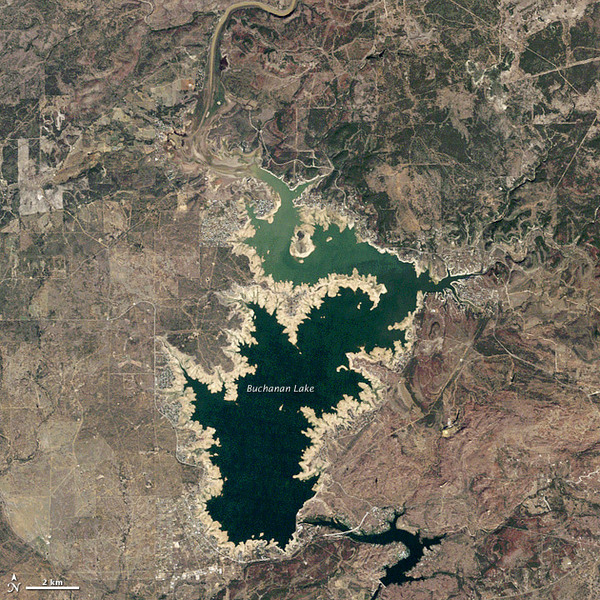
© NASAAn obvious ring surrounds Buchanan Lake in Texas.
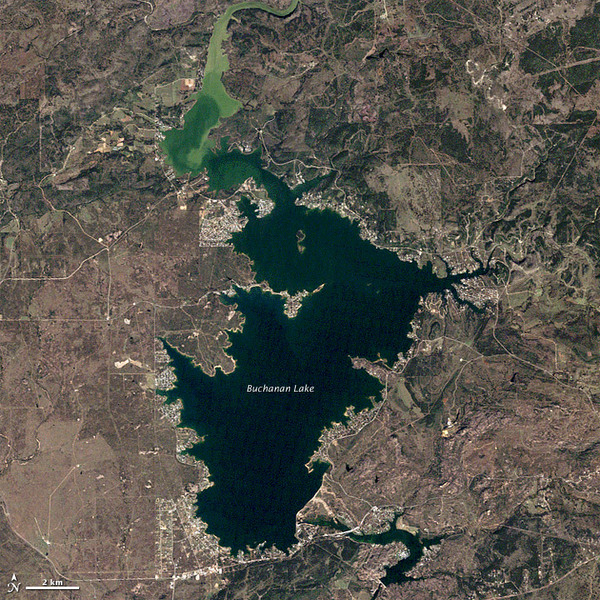
Buchanan Lake_2
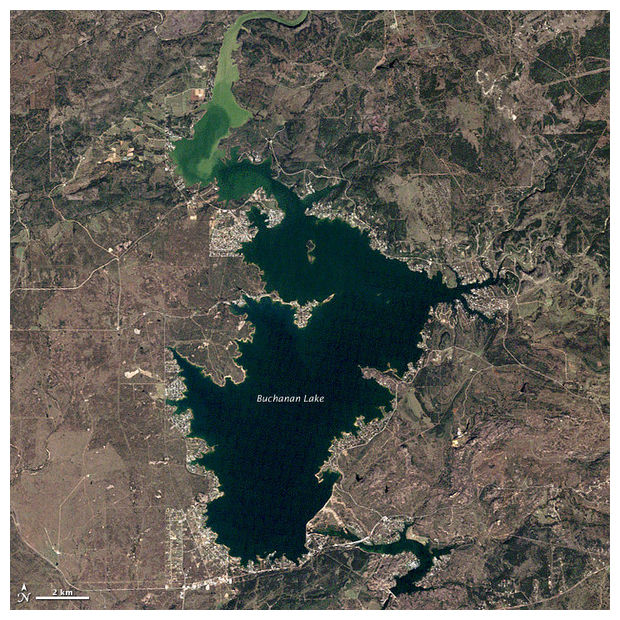
© NASALake Buchanan in 2003 with normal water levels.
More than a year of drought has dropped lake and reservoir levels in central Texas by tens of feet, exposing signs of previous human settlements and threatening water supplies. September 2010 through September 2011 were the driest 12 months on record for much of the region, with rainfall at 30 to 40 percent of the norm.

The Thematic Mapper on Landsat 5 captured these images of Lake Buchanan, Texas, in October 2011 and October 2003. Note the distinct, tan "bathtub ring" around the reservoir in 2011, showing exposed lake bed sediments and revealing how far the waterline has dropped from the previous high - water marks. The lake edge is currently as much as a mile from the stone walls that normally protect lakefront homes.

By the morning of December 28, Lake Buchanan stood at 988.41 feet above sea level, roughly 23 feet (7 meters) below its historic average for the month. Two manmade "Highland Lakes" in the area - Buchanan and Travis - stood at a combined 37 percent of their water capacity.

Around the lake's shores, signs of former human settlements have risen from the bed as water levels have dropped. The town of Bluffton, for instance, was evacuated and flooded when Buchanan Dam and the resulting lake were completed in the late 1930s and early 1940s. Now the foundations of former buildings and businesses are exposed, as is the graveyard. In other areas, everything from ancient fossils and tools, a century-old church, and a former graveyard for freed slaves have appeared out of the lake bed.

According to news reports, residents near Lake Nagodoches in east Texas found a storage tank that held oxygen and hydrogen for NASA's space shuttle Columbia, which broke up during atmospheric re-entry over Texas in 2003.

Info

Supervolcanoes Won't Destroy Earth in 2012

Yellowstone Volcano
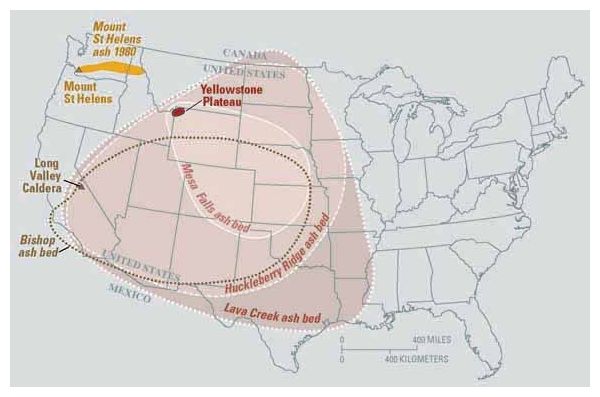
© USGSEruptions of the Yellowstone volcanic system have included the two largest volcanic eruptions in North America in the past few million years; the third largest was at Long Valley in California and produced the Bishop ash bed. The biggest of the Yellowstone eruptions occurred 2.1 million years ago, depositing the Huckleberry Ridge ash bed.
The notion that the world will end with the coming of the new year, as some claim the ancient Maya predicted, has spawned a series of proposed methods for this planetary disaster: galactic forces, Earth's magnetic poles flipping, the eruption of a supervolcano.

Though it has been shown that the Mayans did not in fact predict 2012 would bring the end of the world, there have been supervolcano eruptions in Earth's past that have wrought significant destruction. One such eruption may have been the cause of a major ancient mass extinction event.

But is another supervolcano eruption on the way? At the dawn of the new year, researchers say: Don't hold your breath.

Better Earth

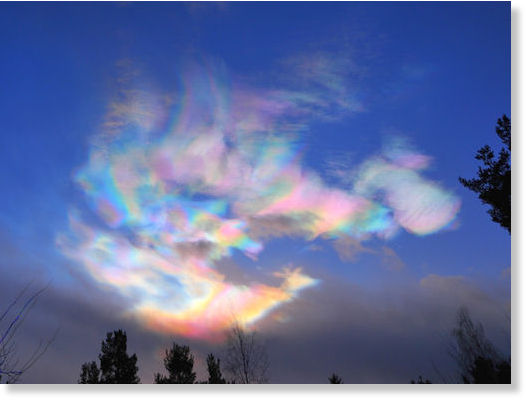
Beautiful polar stratospheric clouds forming around the Arctic Circle

As December draws to a close, the first polar stratospheric clouds (PSCs) of northern winter are forming around the Arctic Circle. Anders Gjørwad Hagen of Vinstra, Norway, photographed this specimen on Dec. 27th:

Image
© Anders Gjørwad Hagen
Also known as "nacreous" or "mother of pearl" clouds, icy PSCs form in the lower stratosphere when temperatures drop to around minus 85ºC. Sunlight shining through tiny ice particles ~10µm across produce the characteristic bright iridescent colors by diffraction and interference.

The display Hagen witnessed formed in the wake of "Dagmar," a storm that "hit the coast of Norway with hurricane strength on Dec. 25th and 26th," says Hagen. "Record breaking winds up to 145 mph were recorded. While people on the coast dealt with the aftermath, photo enthusiasts inland saw the effects of high altitude winds in these colorful clouds. It was a beautiful display, but not comfortable to think of all the suffering lying behind it."

Comment: See also: "Mother of Pearl": Nacreous Clouds

Nacreous Cloud Alert

Rare clouds 'could indicate global warming'

CALIPSO Spies Polar Stratospheric Clouds


Bizarro Earth

Unusual Amount Of Gray Whales Spotted Off California Coast

Whales
© redOrbit

Whale watchers are saying that migrating gray whales are swimming through Southern California waters in record numbers this winter.

The Los Angeles Times said on Wednesday that whale watchers at Point Vicente in Rancho Palos Verdes have recorded a record 163 sightings in December so far, which is the most that have been logged at this location in 28 years.

At this time last year, observers logged 26 gray whales. The previous record saw 133 of the mammals in 1996.

"I've seen some pretty good years but never anything like this," Joyce Daniels, a volunteer in the whale census, told the LA Times.

"We had whales everywhere. So many I was having trouble figuring out which whale was which," she said. "It's a real adrenaline rush to have so many whales."

Over 20,000 gray whales migrate each year from the arctic to Baja California, where females give birth. The mammals then migrate back north for the spring weather. California's coast is not just accustomed to only gray whales. Last spring, hundreds of blue whales were spotted in the area. Humpback whales have also been seen off the Californian coast.

Researchers say they hope this means things in the whaling world are going good and the populations are becoming more robust.

Sun

Weird Christmas weather: Australia tornadoes and unusual warmth in UK and South Pole

Image
© Australia Bureau of MeteorologyRadar hook echo indicative of tornado-producing thunderstorm west of Melbourne on December 25.
While large parts of the U.S. experienced serene Christmas skies, violent thunderstorms tore through parts of Australia. Meanwhile, temperatures spiked to record levels in Antarctica and near record levels in the United Kingdom.

Australia thunderstorms and tornadoes

A Santa on his sleigh or wicked witch on a broomstick? Some Australians were more likely to see the latter December 25.

Severe thunderstorms produced damaging winds, flooding rain, "cricket-ball" size hail, and tornadoes around Melbourne.

Nuke

Japan: Radiation Fears Spread to Forest Industry

Tomio Takahashi checks logs
© MainichiTomio Takahashi checks logs for charcoal and mushroom cultivation in Shiroishi, Miyagi Prefecture, after selected logs were found with high levels of radiation cesium.
Shiroishi, Miyagi -- Radiation fears stemming from the ongoing crisis at the Fukushima No. 1 Nuclear Power Plant and radiation monitoring activities are raising concern among people handling trees to grow mushrooms and make charcoal.

Forest workers are very concerned about any potential fallout from the nuclear crisis because they have to independently monitor radiation before applying to the plant operator, Tokyo Electric Power Co. (TEPCO), for compensation, unlike farmers and fishermen who have standing in law.

Decontamination work in the mountains is said to be much more difficult than on flat land and some forest workers are considering switching jobs.

The Forestry Agency in October set a ceiling of 150 becquerels per kilogram for raw wood for mushroom cultivation and in November set limits on radioactive cesium found in firewood and charcoal for cooking at 40 becquerels and 280 becquerels, respectively.

The governmental agency advised Tokyo and other prefectures concerned not to market forestry products that exceed those ceilings. While local governments conduct radiation checks on farm and marine products under the Food Sanitation Law, there is no law for contaminated raw wood or charcoal. The agency says it is simply requesting members of the forest products industry to unilaterally check radiation and make redress requests.

Target

Canada: Ottawa at risk for big earthquake

ottawa earthquake
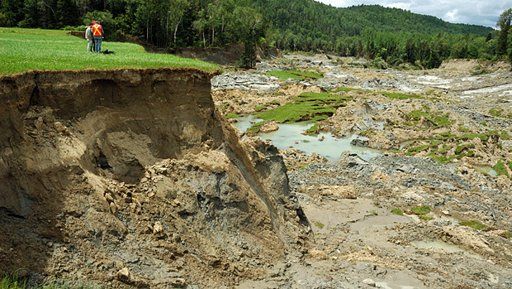
© CBC The city of Ottawa is at risk for a big earthquake, experts say. The Val-des-Bois quake that shook the capital in 2010 caused this land collapse in Notre Dame de la Salette, Que.
Seismologists and structural engineers say the city of Ottawa is at risk for a big earthquake.

The Val-des-Bois quake that shook the capital last year reminded people that Ottawa sits in an earthquake zone. And there is a chance it could one day produce a destructive quake far worse than February's deadly magnitude-6.3 tremor in Christchurch, New Zealand.

Claude Blais was at the pharmacy in Gracefield, Que., when last year's quake hit.

"All the lights broke down, and all the shelves emptied themselves. It was just horrible," Blais said. "You kind of think it's the end of the world."

It wasn't like that in Ottawa. That's the difference between being close to the epicentre of a 5.2 earthquake, and being 65 kilometres away.

Radar

Red Sea Volcano: New Island Forms Off Yemen Coast After Underwater Eruption

Image
© Getty Images
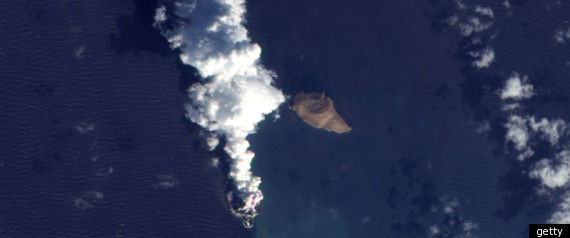
A new island has emerged in the Red Sea following an underwater volcanic eruption.

Fishermen first spotted the phenomenon, which is caused by lava fountains, earlier in December in a remote part of the sea close to the Yemen coast.

The fountains are reported to have reached more than 30 metres (90 feet) in height.

Nasa repositioned their satellite cameras to capture the event, resulting in some amazing shots of the volcanic explosion breaking the water.

Scientists are unsure whether the island will be permanent.

According to a Nasa spokesman the Advanced Land Imager on Nasa's Earth Observing-1 satellite captured the explosion.

"The image from December 2011 shows an apparent island where there had previously been an unbroken water surface," he said.

"A thick plume rises from the island, dark near the bottom and light near the top, perhaps a mixture of volcanic ash and water vapour."

The eruption occurred in a region of the Red Sea where the tectonic plates of Africa and Arabia meet, close to the Zubair Group of islands. Due to constant tectonic shifts, new ocean crust regularly forms along the rift.