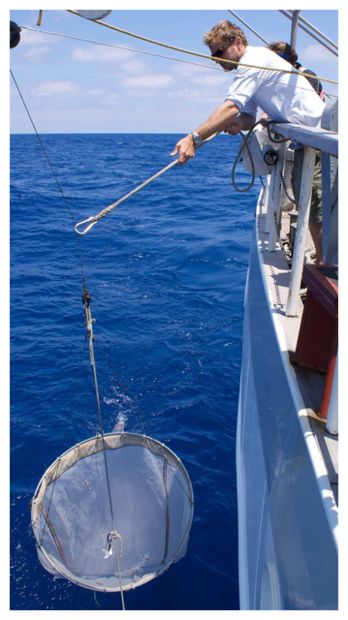
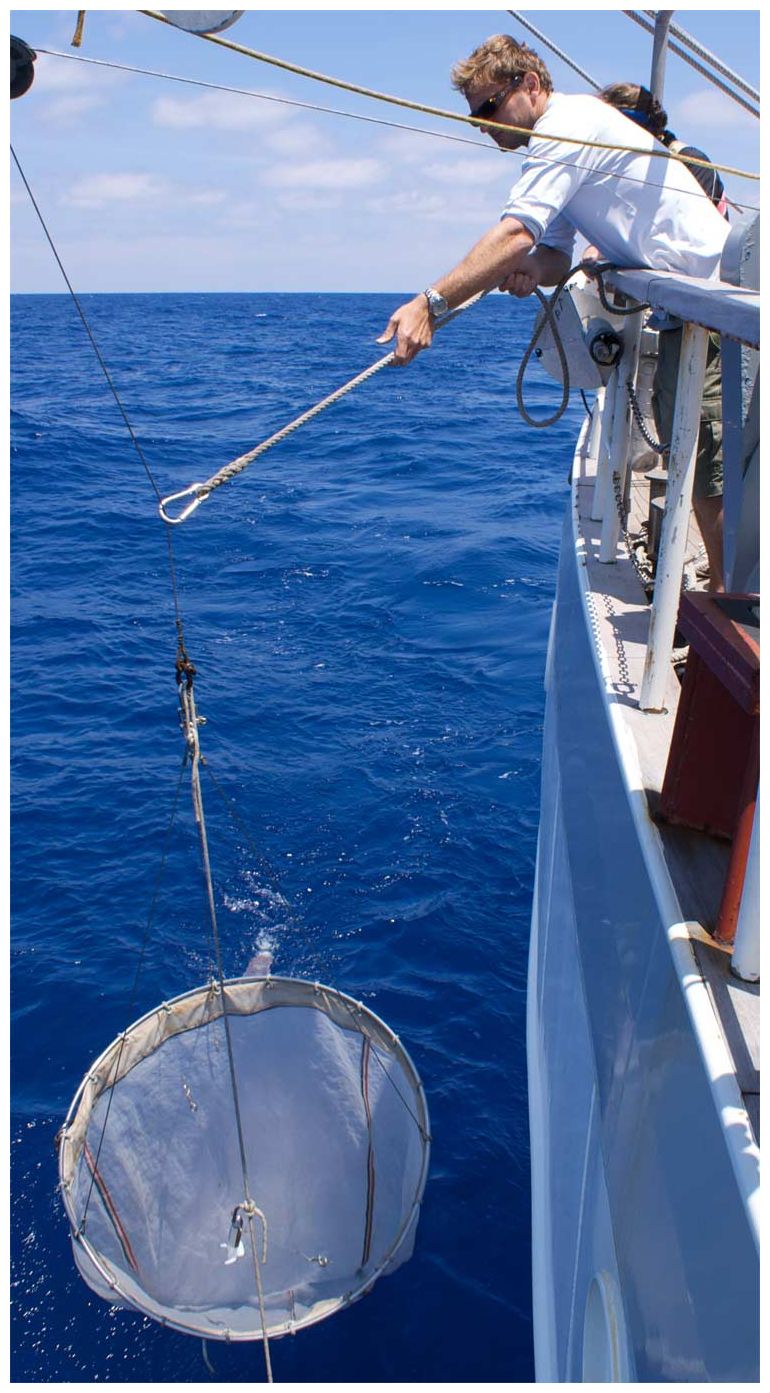
© Sea Education AssociationGiora Proskurowski deploys a net collect samples that help estimate how much plastic debris is in the ocean.
An oceanographer who noticed a disappearing act in which the surface of the ocean went from confetti-covered to clear now suggests wind may driving large amounts of trash deeper into the sea.
Oceanographer Giora Proskurowski was sailing in the Pacific Ocean when he saw the small bits of plastic debris disappear beneath the water as soon as the wind picked up.
His research on the theory, with Tobias Kukulka of the University of Delaware, suggests that on average,
plastic debris in the ocean may be 2.5 times higher than estimates using surface-water sampling. In high winds, the volume of plastic trash could be underestimated by a factor of 27, the researchers report this month in the journal Geophysical Research Letters.
Plastic waste can wreak havoc on an ecosystem, harming fish and other organisms that ingest it, possibly even degrading a fish's liver; the trashy bits also make nice homes for bacteria and algae that get carried to other areas of the ocean where they could be invasive or cause other problems, the researchers noted.
In 2010, the team collected water samples at various depths in the
North Atlantic Ocean. "Almost every subsurface tow we took had plastic in the net," Proskurowski told LiveScience, adding that they used a specialized tow net that isolated certain layers of the water, so it would only open at a specific depth and close before being pulled up.








Comment: It's not the first or second time something like this has happened. And we, at SOTT, wonder what exactly is going on.
Jellyfish Invasions Force Shutdowns at 3 Separate Nuclear Plants
Attack of the jellyfish: Sea creatures shut down ANOTHER power station amid claims population surge is due to climate change
Jellyfish threaten Israeli power plant
Jellyfish shut down British nuclear reactor