Earth ChangesS


Attention

What's causing the huge spike in earthquakes in Oklahoma?

Image
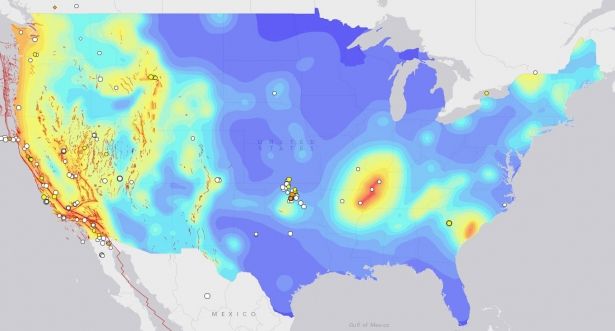
© USGSn this map of earthquakes recorded by the US Geological Survey in the past thirty days (each quake is marked by a dot on the map), Oklahoma is a clear hot spot.
A dramatic uptick in earthquakes has been shaking central Oklahoma this year, continuing a recent trend of unusually high earthquake activity in the state and leading scientists to speculate about a possible link to oil and gas production there.

The US Geological Survey found that from 1975 to 2008, central Oklahoma experienced one to three 3.0-magnitude earthquakes a year, compared with an average of forty per year from 2009 to 2013. And it looks like that number is going to get bigger. It's only February, and the state has already logged more than twenty-five quakes of 3.0-magnitude or larger this year, and more than 150 total quakes in the past week alone.

Comment: Earthquakes are up the world over, so this probably goes beyond local fracking.


Arrow Down

Huge sinkhole swallows car and driver in Rockville Centre, Long Island

Image
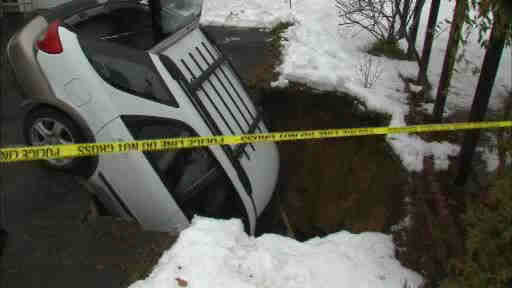
Rescue crews rescued a Long Island woman after her car was swallowed by a former cesspool that opened up the ground.

A woman's car was swallowed up by a huge sinkhole right in her own driveway in Rockville Centre.

"It's really hard to describe, it's just all of sudden swish, and stop," said Gail Sorrentino, sinkhole victim.

Gail Sorrentino took a very strange ride in her car Friday afternoon and she didn't even have to leave her driveway.

"I pulled in I'm looking at the arbor, and then I'm looking at the dirt," Sorrentino said, "The car just went down with no sound, no booms, no rattles no nothing."

After pulling into the spot where she's parked every day for years, she found herself and her car suddenly underground after the earth swallowed her Subaru with Gail still in the driver's seat.

There was nothing she could do but call 911.

"I said, 'I'm calling from my car which is in a sinkhole in my driveway.' And there was this pause at the other end. And she said, 'Ma'am?' I said, 'I'm in the car!'" Sorrentino said.

"You handled yourself very well," said John Thorp, Rockville Centre Fire Chief.

"Thank you!" Sorrentino said.

Attention

Remains of dead whale removed from Portsmouth beach, UK

Image
@DarkQueen_xxx Twitter
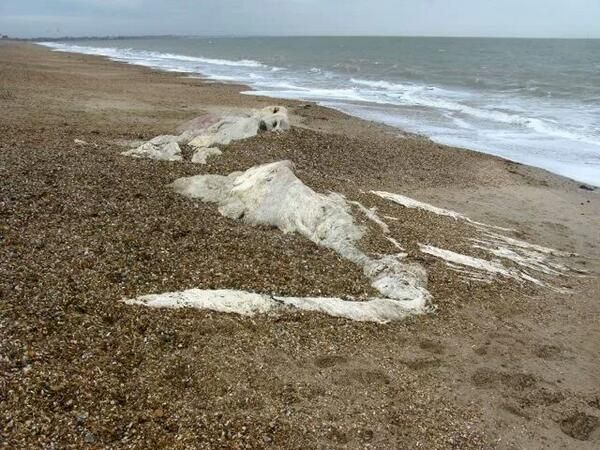
The removal of a decomposing whale from Eastney beach took 12 hours.


The dead animal was found on the shoreline by dog walkers on Monday afternoon.

Portsmouth City Council was assisted by Cosham Plant Hire, Veolia Environmental Services, Colas and the University of Portsmouth to remove the whale yesterday.

Despite previous suggestions it was blubber, the council said marine biologists from the university took DNA samples during the move to confirm it was a whale.

Colas cordoned off the road by the Royal Marines Museum in order to begin the operation, which consisted of transferring the rotting corpse from the bottom of the shoreline up to a nearby skip.

Bulb

Finally scientific consensus: The recent displaced polar vortex wasn't caused by global warming

Image
© Rick McKee /Augusta Chronicle
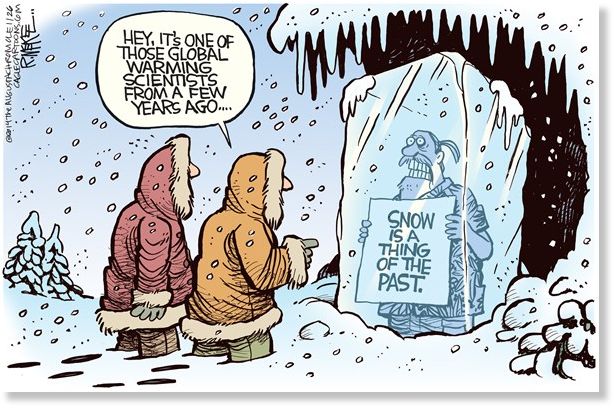
For anyone who was witness to the absurdity of the recent warming makes it cold meme, it should come as no surprise that even ardent Catastrophic Anthropogenic Global Warming believers are trying to distance themselves from the meme before it causes more damage. After the White House took a run at it, and the willfully gullible media, e.g. Bloomberg Businessweek, BBC and NPR lapped it up, now everyone, including the scientist credited with starting it, are walking away. Let us start with this Washington Post - Capital Weather Gang article yesterday, "Scientists: Don't make "extreme cold" centerpiece of global warming argument":
"It's an intriguing theory - that recently has gotten legs: the melting Arctic - spurred by global warming - is causing the weather's steering flow, the jet stream, to become more extreme. This extreme jet stream - rather than zipping around the world in a straight circle (right below) - is more frequently meandering off course (left below) and getting stuck in place, sending bitter, prolonged blasts of cold southward and conversely, see-sawing strong heat domes northward. It's a fascinating paradox: global warming as the culprit for bone-chilling cold.

But more and more scientists are expressing reservations about this hypothesis, first proposed by Rutgers climate scientist Jennifer Francis and collaborators.

"It's an interesting idea, but alternative observational analyses and simulations with climate models have not confirmed the hypothesis, and we do not view the theoretical arguments underlying it as compelling," write five preeminent climate scientists (John Wallace, Isaac Held, David Thompson, Kevin Trenberth, and John Walsh) in a recent letter published in Science Magazine.

Elizabeth Barnes, an atmospheric scientists from Colorado State University, after an attempt to dismantle Francis' theory last summer, published a second challenge in January.

"...the link between recent Arctic warming and increased Northern Hemisphere blocking is currently not supported by observations," Barnes' study concludes."

Snowflake

Winter storm Seneca brings another dangerous wintry blast to Midwest

Winter Storm Seneca wound down over the Midwest Friday, casting a final round of heavy snow and vicious winds across the area.
Image
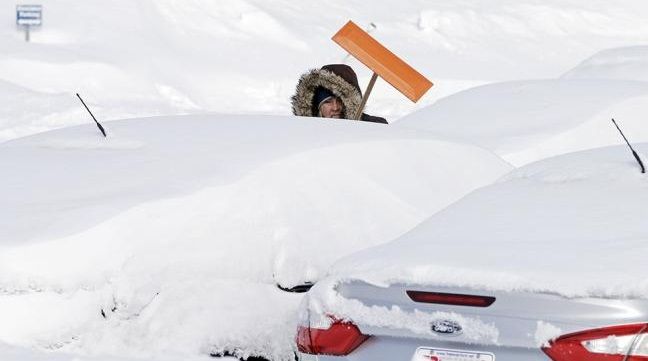
© AP Photo/Jim MoneSales consultant Debra Anderson makes her way through the lot to clear snow off new cars Friday, Feb. 21, 2014 in Bloomington, Minn., following a snow storm that dumped heavy, wet snow over eastern Minnesota and western Wisconsin, closing many schools including those in Bloomington and Minneapolis
At least two deaths occurred - one on icy roads in Minnesota and one in Michigan. More than 1,000 flights were canceled Friday, according to FlightAware.

Here's a rundown of the latest news from the areas that were impacted by Winter Storm Seneca.

Arrow Down

Another sinkhole opens up in Portland, Oregon - Nobody swallowed this time

Image
© AP Photo/Portland, Ore., Fire & RescueA sinkhole in Portland, Ore., on Tuesday, Feb. 18, 2014. A Portland fire official says a woman and her dog have been rescued unharmed after falling into the six-meter-deep sinkhole that opened up in her backyard
After a wet spell unusual even for Portland, a second homeowner has found a sinkhole in the yard, but this one didn't swallow anybody.

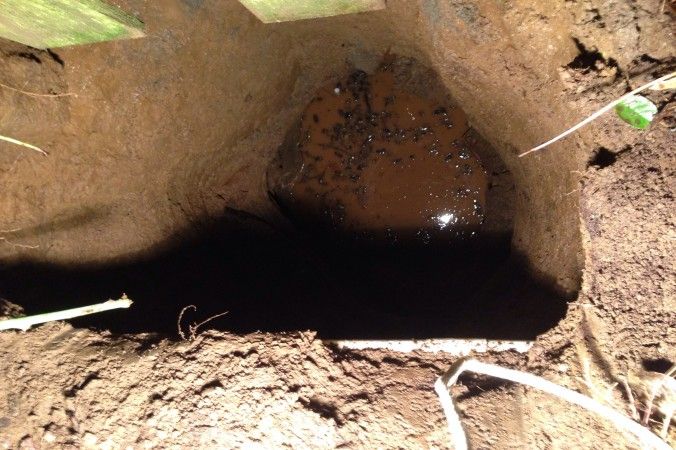
Firefighters on Wednesday put up yellow tape around a 20-foot-deep hole at the southeast Portland home of Justin Nguyen, who said he'd leave until he figures out what caused the hole and how to repair it.

"It might spread wider. If you add more weight to edge of the sinkhole, it could fall down there," he said, showing the hole to KGW-TV.

A day earlier, a faculty member at Oregon Health and Science University and her puppy were trapped for 45 minutes in a hole that city workers determined was an old cesspool that collapsed.

A passer-by heard Kelly Ryan crying for help, stuck in muck 15 to 20 feet down. Firefighters rescued her and the 18-week-old Newfoundland dog unharmed.

Snowflake

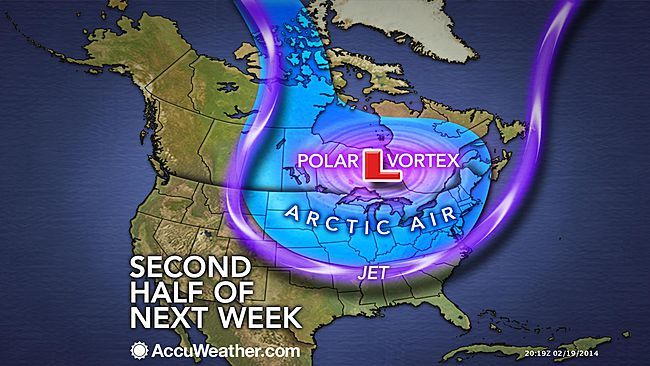
Polar vortex to make encore performance in Midwest, East U.S.

Image
Consider the weather this week a mere pause in a tough winter that will resume next week with cold air and the potential for snowstorms.

Signs are pointing toward another southward dip from the polar vortex. The polar vortex is essentially a mass of very cold air that usually hangs out above the Arctic Circle and is contained by strong winds.

According to Long Range Expert Mark Paquette, "We noticed a minor Sudden Stratospheric Warming event taking place back on Feb. 6-7, 2014."

When sudden warming takes place high in the atmosphere, it initiates a chain of events that tends to displace the polar vortex between 14 and 30 days later.

"In addition to the exact timing of the cold outbreak is you never know for sure initially which continent the cold air will be directed," Paquette said, "This time it appears it will take aim at the eastern part of North America."

Snowflake Cold

Cool or late Spring portended by near record ice on Lake Superior

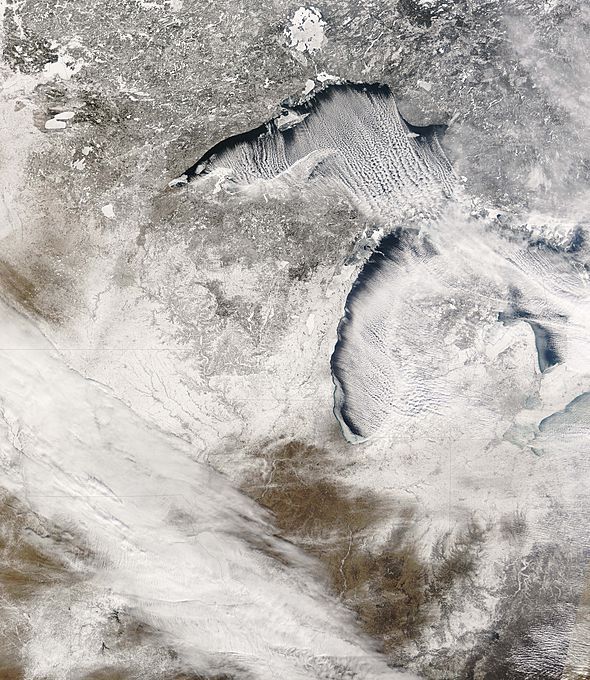
lake superier ice cover
© NASAMODIS captured this image of Lake Superior and Lake Michigan on February 5, 2007, from NASA's Terra satellite.
With no end in sight, the winter of 2014 rages on, ushering in frigid Arctic air and dumping record-breaking snow and ice on much of the nation. This season, ice coverage on Lake Superior has exceeded other measurements in recent history.

"By the long shot this is the most ice we've had on Lake Superior in 20 years," Associate Professor Jay Austin of the Large Lakes Observatory in Duluth, Minn., said.

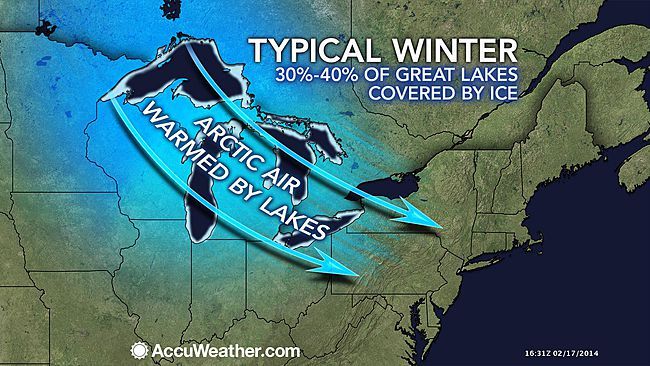
During a typical winter, 30 to 40 percent of the Great Lakes are covered by ice, according to AccuWeather Senior Meteorologist Brett Anderson.
regular great lakes winter
Usually Arctic air swept over the Great Lakes creates lake-effect snow, but modifies the air, making it warmer. This usually makes regions from Ohio through the Northeast a little warmer than it otherwise would be.

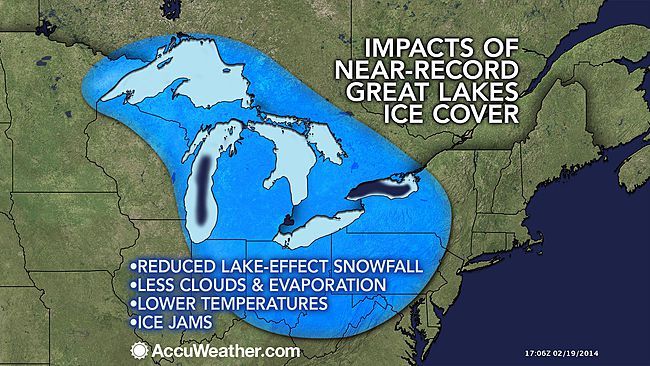
However, this winter 80 to 90 percent of the Great Lakes are covered in ice. As of Thursday, Feb. 13, 2014, Lake Superior was classified as 90 percent covered.
extra ice cover great lakes winter
"The Arctic air masses don't get warmed up as much because of all the snow and ice," Anderson said. "There has not been much of a thaw so the ice keeps building up."

The last time in recent history the ice coverage was even close to this winter's percentage was the winter of 1993/94. That winter ice coverage was measured at 90.7 percent.

Attention

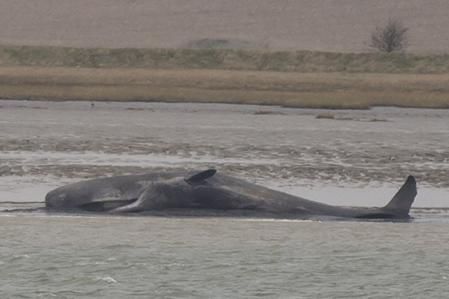
Dead sperm whale washes up on north Kent beach, UK

Image
© Mike GouldThe whale as seen from Seasalter
Thames Coastguard investigates whale sighting in Swale between Seasalter and Sheppey

A whale found stranded off the coast of Seasalter has been confirmed as dead.

Coastguard crews and marine experts were called in after a sighting of the 20ft mammal in the Swale between Whitstable and Sheppey.

But a spokesman for the British Divers Marine Life Rescue today said the whale had died.

She said: "It has now floated away again as the tide has come in.

"We don't know when it died, or how it died, but it is dead.

"The coastguard will return to search for it when the tide goes back out.

"After that, the zoological society from London will come down and take samples."

Faversham tour guide Mark Roser spotted the huge mammal - now confirmed as a sperm whale - this morning.

Target

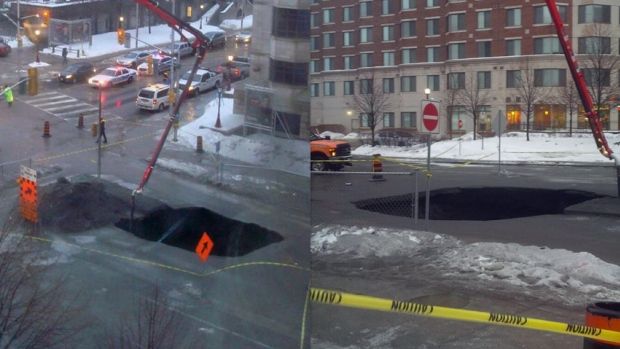
Massive 40-foot deep sinkhole forms at busy Ottawa intersection

Image
© John Holtby and Brian BancroftThis sinkhole formed early Friday after a road collapse in downtown Ottawa.
24-hour work by Rideau Transit Group began Wednesday for light rail transit system

A sinkhole eight metres wide and 12 metres deep has opened up at the construction site digging the eastern entrance to Ottawa's light rail tunnel.

The cause isn't yet known, city officials said. No one was injured.

Ottawa police reported the sinkhole on Waller Street, just south of Laurier Avenue, at about 1 a.m. Police said the road collapsed leaving a hole on the Transitway near the University of Ottawa.

A news release from the City of Ottawa confirmed the sinkhole formed where workers had been tunnelling for the eastern portal of the Confederation Line LRT project.

It said work crews from the Rideau Transit Group had begun 24-hour tunnelling operations on Wednesday, and that they were working at the site when the sinkhole formed.